Clay vs Plastic Drainage Pipe: Modern vs Traditional
For most domestic drainage installations in the UK, PVC-U plastic pipe is the better choice — it is lighter, cheaper, faster to install, and uses simple push-fit joints that are virtually leak-proof. Clay pipe is heavier, more brittle, more expensive, and slower to install, but it excels in longevity (100+ years), resistance to chemical attack, and crush strength at shallow depths. In practice, PVC-U (manufactured to BS EN 1401) has become the standard for domestic underground drainage, used in over 90% of new installations. Clay remains relevant for high-chemical-exposure environments, heritage projects, and situations where extreme longevity justifies the higher cost.
This is a comparison that has decisively shifted toward plastic over the past 40 years. The UK’s underground drainage infrastructure is a mix of both — clay pipes laid over the past 150+ years alongside PVC-U installed since the 1970s. Understanding the strengths of each material helps you make the right choice for new work and informed decisions when connecting to existing systems.
Head-to-Head Comparison
| Feature | Clay Pipe | PVC-U Plastic Pipe |
|---|---|---|
| Material | Vitrified clay (fired ceramic) | Unplasticised polyvinyl chloride |
| Weight per metre (110 mm) | 8–12 kg | 1.2–1.8 kg |
| Standard lengths | 600 mm – 1,500 mm | 1 m, 3 m, 6 m |
| Joint type | Push-fit with rubber seal (modern) or mortar (traditional) | Ring-seal push-fit |
| Installation speed | Slow — heavy, short lengths, more joints | Fast — light, long lengths, quick joints |
| Cost per metre (110 mm) | £8–15 | £3–7 |
| Crush resistance | Excellent (inherently strong in compression) | Good (SN4 or SN8 rating depending on class) |
| Chemical resistance | Excellent (inert to most chemicals) | Good (resistant to most domestic chemicals) |
| Root resistance | Good (smooth joints resist root intrusion) | Good (modern push-fit seals resist roots) |
| Lifespan | 100+ years | 50–100+ years |
| UV resistance | Excellent (can be left exposed) | Poor (must be buried — UV degrades PVC) |
| Flexibility | None — brittle, cracks if ground moves | Moderate — can flex with minor ground movement |
| Fire performance | Non-combustible | Self-extinguishing |
| Environmental | Natural material, high-energy manufacturing | Recyclable, lower-energy manufacturing |
When to Choose PVC-U (Plastic)
Standard Domestic Drainage
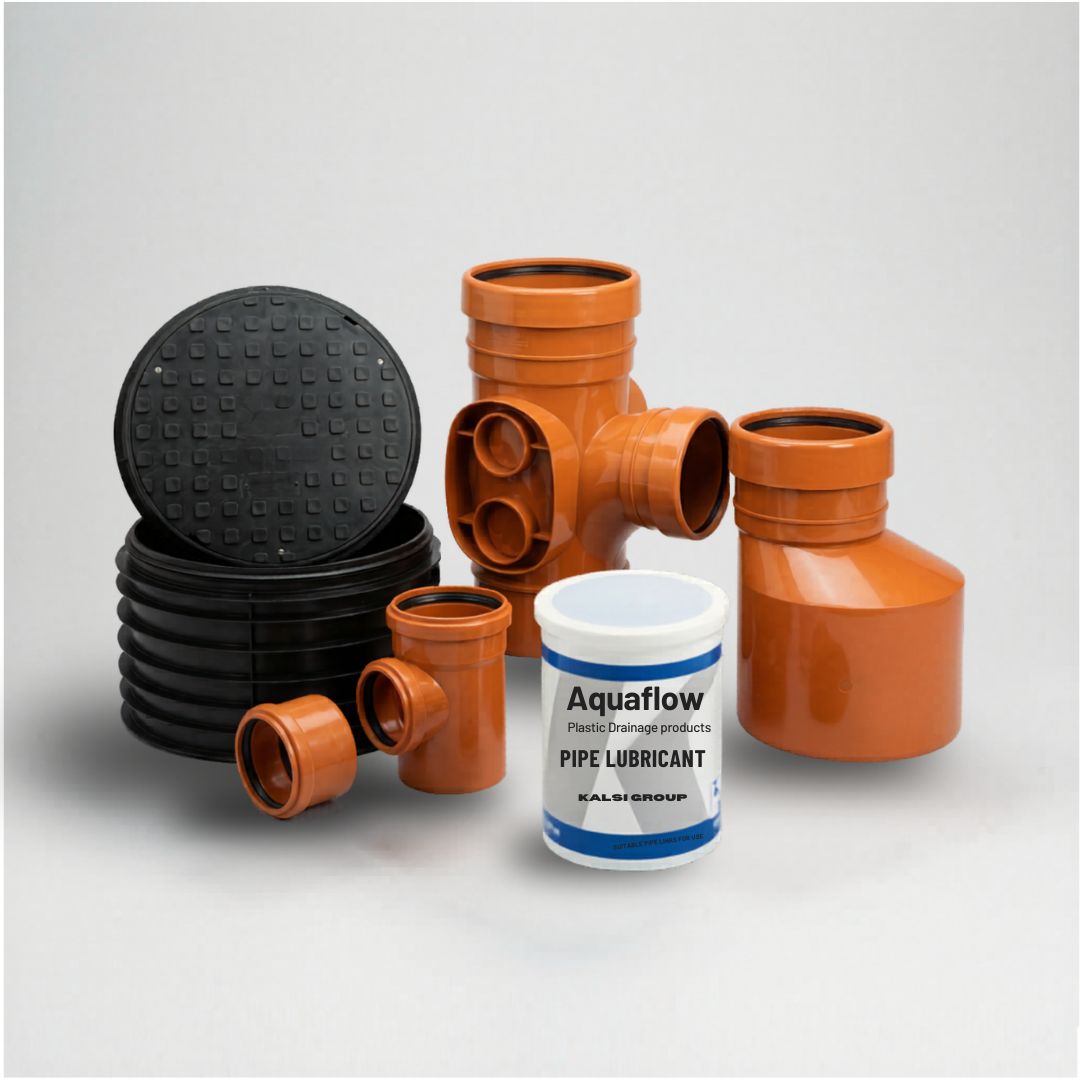
For house drains, extension drainage, and most residential projects, PVC-U is the default choice. It is accepted by Building Control, recommended by water companies, and used by virtually all groundwork contractors. Kalsi Plastics’ 110mm underground drainage system provides a comprehensive range of pipes and fittings for domestic installations.
Speed-Critical Projects
Long lengths (3 m and 6 m) with quick push-fit joints make PVC-U significantly faster to install. On a typical 15 m domestic drain run, PVC-U installation is 3–4 times faster than clay. For a builder running to a tight programme, this translates directly into saved labour days.
Budget-Conscious Projects
PVC-U costs roughly half the price of clay per linear metre, and the labour saving amplifies the difference. On a 20 m drain run, the total cost saving (materials plus labour) can easily reach £400–800.
DIY and Self-Build
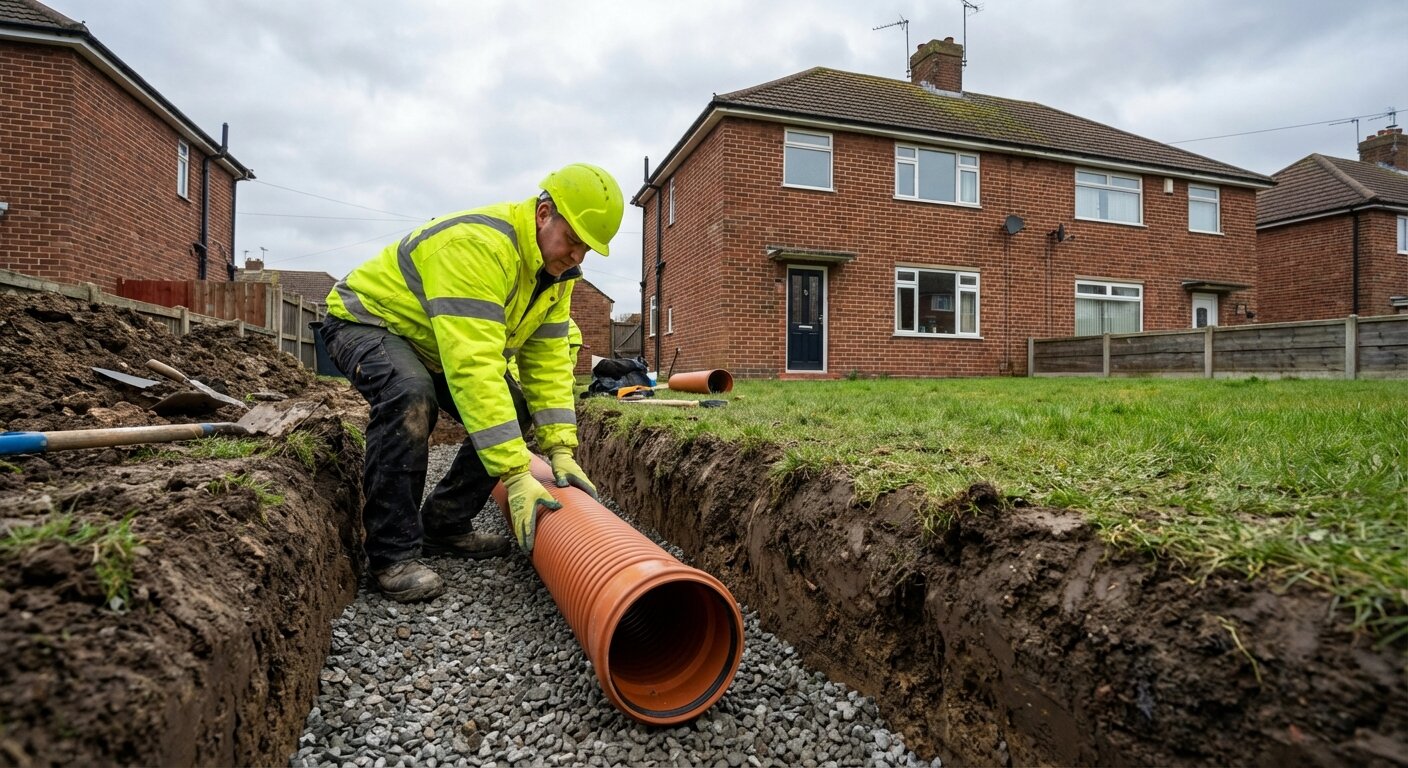
The light weight (1.5 kg/m vs 10+ kg/m for clay) makes PVC-U practical for manual handling without machinery. A 3 m length of 110 mm PVC-U weighs around 4.5 kg — manageable for one person. The equivalent in clay would weigh 24–36 kg and require two people or a small excavator.
Extensions and Renovations
When connecting new drainage to an existing system, PVC-U is the practical choice. Adaptors are readily available to connect PVC-U to existing clay, cast iron, or concrete pipe. See our guide on drainage for house extensions for the full process.
When to Choose Clay
Chemical Exposure
Laboratories, hospitals, industrial facilities, and properties with aggressive groundwater may benefit from clay’s superior chemical resistance. PVC-U resists most domestic chemicals but can be affected by certain solvents and industrial chemicals.
Heritage and Conservation
On some listed building projects, clay may be specified to maintain material consistency with the existing drainage. Conservation officers occasionally require like-for-like replacement.
Very Shallow or Exposed Runs
Clay’s natural UV resistance means it can be left exposed above ground (e.g., in retaining walls, visible channel drains). PVC-U degrades in sunlight and must be buried or protected.
Extreme Longevity Requirements
Where the drain cannot be accessed for replacement (e.g., under a major structure with no planned demolition), clay’s 100+ year proven lifespan provides extra assurance.
Installation Comparison
| Step | Clay | PVC-U |
|---|---|---|
| Handling | Heavy — 2 people or machinery for larger sizes | Light — one person handles easily |
| Cutting | Angle grinder with diamond blade | Hacksaw or pipe cutter |
| Jointing | Push-fit with rubber seal (modern); slower due to weight and alignment | Push-fit with ring seal; fast, one-hand operation |
| Number of joints per 10m | 7–17 joints (600–1,500 mm lengths) | 2–3 joints (3–6 m lengths) |
| Bedding | Critical — clay is brittle; any point load causes cracks | Important but more forgiving — PVC flexes slightly |
| Breakage risk | High — can shatter if dropped or hit | Low — impact-resistant |
Bedding Requirements
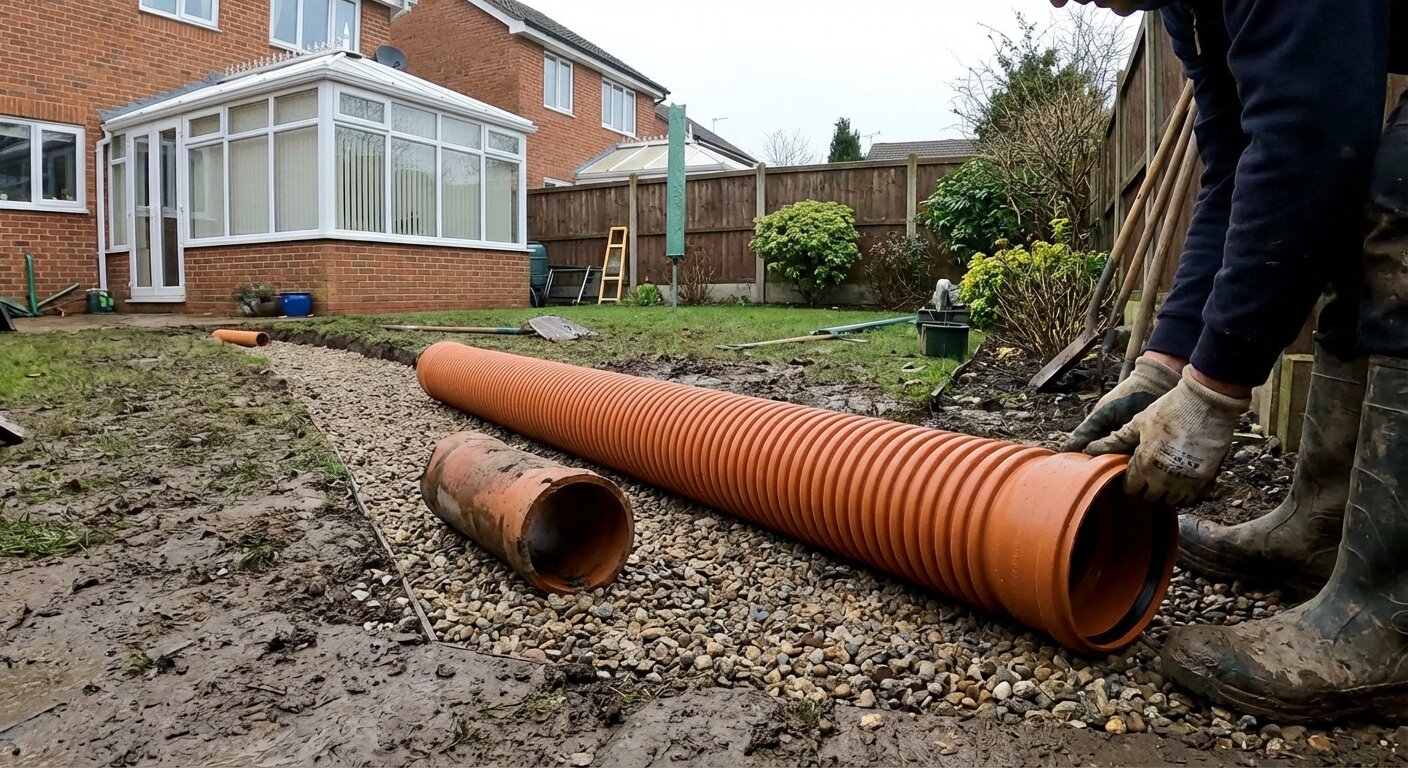
Both materials require proper bedding and backfill, but clay is significantly less forgiving. A stone pressing against a clay pipe barrel under load will crack the pipe. PVC-U has enough flex to distribute the point load and survive. Class B granular bedding (pea gravel, 100 mm minimum under the pipe) is the standard for both, but clay is more reliant on correct bedding than PVC-U.
What About Existing Clay Drains?
If your property has existing clay drains (common on pre-1990s UK houses), you have three options when work is needed:
1. Repair the Clay
For localised damage (cracked joint, root intrusion, minor displacement), repair in-situ using:
- Patch repair with flexible coupling
- Local relining with a sleeve liner
- Re-seal joints with modern flexible gaskets
2. Connect New PVC to Existing Clay
When extending or adding to the drainage, connect new PVC-U to the existing clay using flexible couplings (rubber sleeves with stainless steel clamps). This is the most common approach. Kalsi’s underground drainage accessories include adaptor couplings for connecting to clay and other legacy materials.
3. Replace Clay with PVC
When the existing clay drain is extensively damaged, deformed, or blocked by roots, complete replacement with PVC-U is the long-term solution. This involves excavating the full run, removing the clay, and laying new PVC-U pipe with proper bedding.
A CCTV drain survey is the best way to assess the condition of existing clay drains before deciding on the approach.
Environmental Comparison
| Factor | Clay | PVC-U |
|---|---|---|
| Raw material | Natural clay (abundant) | Derived from oil (57% salt, 43% oil-derived) |
| Manufacturing energy | High (firing at 1,000°C+) | Moderate (extrusion at 180–200°C) |
| Transport weight | Heavy (higher fuel per pipe) | Light (lower fuel per pipe) |
| Lifespan | 100+ years | 50–100+ years |
| End of life | Inert — can be crushed for aggregate | Recyclable — can be reprocessed into new PVC |
| Chemical leaching | None | Minimal (PVC-U is chemically stable) |
The environmental case is not clear-cut. Clay uses natural materials but consumes significant energy in firing. PVC uses oil-derived feedstock but has lower manufacturing energy, is lighter to transport, and is fully recyclable. Over a 100-year building lifecycle, both materials perform responsibly. PVC-U’s recyclability is a growing advantage — manufacturers increasingly take back end-of-life pipe for reprocessing into new products, supporting a circular economy.
British Standards and Compliance
Both materials are covered by British and European Standards:
| Standard | Material | Covers |
|---|---|---|
| BS EN 1401 | PVC-U | Plastic piping systems for underground drainage — dimensions, tolerances, performance |
| BS EN 295 | Clay | Vitrified clay pipes — dimensions, joints, performance |
| BS EN 1610 | Both | Installation and testing of drains and sewers |
| Approved Document H | Both | Building Regulations guidance on drainage design and construction |
Building Control accepts both materials for domestic drainage provided the installation meets the relevant standards. In practice, PVC-U to BS EN 1401 is the most commonly specified.
Frequently Asked Questions
Is plastic drainage better than clay?
For most domestic applications, yes. PVC-U is lighter, cheaper, faster to install, and uses reliable push-fit joints. Clay is stronger in compression and more chemically resistant, making it better for industrial or heritage applications. For standard UK house drainage, PVC-U to BS EN 1401 is the industry standard.
How long does clay drainage pipe last?
Clay pipe can last 100+ years — there are functioning clay drains in UK cities that are over 150 years old. However, the traditional mortar joints (used before modern rubber seals) are the weak point. Root intrusion, joint displacement, and mortar deterioration are common in old clay systems. Modern clay with rubber-seal joints is equally long-lasting.
Can I mix clay and plastic drainage pipe?
Yes. Use flexible couplings (rubber sleeves with stainless steel clamps) to connect PVC-U to clay. This is standard practice when extending drainage on properties with existing clay systems. Ensure the invert levels match and the joint is watertight.
Is PVC-U pipe strong enough to bury?
Yes. PVC-U underground drainage pipe to BS EN 1401 is designed for burial. It is available in two stiffness classes: SN4 (standard — suitable for most domestic depths) and SN8 (heavy duty — for shallower cover or heavier surface loads). With correct bedding (granular surround), PVC-U handles the burial loads on domestic and most commercial projects.
Why is clay pipe still used?
Clay remains relevant for projects requiring extreme chemical resistance (industrial drainage), very long lifespan assurance (major infrastructure), or material-matching on heritage sites. It is also still popular in some European markets where different building traditions prevail. In the UK domestic market, PVC-U has largely replaced clay for new installations.
What size plastic pipe replaces clay?
Standard 110 mm PVC-U pipe is the direct replacement for 4-inch (100 mm) clay pipe, which was the domestic standard. For larger systems, 160 mm PVC-U replaces 6-inch clay. Kalsi’s 160mm drainage system covers larger-diameter applications.