110mm vs 160mm Drainage Pipe: When to Use Each
For most domestic underground drainage — foul drains from toilets, bathrooms, and kitchens, and surface-water drains from gutters and driveways — 110 mm pipe is the standard and correct size. 160 mm pipe is used when the drain serves a large number of properties (typically 10+ dwellings), when flow calculations show 110 mm is insufficient, on commercial and industrial projects, or as a public sewer connection. Building Regulations (Approved Document H) specify minimum pipe sizes based on the number and type of fixtures connected, and for single domestic properties, 110 mm meets all requirements.
Getting the pipe size right at the planning stage prevents expensive retrospective work. An undersized drain can cause backflow, blockages, and failed Building Control inspections. An oversized pipe wastes money and may not achieve the self-cleansing velocity needed to keep solids moving through the system.
Quick Sizing Guide
| Application | Minimum Pipe Size | Typical Pipe Size |
|---|---|---|
| Single dwelling — foul drain | 100 mm | 110 mm |
| Single dwelling — surface water | 75 mm | 110 mm |
| Branch drain (single toilet) | 100 mm | 110 mm |
| Shared drain (2–5 dwellings) | 100 mm | 110 mm |
| Shared drain (6–10 dwellings) | 100 mm | 110 mm or 160 mm |
| Shared drain (10+ dwellings) | 150 mm | 160 mm |
| Public sewer adoption | Variable | 150 mm (160 mm pipe) |
| Commercial/industrial | Calculated | 160 mm or larger |
Note: 110 mm pipe has a nominal bore of approximately 104 mm; 160 mm pipe has a bore of approximately 152 mm. The naming convention refers to the outside diameter.
Flow Capacity Comparison
| Parameter | 110 mm Pipe | 160 mm Pipe |
|---|---|---|
| Outside diameter | 110 mm | 160 mm |
| Internal bore | ~104 mm | ~152 mm |
| Cross-sectional area | ~8,495 mm² | ~18,146 mm² |
| Flow at 1:40 gradient (half-full) | ~3.7 l/s | ~10.2 l/s |
| Flow at 1:60 gradient (half-full) | ~3.0 l/s | ~8.3 l/s |
| Flow at 1:80 gradient (half-full) | ~2.6 l/s | ~7.2 l/s |
The 160 mm pipe carries approximately 2.7 times more flow than 110 mm at the same gradient. This is directly proportional to the cross-sectional area.
For a single domestic property, the maximum foul water discharge is typically 1.5–2.5 l/s (all fixtures running simultaneously, which rarely happens). A 110 mm pipe at a 1:40 gradient handles this with substantial headroom.
When 110mm Is the Right Choice
Standard Domestic Foul Drainage
For houses, bungalows, flats (individual buildings), and most extensions:
- All toilets, bathrooms, kitchens, and utility rooms connect to a 110 mm foul drain
- The drain runs to the public sewer connection or septic tank
- One property = 110 mm
Domestic Surface Water
Rainwater from gutters and downpipes typically connects to a 110 mm surface-water drain running to a soakaway, watercourse, or surface-water sewer.
Branch Connections
Individual branch drains connecting to a larger shared drain are 110 mm regardless of the main drain size.
Extensions and New Bathrooms
Adding a new bathroom, en-suite, or kitchen to an existing property — the new drain from the extension to the existing drainage is 110 mm.
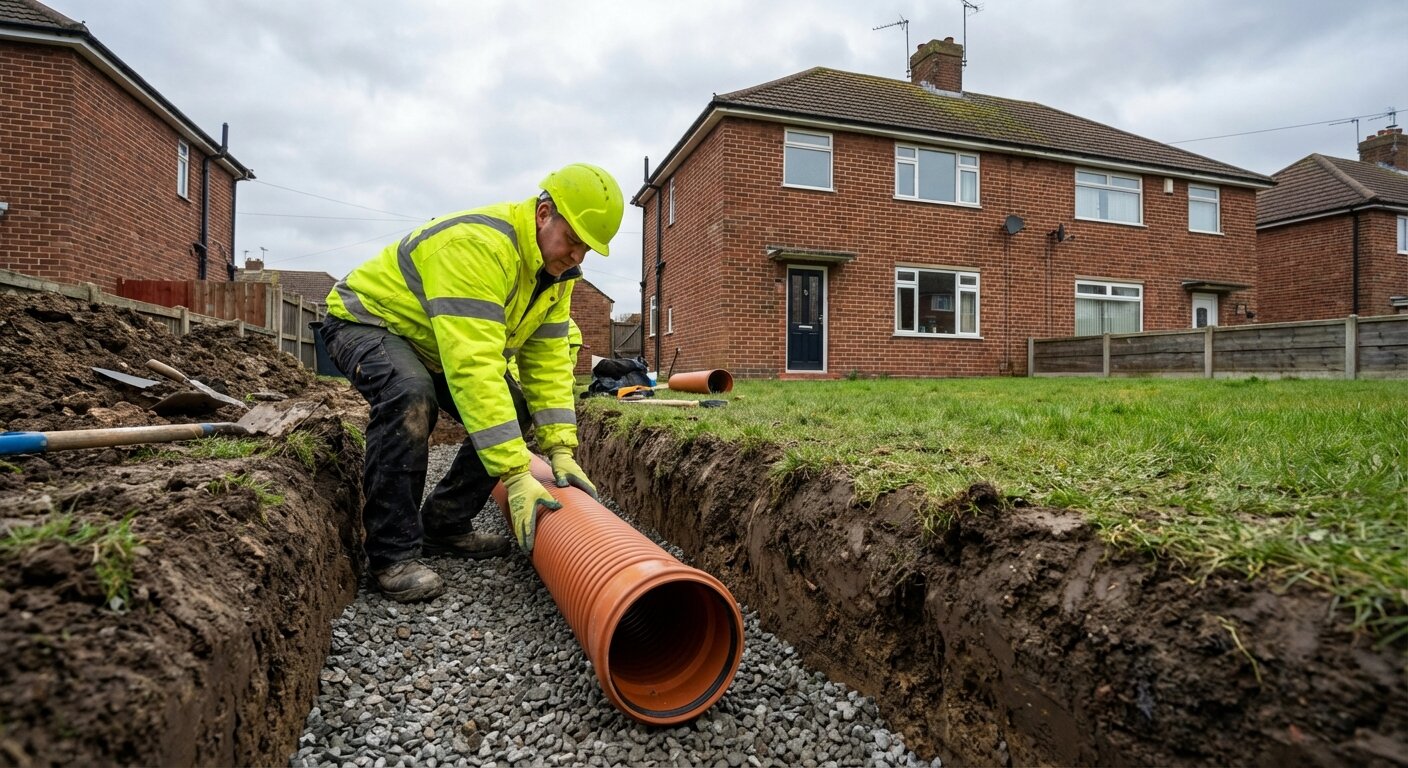
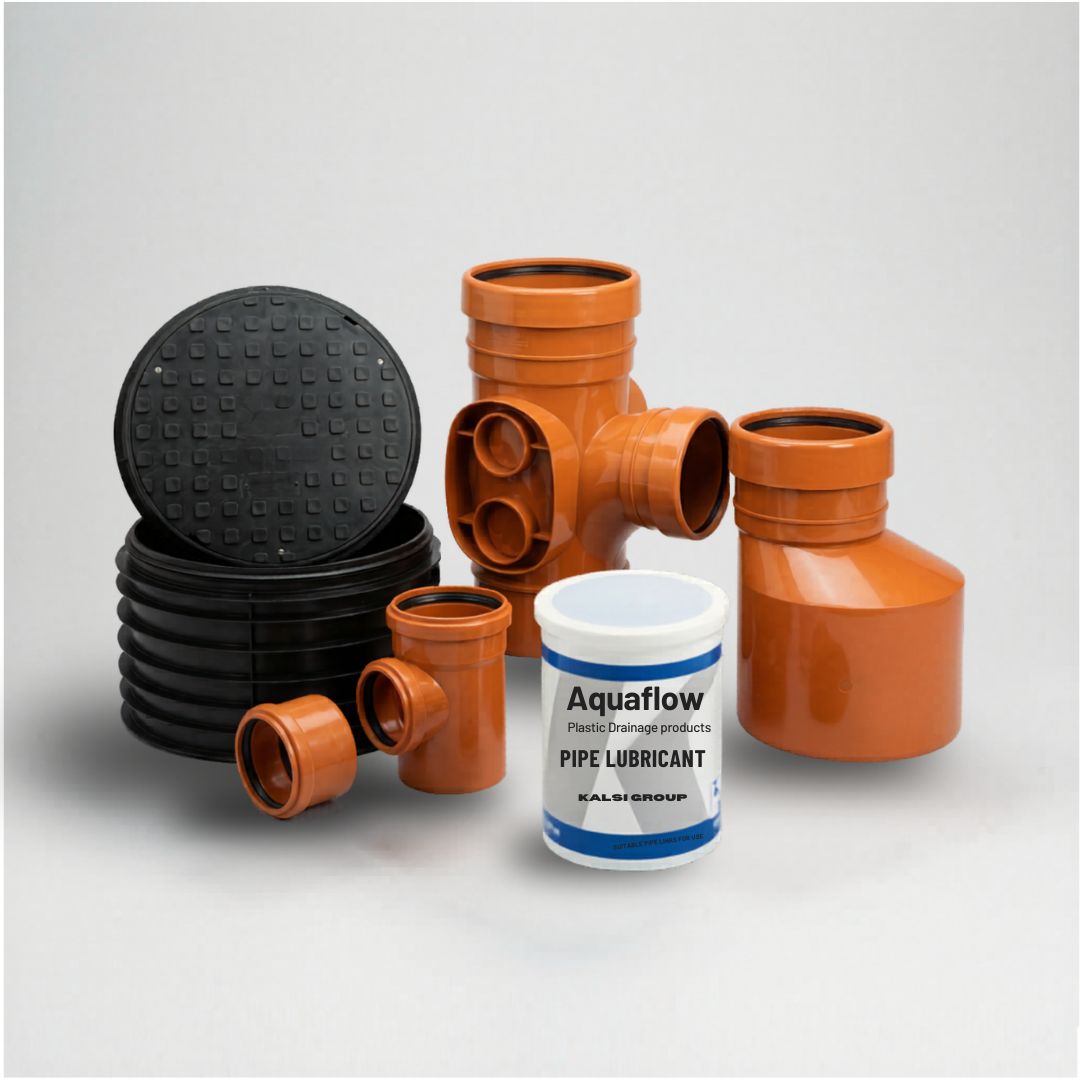
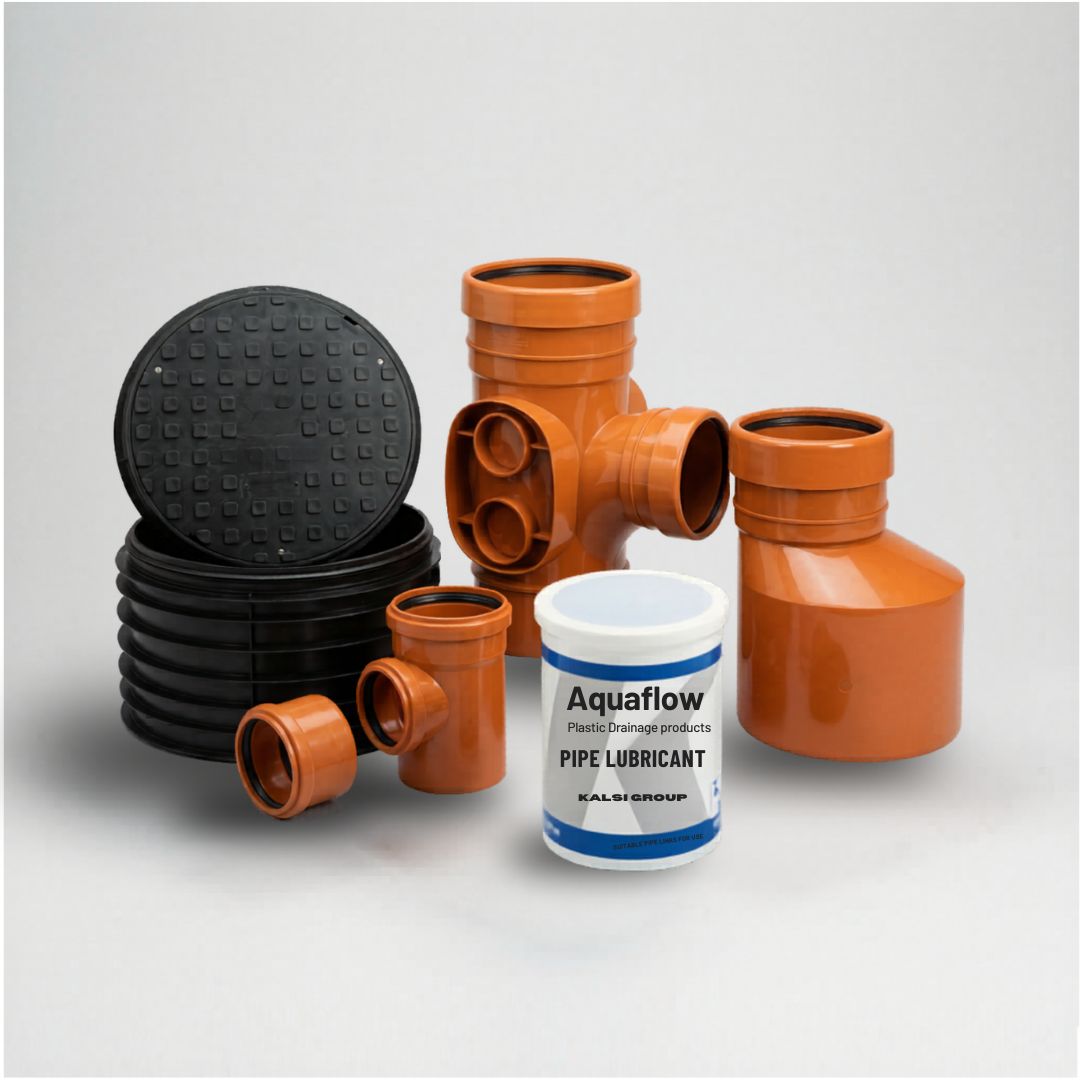
Kalsi’s 110mm underground drainage system includes pipes, fittings, bends, junctions, and inspection chambers for complete domestic drainage installation.
When 160mm Is Needed
Large Developments
When a single drain serves multiple dwellings (typically 10+), the combined flow exceeds 110 mm capacity. The shared drain from the development to the public sewer is 160 mm.
Commercial and Industrial
Restaurants, hotels, schools, offices, factories — higher fixture counts and water usage demand larger drains.
Sewer Adoption
Water companies adopting new drains as public sewers often require 150 mm minimum bore (160 mm pipe) regardless of the current load, to future-proof for additional connections.
Where Gradient Is Limited
If the site topography restricts the drain gradient to 1:80 or flatter, 160 mm provides adequate flow capacity at the reduced slope. A 110 mm pipe at 1:80 can struggle with self-cleansing velocity.
Combined Drains
Where foul and surface water share a single combined drain (common on older properties and still permitted in some situations), the combined flow may justify 160 mm.
Kalsi’s 160mm underground drainage system covers all the larger-bore components.
Building Regulations: Approved Document H
Approved Document H (Drainage and Waste Disposal) in England and Wales sets minimum requirements:
Minimum Pipe Sizes
- Foul drain serving a single dwelling: 100 mm minimum bore (110 mm pipe)
- Foul drain serving multiple dwellings: 100 mm minimum, but 150 mm when serving 10+ properties
- Surface water drain: 75 mm minimum (110 mm typical)
Minimum Gradients
| Pipe Size | Minimum Gradient (foul) | Recommended Gradient |
|---|---|---|
| 110 mm | 1:80 (with care) | 1:40 to 1:60 |
| 160 mm | 1:120 (minimum) | 1:60 to 1:80 |
The gradient must achieve self-cleansing velocity — typically 0.7 m/s at one-third pipe capacity. This ensures solids are flushed through and do not settle in the pipe. Too flat and solids accumulate; too steep and liquid outpaces solids, leaving them stranded.
The 1:40 Rule of Thumb
For domestic 110 mm foul drains, a gradient of 1:40 (25 mm drop per metre) is widely used and comfortably meets Building Regulations. It is sometimes called the “gold standard” gradient.
Self-Cleansing Velocity
This is a critical concept that determines the minimum acceptable gradient:
| Pipe Size | Minimum Velocity | Gradient for Self-Cleansing |
|---|---|---|
| 110 mm | 0.7 m/s | 1:40 to 1:60 (domestic) |
| 160 mm | 0.7 m/s | 1:60 to 1:80 |
At low gradients, water flows too slowly to carry solid waste. At very steep gradients, water rushes past the solids without picking them up. The ideal gradient keeps water and solids moving together at a pace that prevents sedimentation.
Why this matters for 110 mm vs 160 mm: A 160 mm pipe at a given gradient has a lower flow velocity than 110 mm (because the water spreads over a larger cross-section). This means 160 mm pipe needs a slightly steeper gradient to achieve the same self-cleansing velocity — or it needs a higher total flow volume. Using 160 mm on a single dwelling where the flow is low can actually cause problems because the water trickles along the bottom without generating enough velocity to carry waste.
Connecting to Existing Drainage
110mm to 110mm
Standard connection using couplers, bends, and junctions from the underground drainage fittings range.
110mm to 160mm
When a 110 mm domestic drain connects to a 160 mm shared drain or sewer, use a level-invert reducer (160 mm to 110 mm adaptor). The 110 mm pipe enters the 160 mm pipe at the correct invert level to maintain flow.
New to Old
Older drainage may use clay, cast iron, or pitch fibre pipes in non-standard sizes. Adaptors are available to connect modern PVC-U to:
- Clay pipe (various diameters)
- Cast iron (various diameters)
- Pitch fibre (various diameters)
Material: PVC-U Underground Pipe
Both 110 mm and 160 mm underground drainage pipes are manufactured in PVC-U to BS EN 1401. They are:
- Terracotta/orange colour (standard for underground drainage)
- UV-sensitive — designed for burial, not above-ground use
- Ring-seal push-fit joints — quick assembly, watertight, allow slight movement
- Available in 1 m, 3 m, and 6 m lengths
- Rated for burial depths from 300 mm to 6+ metres depending on pipe class (SN4 or SN8)
Frequently Asked Questions
What size drainage pipe do I need?
For a single domestic property (house or bungalow), 110 mm pipe is correct for both foul and surface-water drainage. 160 mm is needed for drains serving 10+ dwellings, commercial properties, or where gradient limitations require larger capacity. Check Approved Document H for specific requirements.
Can I use 110mm pipe for a shared drain?
Yes, for up to approximately 10 dwellings, provided the gradient is adequate (1:40 or steeper). Above 10 dwellings, 160 mm is typically required. The water company may also have specific requirements for adoptable drains.
Is 160mm drainage pipe overkill for a house?
Generally yes. A single dwelling does not generate enough flow to achieve self-cleansing velocity in a 160 mm pipe, which can lead to solids settling and causing blockages. 110 mm is the correct size for single-dwelling domestic drainage.
What gradient should 110mm drainage pipe have?
A gradient of 1:40 (25 mm fall per metre) is the recommended standard for 110 mm foul drainage. The absolute minimum is 1:80 (12.5 mm per metre), but steeper gradients are preferred. For surface water, 1:60 to 1:100 is acceptable.
Can I connect 110mm pipe to 160mm pipe?
Yes, using a level-invert reducer fitting. This adaptor maintains the correct invert level so water flows smoothly from the smaller pipe into the larger one. It is a standard fitting available in the underground drainage accessories range.