Building Regs Part H Drainage: Plain English Guide
Approved Document H is the part of the Building Regulations for England and Wales that covers drainage and waste disposal. It sets out the requirements for foul drainage (toilets, sinks, baths), surface-water drainage (rainwater), and the safe disposal of waste water. In plain terms, it tells you: what size pipes to use, how steep to lay them, where to put inspection chambers, how to connect to the sewer, and what to do if there is no mains drainage. Part H applies to all new buildings, extensions, and significant drainage alterations — and Building Control will inspect the work before you can backfill.
This guide translates the technical language of Approved Document H into practical information that groundworkers, plumbers, builders, and homeowners can use on real projects. The full document is 56 pages of dense regulatory text — here are the parts that matter most.
What Part H Covers
Part H has six sections:
| Section | Title | What It Covers |
|---|---|---|
| H1 | Foul water drainage | Drains from toilets, sinks, baths, showers, kitchens |
| H2 | Wastewater treatment systems | Septic tanks, treatment plants, cesspools |
| H3 | Rainwater drainage | Gutters, downpipes, underground surface-water drains |
| H4 | Building over sewers | Rules for building near or over existing sewers |
| H5 | Separate systems of drainage | Keeping foul and surface water separate |
| H6 | Solid waste storage | Bin stores and waste collection |
H1: Foul Water Drainage
Minimum Pipe Sizes
| Situation | Minimum Pipe Size |
|---|---|
| Single dwelling foul drain | 100 mm bore (110 mm pipe) |
| Single WC branch | 100 mm bore |
| Up to 10 dwellings on shared drain | 100 mm bore |
| More than 10 dwellings | 150 mm bore (160 mm pipe) |
Minimum Gradients
| Pipe Size | Number of WCs | Minimum Gradient |
|---|---|---|
| 110 mm | 1 WC | 1:40 (or 1:80 with careful design) |
| 110 mm | Up to 5 WCs | 1:40 |
| 110 mm | 6–10 WCs | 1:40 |
| 160 mm | Any | 1:60 minimum |
The gradient must achieve a self-cleansing velocity of at least 0.7 m/s when the pipe is running at one-third capacity.
The key number most installers use: 1:40 for 110 mm domestic foul drainage. This means the pipe falls 25 mm for every 1,000 mm (1 metre) of run.
Inspection Chambers and Access
Part H requires drainage access at:
- The head of each drain run (nearest the building)
- Every change of direction (bend greater than 45°)
- Every junction where branches connect
- Every change of gradient
- At intervals not exceeding 45 m on straight runs (12 m if the drain is small-bore)
Access can be via inspection chambers, rodding eyes, or access fittings depending on the depth and complexity.
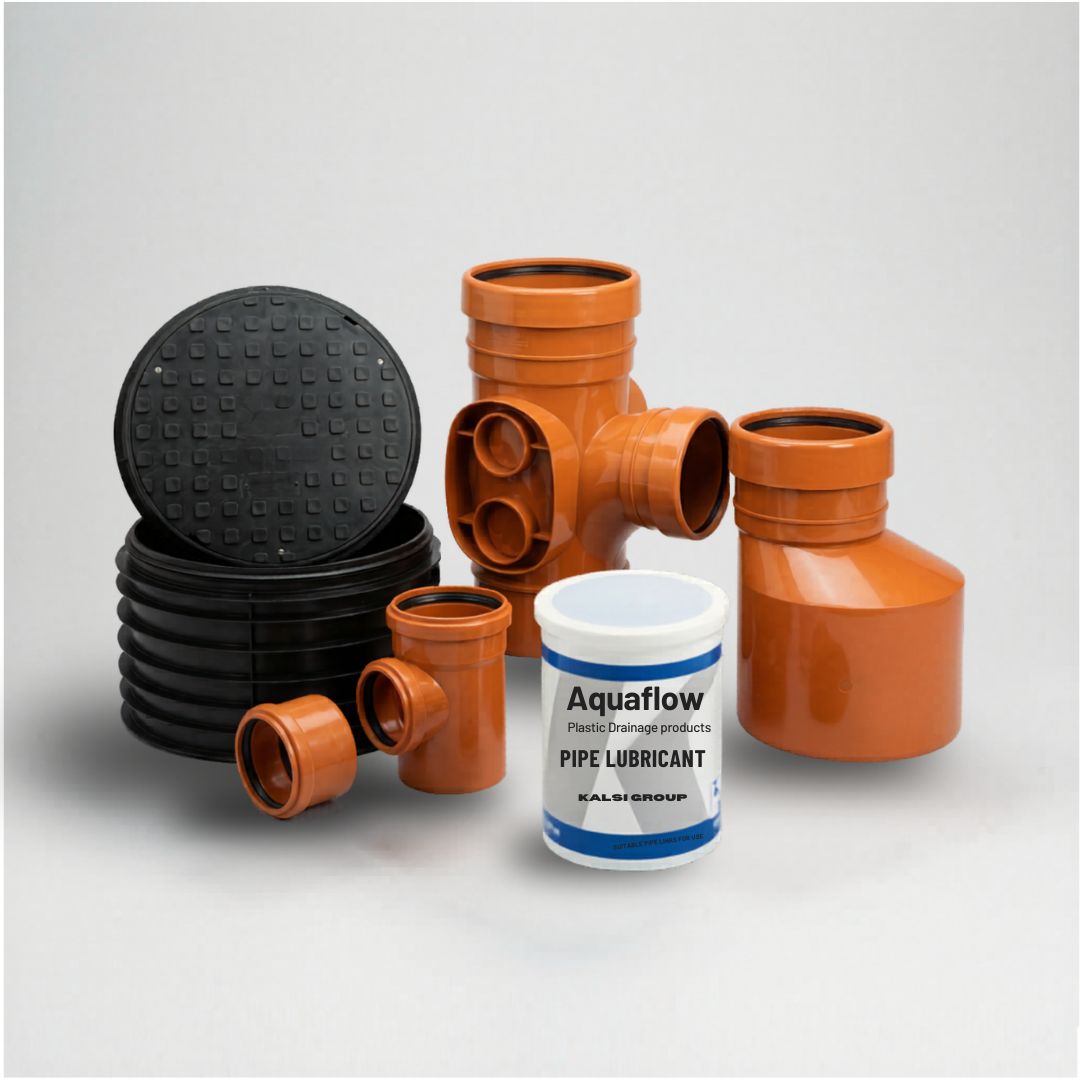
Kalsi’s inspection chamber range covers standard domestic requirements.
Connection to the Sewer
- Foul drains must connect to the public foul sewer (not the surface-water sewer)
- Connection requires written consent from the water company (Section 106 agreement)
- The connection must be made at a designated point, typically via a Y-junction on the sewer
- A trapped gully or interceptor may be required (depends on local requirements)
H2: Wastewater Treatment Systems
For properties not connected to mains drainage (rural areas), Part H covers:
Septic Tanks
- Must comply with BS EN 12566
- Must discharge to a drainage field (soakaway) designed to BS 6297
- Must not discharge directly to a watercourse (since January 2020 under General Binding Rules)
- Must be regularly desludged (typically annually)
Package Treatment Plants
- An alternative to septic tanks for areas where a drainage field is not feasible
- Produce a higher-quality effluent that can discharge to a watercourse (subject to Environment Agency permit)
- Must comply with BS EN 12566
Cesspools
- A sealed tank with no outlet — all waste is stored and collected periodically
- Only used as a last resort where no other option is available
- Minimum capacity: 18,000 litres (larger for bigger households)
- Very expensive to operate (frequent tanker emptying)
H3: Rainwater Drainage
Gutter Sizing
Part H references BS EN 12056-3 for gutter and downpipe sizing. The key principle: the rainwater system must handle the design rainfall intensity for the location (75 mm/h for most of England and Wales).
Surface Water Disposal Hierarchy
Part H sets a clear hierarchy for where rainwater should go:
- Soakaway or infiltration — the preferred option if ground conditions allow (percolation test required)
- Watercourse — stream, river, or pond (with attenuation if needed)
- Surface-water sewer — if available
- Combined sewer — only if no other option exists
You must work down this list and only use the next option if the previous one is not feasible. This is a legal requirement, and Building Control will check.
Soakaway Requirements
- Must be at least 5 m from any building
- Must be at least 2.5 m from any boundary
- Must pass a percolation test (BRE Digest 365 method)
- Must be sized to store the worst-case rainfall event for the site
H4: Building Over Sewers
If your project involves building near or over an existing public sewer:
- Within 3 m of a public sewer — you may need an agreement with the water company (Build Over Agreement)
- Building directly over a sewer — special construction requirements apply (bridged foundations, access for maintenance)
- Diverting a sewer — possible but requires the water company’s consent and a formal diversion agreement
Always check for existing sewers before designing the building layout. Sewer maps are available from the water company.
H5: Separate Systems
Part H strongly encourages separate foul and surface-water drainage:
- Foul water (toilets, sinks, baths) → foul sewer or treatment
- Surface water (rain) → soakaway, watercourse, or surface-water sewer
Connecting surface water to the foul sewer:
- Increases the risk of sewer flooding
- Overloads sewage treatment works
- Is prohibited on new developments
- May be acceptable on existing combined systems (check with water company)
Retrofitting Separation
When extending or altering drainage on older properties with combined systems, Building Control may require the surface water to be separated and directed to a soakaway or surface-water sewer.
Practical Application: Typical House Extension
For a standard rear extension adding a kitchen and WC:
| Element | Part H Requirement |
|---|---|
| New foul drain | 110 mm pipe at 1:40 gradient, connecting to existing drain |
| Inspection chamber | At junction with existing drain |
| Rainwater from extension roof | Separate surface-water drain to soakaway (preferred) or existing SW system |
| Building Control | Notify before starting; inspection before backfill |
What Building Control Will Check
- ✅ Pipe size and material (110 mm PVC-U to BS EN 1401)
- ✅ Gradient (measured with laser or spirit level)
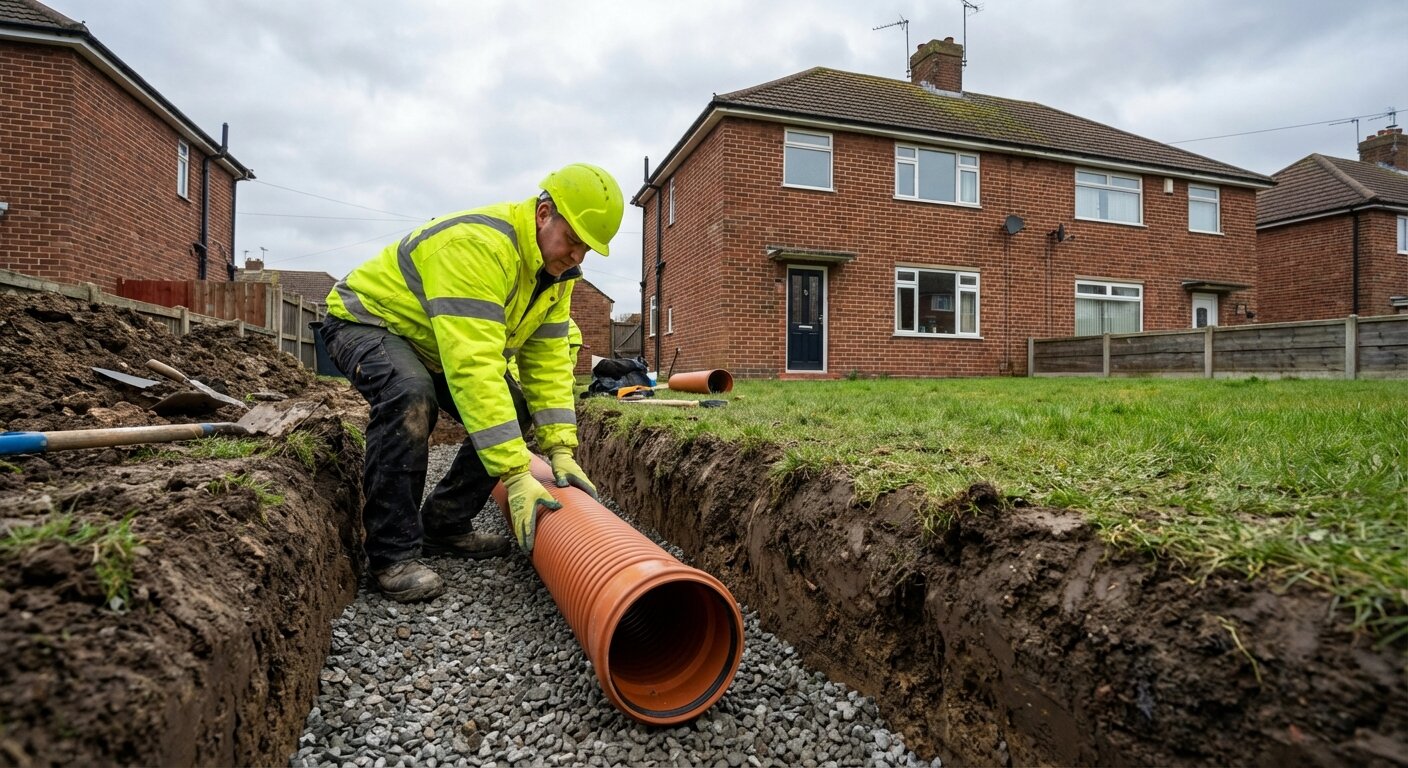
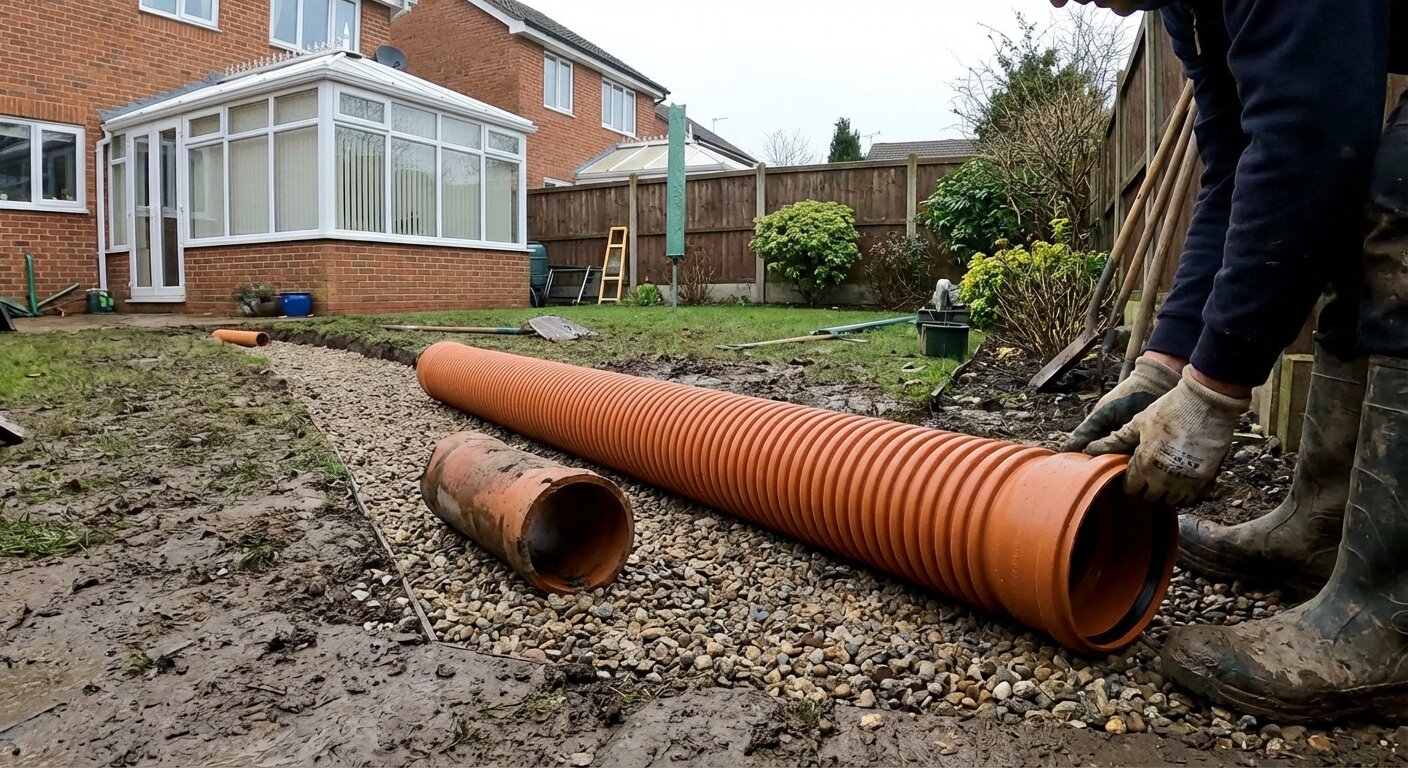
- ✅ Bedding (granular surround to BS EN 1610)
- ✅ Inspection chamber position, size, and construction
- ✅ Water test or air test result
- ✅ Cover depth adequate for the loading
- ✅ Connection to existing drain is sound
- ✅ Surface water is disposed of correctly (not to foul sewer)
Scotland and Northern Ireland
Scotland
Drainage is covered by Section 3 of the Technical Handbooks (Domestic). The requirements are broadly similar to Part H but with some differences in gradient minimums and access requirements.
Northern Ireland
Part N (Drainage) of the Building Regulations (Northern Ireland) covers equivalent requirements.
Frequently Asked Questions
What does Part H say about drainage?
Part H (Approved Document H) covers foul drainage, surface water drainage, septic tanks, building over sewers, and waste disposal. Key requirements include minimum pipe sizes (110 mm for single dwellings), minimum gradients (1:40 for domestic foul drains), inspection chamber locations, and a hierarchy for surface water disposal (soakaway first, sewer last).
Do I need Building Control approval for drainage?
Yes, for new drainage, alterations to existing drainage, and new connections to the public sewer. Notify Building Control before starting work. They will inspect the installation before you backfill. Failure to obtain sign-off can cause problems at property sale.
Can I connect rainwater to the foul sewer?
Generally no. Part H requires surface water to be kept separate from foul drainage. The disposal hierarchy is: soakaway first, then watercourse, then surface-water sewer, then combined sewer as a last resort. Connecting clean rainwater to the foul sewer is prohibited on new developments.
What is the minimum drain gradient?
For 110 mm foul drains serving domestic properties, the standard gradient is 1:40 (25 mm per metre). The absolute minimum is 1:80 (12.5 mm per metre) under specific conditions. For surface water, 1:60 to 1:100 is typical.
What happens if drainage doesn’t have Building Control sign-off?
Unsigned drainage is flagged during property conveyancing searches. The buyer’s solicitor will request a Building Control completion certificate. If one does not exist, the buyer may require an indemnity insurance policy, a retrospective inspection (which may involve excavation), or a price reduction. Avoid this by always notifying Building Control.