Traps, Bends & Fittings: Waste Pipe Accessories Guide
The waste fittings you need depend on your fixture layout, but every installation requires traps (one per fixture), bends (for direction changes), tees (for branch connections), and clips (for pipe support). A typical bathroom installation uses 6–12 fittings beyond the pipe itself. Getting the right fittings in the right sizes before starting saves trips to the merchant and prevents bodge connections that leak or restrict flow.
Waste pipe fittings are the connections that make the system work. The pipe provides the conduit; the fittings provide the turns, junctions, traps, and transitions that route waste from every fixture to the soil stack or drain. Each fitting must match the pipe system (push-fit or solvent weld) and size (32 mm, 40 mm, or 50 mm).
Essential Fittings
Traps
Every fixture must have a trap — a U-shaped water seal that prevents sewer gas entering the room. The minimum water seal depth is 75 mm under Building Regulations.
| Trap Type | Size | Best For |
|---|---|---|
| Bottle trap | 32 mm, 40 mm | Basins — compact, visible, easy to clean |
| P-trap | 32 mm, 40 mm | Wall exit — pipe exits horizontally through the wall |
| S-trap | 32 mm, 40 mm | Floor exit — pipe exits vertically through the floor |
| Bath trap | 40 mm (low profile) | Baths — fits in the limited space under the bath |
| Shower trap | 40 mm (very low) | Shower trays — 50–90 mm deep depending on tray height |
| Running trap | 40 mm, 50 mm | Washing machines, dishwashers — in-line trap on the waste run |
| Anti-siphon trap | 32 mm, 40 mm | Long waste runs — built-in air admittance to prevent siphonage |
Choosing the right trap type: The trap type is determined by the pipe exit direction (through the wall = P-trap; through the floor = S-trap) and the available space (under a bath = bath trap; under a shower tray = shower trap). If the pipe route is flexible, a P-trap with a horizontal exit is generally the most versatile choice.
Bends
| Bend Angle | Use |
|---|---|
| 45° | Gentle direction change — preferred for flow |
| 90° (knuckle) | Right-angle change — use sparingly, creates flow resistance |
| 90° (swept/long-radius) | Right-angle with gentle curve — better flow than knuckle bend |
| 92.5° | Stack connection angle — directs flow downward when entering vertical pipe |
| 135° | Obtuse angle — used where pipe changes direction gradually |
Rule of thumb: Use two 45° bends with a straight section between them instead of a single 90° knuckle bend. The gentler radius reduces blockage risk and improves flow. On horizontal runs, swept bends are always preferable to knuckle bends.
Tees
| Tee Type | Use |
|---|---|
| Equal tee | Branch of same size (e.g., 40 mm × 40 mm × 40 mm) |
| Reducing tee | Branch of smaller size (e.g., 40 mm × 40 mm × 32 mm) |
| Swept tee | Angled branch entry — better for flow than a right-angle tee |
When combining waste runs: If a basin (32 mm) joins a bath (40 mm) waste run, use a 40 mm × 40 mm × 32 mm reducing tee. The branch run downstream of the tee should be 50 mm if the combined run is long (over 2 m).
Reducers and Adaptors
| Fitting | Use |
|---|---|
| Reducer | Transitions between pipe sizes (e.g., 40 mm to 32 mm) |
| Push-fit to solvent weld adaptor | Joins push-fit system to solvent weld (or vice versa) |
| Compression fitting | Connects waste pipe to copper or chrome pipe |
| Boss adaptor | Connects waste pipe to a soil stack (boss connection) |
| Tank connector | Connects waste pipe through a header tank or cistern wall |
| Waste to overflow adaptor | Combines waste and overflow into a single outlet |
Support Clips
| Clip Type | Spacing |
|---|---|
| Pipe clip (screw-fix) | 500 mm centres for 32 mm; 600 mm for 40 mm; 800 mm for 50 mm |
| Push-in clip | For dry-lining/plasterboard walls |
| Snap-fit clip | Quick installation, reusable |
| Saddle clip | Larger pipes, soil pipe support |
| Resilient clip | Rubber-isolated for noise reduction on internal runs |
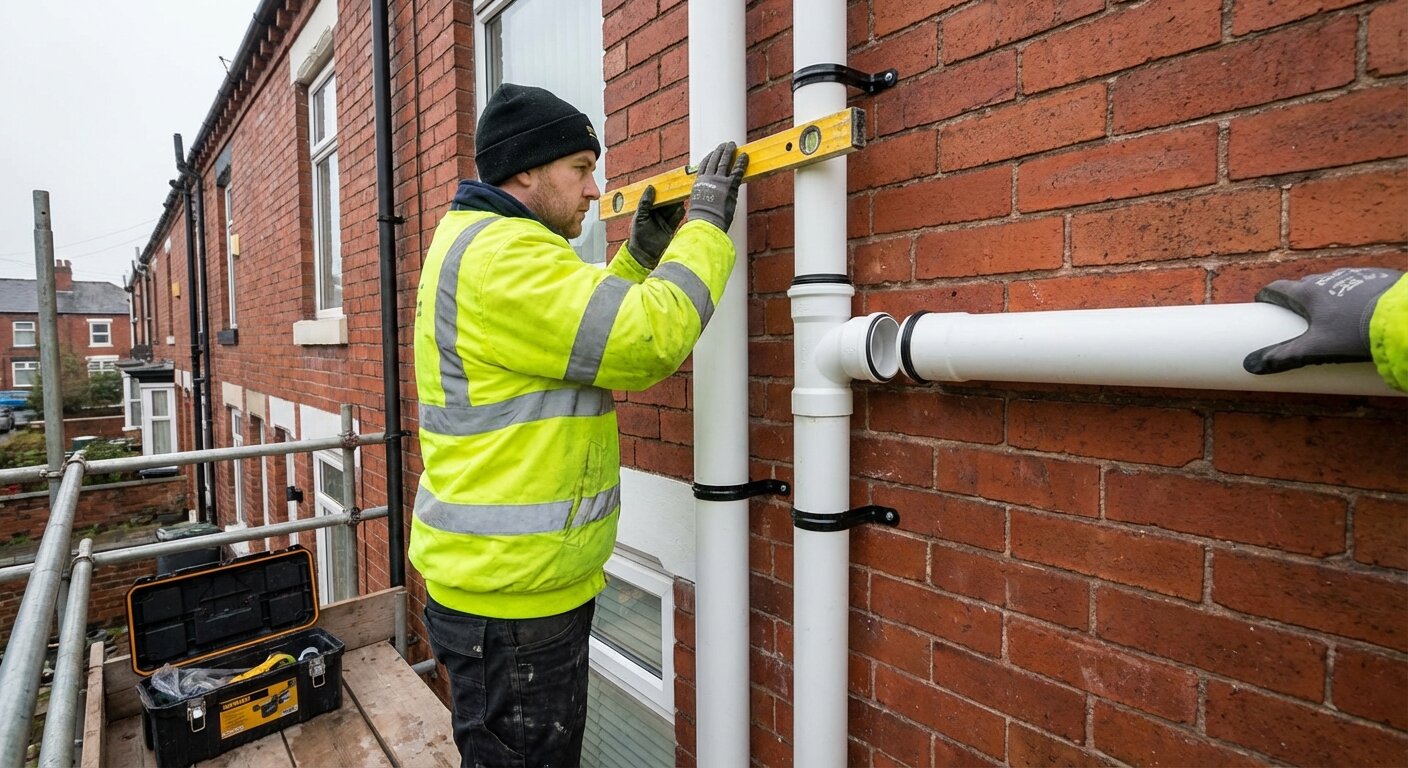
Do not skip clips. Unsupported waste pipe sags between fixings, creating low points that collect debris and restrict flow. Every joint and change of direction should have a clip within 150 mm to prevent stress on the fitting.
Fittings Shopping List by Room
Bathroom (Basin + Bath + Shower)
| Fitting | Quantity | Size |
|---|---|---|
| Bottle trap or P-trap (basin) | 1 | 32 mm |
| Bath trap (low profile) | 1 | 40 mm |
| Shower trap | 1 | 40 mm |
| 90° bend (swept) | 2–4 | 32 mm + 40 mm |
| 45° bend | 2–3 | 32 mm + 40 mm |
| Tee (if combining waste runs) | 1 | 40 mm or 50 mm |
| Pipe clips | 12–20 | 32 mm + 40 mm |
| Boss adaptors (for stack connection) | 2–3 | 32 mm, 40 mm |
Kitchen (Sink + Appliances)
| Fitting | Quantity | Size |
|---|---|---|
| P-trap or bottle trap (sink) | 1 | 40 mm |
| Appliance tee (washing machine) | 1 | 40 mm |
| Appliance tee (dishwasher) | 1 | 40 mm |
| 90° bend | 1–2 | 40 mm |
| Pipe clips | 6–10 | 40 mm |
En-Suite (Basin + Shower + WC)
| Fitting | Quantity | Size |
|---|---|---|
| Basin trap | 1 | 32 mm |
| Shower trap | 1 | 40 mm |
| WC pan connector | 1 | 110 mm |
| Boss adaptors | 3 | 32 mm, 40 mm, 110 mm |
| Bends (various) | 3–6 | Mixed sizes |
| Pipe clips | 10–15 | Mixed sizes |
Browse Kalsi’s complete waste pipe fittings range for all standard components in push-fit and solvent weld.
Push-Fit vs Solvent Weld Fittings
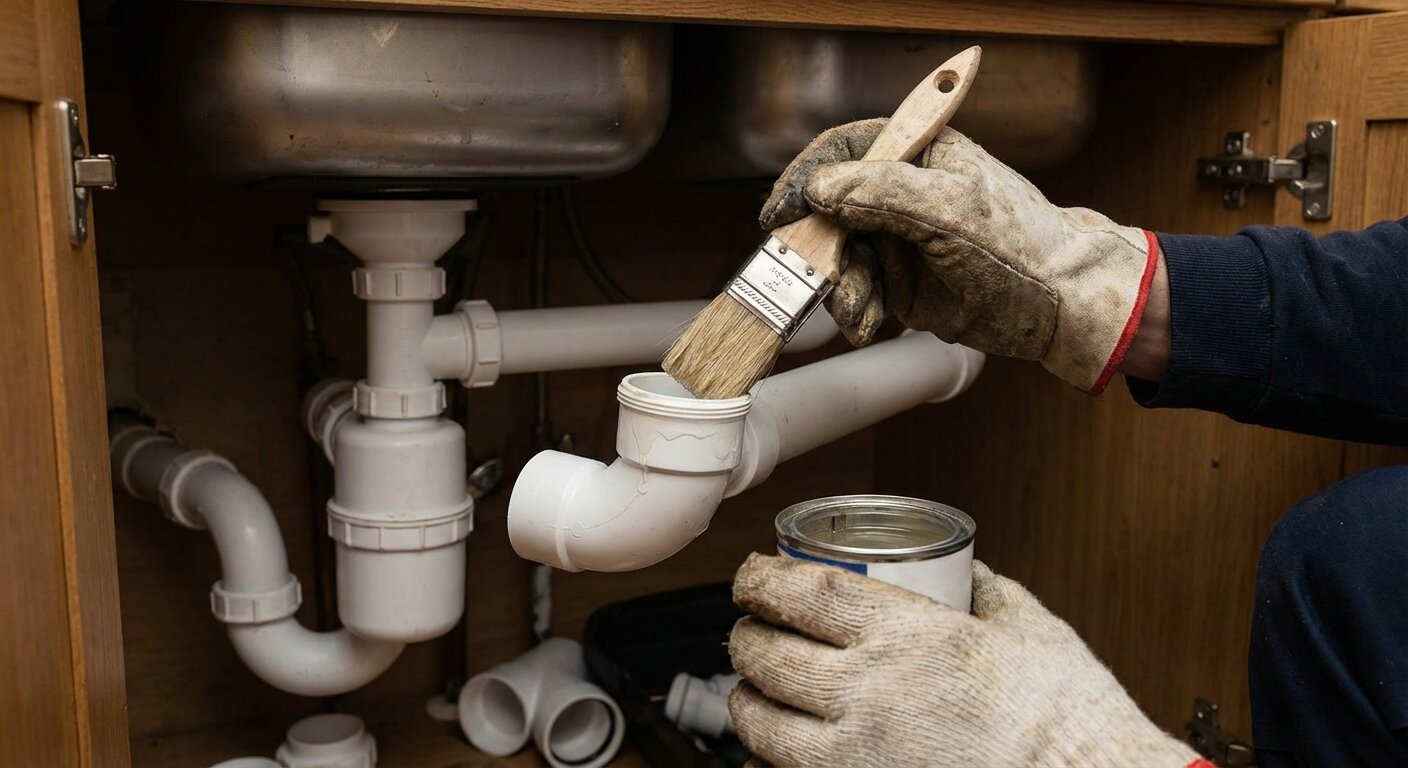
Both systems are available in all sizes and fitting types. They are NOT interchangeable — a push-fit fitting does not accept solvent weld pipe (different socket dimensions), and vice versa. However, adaptors are available to transition between the two systems.
| Feature | Push-Fit Fittings | Solvent Weld Fittings |
|---|---|---|
| Assembly | Snap together with ring seal | Cement and hold for 30 seconds |
| Disassembly | Yes (twist and pull) | No (permanent bond) |
| Appearance | Slightly bulkier (seal housing) | Slim, flush |
| Joint reliability | Excellent | Excellent |
| Best for | Internal, accessible runs | External, permanent runs |
| Maintenance | Easy to replace individual fittings | Must cut out and re-do |
| Speed | Faster (no cure time) | Slower (cement cure required) |
Mixing Systems
It is common to use push-fit under accessible fixtures (for future maintenance) and solvent weld for concealed or external runs. Always use the manufacturer’s transition adaptor at the changeover point — do not force one system’s pipe into the other’s fittings.
Sizing: Getting It Right
The golden rule: the fitting must match the pipe in both size and system type. A 32 mm push-fit fitting will not accept 40 mm pipe. A 40 mm solvent weld fitting will not properly seal around push-fit pipe.
When combining different pipe sizes (e.g., joining a 32 mm basin waste into a 40 mm main run), use a reducing fitting — never force a smaller pipe into a larger fitting with sealant or tape. Reducing fittings provide a proper stepped connection that maintains flow and prevents leaks.
Checking Compatibility
All waste pipe and fittings manufactured to BS EN 1329-1 (PVC-U) or BS EN 1455-1 (ABS) share standard dimensions. In theory, different manufacturers’ products are interchangeable within the same system type and size. In practice, using pipe and fittings from the same manufacturer gives the best fit and seal — tolerances can vary slightly between brands.
Frequently Asked Questions
What waste fittings do I need?
At minimum: a trap for every fixture, bends for every direction change, tees if combining waste runs, and clips to support the pipe at regular intervals. The exact list depends on your layout — draw the pipe route and list each fitting needed.
Are waste fittings universal between brands?
Within the same system type (push-fit or solvent weld) and size, fittings from different manufacturers are generally compatible because they are made to BS EN 1329 (PVC-U) or BS EN 1455 (ABS) standards. However, for the best seal, using fittings from the same manufacturer as the pipe is recommended.
What trap do I need for a shower?
A low-profile shower trap in 40 mm, typically 50–90 mm deep. The exact height depends on the shower tray — some trays have very shallow undersides that require ultra-low traps. Measure the available space under the tray before ordering.
Can I use 32mm fittings on 40mm pipe?
No. Pipe and fittings must match in size. A 32 mm fitting will not accept 40 mm pipe, and a 40 mm fitting will be loose on 32 mm pipe. Use a reducer fitting to transition between sizes correctly.
How many pipe clips do I need?
Space clips at 500 mm for 32 mm pipe, 600 mm for 40 mm, and 800 mm for 50 mm. Add an extra clip near every fitting (bend, tee, trap) to prevent stress on the joint. Count the clips needed during the planning stage — it is always more than you expect.
Related Kalsi Products
- Waste Push-Fit System — full range of push-fit waste pipe and fittings
- MultiFlex Waste System — flexible waste pipe for tight spaces
- Soil & Waste Range — soil stacks, boss connectors, branch fittings
- Installation Guides — fitting instructions for all systems
- Technical Downloads — datasheets and product specifications