Push-Fit vs Solvent Weld Waste Pipe: Pros & Cons
For most domestic waste plumbing (basins, baths, showers, sinks), push-fit is the better choice — it is faster to install, easier to disassemble for maintenance, and produces reliable watertight joints without special skills or drying time. Solvent weld creates a permanent, rigid joint that is marginally more secure in high-temperature applications and looks slightly neater, but it cannot be disassembled and requires careful application of solvent cement. Both systems use the same PVC-U or ABS pipe materials and are equally accepted by Building Regulations. The choice comes down to your priorities: speed and flexibility (push-fit) versus permanence and aesthetics (solvent weld).
This is one of the most debated choices in domestic plumbing. Professional plumbers have strong opinions — some swear by solvent weld for its permanence, others by push-fit for its practicality. The honest answer is that both work perfectly well for standard domestic waste plumbing, and the “best” choice depends on the specific application.
Head-to-Head Comparison
| Feature | Push-Fit | Solvent Weld |
|---|---|---|
| Joint method | Rubber O-ring seal, snap-together | Solvent cement permanently bonds pipe to fitting |
| Disassembly | Yes — pull apart for maintenance | No — permanent bond |
| Installation speed | Very fast — no drying time | Moderate — requires application + 5–15 min cure |
| Skill level | Minimal — anyone can do it | Moderate — need to apply cement evenly and quickly |
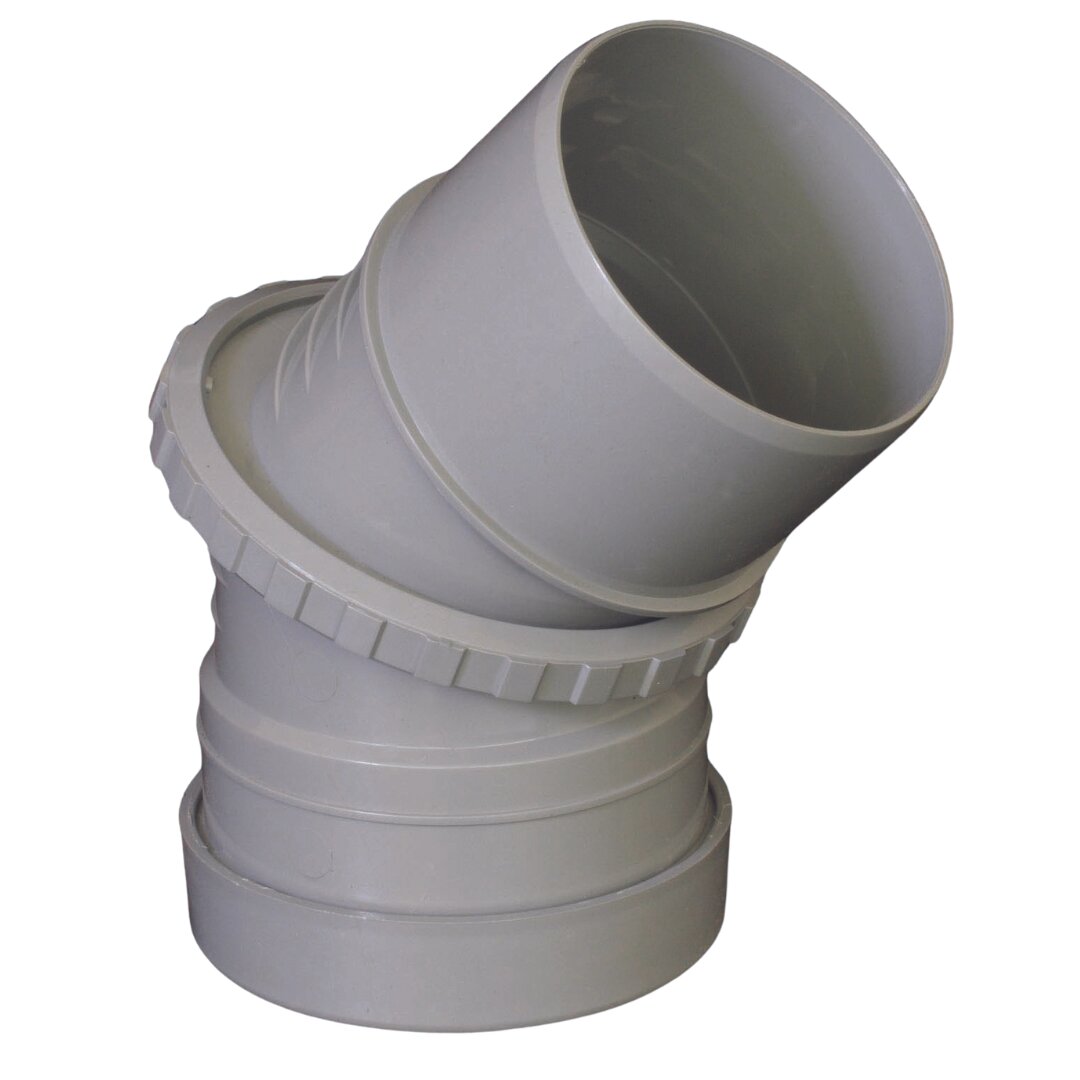
| Joint appearance | Visible O-ring housing (slightly bulkier) | Flush, clean joint line |
| Temperature resistance | Good (up to 75°C typical) | Slightly better (rigid bond unaffected by temperature) |
| Movement allowance | Yes — pipe can move slightly in the fitting | None — rigid connection |
| Expansion | Accommodated by design (pipe slides in fitting) | Must leave expansion gap + use expansion couplings |
| Noise | Can transmit noise through rigid pipe | Same — pipe material determines noise |
| Cost per fitting | Slightly higher (O-ring mechanism) | Slightly lower (simpler fitting + cement) |
| Availability | Universal — all merchants | Universal — all merchants |
When to Use Push-Fit
Bathrooms (General)
Push-fit is ideal for bathroom waste — basins, baths, showers. These connections occasionally need access for clearing blockages or modifying pipe runs. Push-fit makes this simple — disconnect the joint, clear the blockage, reconnect.
Kalsi’s waste push-fit system includes the complete range of pipes and fittings for domestic bathroom and kitchen waste plumbing.
Under-Basin Connections
The space under a basin is tight and awkward. Push-fit connections go together in seconds without needing access for a solvent cement brush. If the basin trap needs replacing or the pipe needs adjustment in the future, push-fit lets you do it without cutting.
DIY Projects
If you are not a trained plumber, push-fit is the safer choice. A rubber seal either seals or it does not — there is no ambiguity. Solvent cement badly applied can fail or create a weak joint that leaks weeks later.
Exposed Pipe Runs
Where pipes are accessible (in a utility room, under a raised floor, in a boiler cupboard), push-fit allows future modifications without cutting the pipe. This is particularly valuable in rental properties where the layout may change.
Temporary or Adaptive Installations
On rental properties, student accommodation, or buildings that are frequently modified, push-fit allows waste layouts to be changed without ripping everything out. The entire system can be reconfigured by disconnecting and reconnecting joints.
First Fix Before Tiling
In new builds and renovations, waste pipe is often installed before walls are tiled. Push-fit connections allow final adjustments after the tiles are on — invaluable when the exact position of a basin or shower trap needs to shift by a few millimetres.
When to Use Solvent Weld
Visible, External Pipe Runs
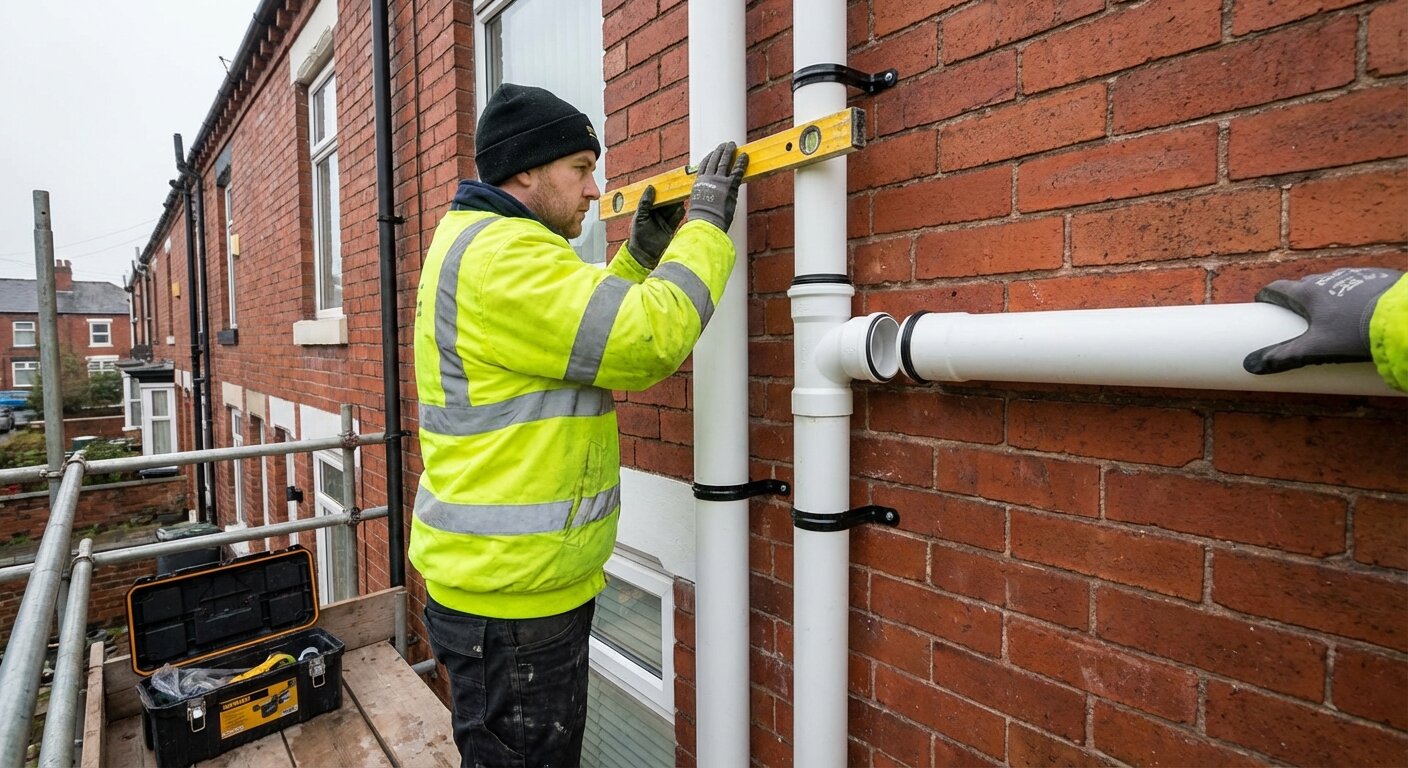
Where waste pipes are visible on the outside of the building (common on rear elevations), solvent weld gives a neater, slimmer appearance. The flush joint line looks more professional than the visible O-ring housing of push-fit fittings.
High-Temperature Waste
Waste from combination boilers, commercial dishwashers, and certain industrial processes can exceed 75°C. Solvent weld joints handle sustained high temperatures more reliably because the permanent bond does not rely on a rubber seal that could soften.
Maximum Leak Resistance
Where a leak would be particularly damaging (e.g., pipe running through a ceiling void above a finished room), the permanence of a solvent weld joint provides extra assurance. The chemical bond is as strong as the pipe material itself.
Soil Pipes (110mm)
The 110 mm soil stack above ground typically uses solvent weld for its rigidity and resistance to movement. The vertical pipe takes the weight of waste from upper floors, and the rigid joints prevent the stack from shifting. Kalsi’s solvent weld soil system covers all soil pipe requirements.
Long Horizontal Runs
On extended horizontal waste runs (common in ground-floor extensions), solvent weld provides rigidity that keeps the pipe aligned over its full length. Push-fit can allow slight movement at each joint, which over a 10 m run can create sag.
How Push-Fit Works
- Cut the pipe to length with a fine-toothed hacksaw
- Deburr the cut end (remove any rough edges that could damage the O-ring)
- Push the pipe into the fitting until it reaches the internal stop
- The rubber O-ring compresses against the pipe, creating a watertight seal
- To disassemble: press the release ring on the fitting and pull the pipe out
Key points:
- The pipe must be clean and smooth where it enters the fitting
- Do not use lubricant (it can degrade the seal over time)
- Mark the pipe at the correct insertion depth before pushing in
- Support the pipe with clips at regular intervals to prevent stress on joints
- Check that the O-ring is seated correctly in the fitting before assembly
How Solvent Weld Works
- Cut the pipe to length
- Deburr and chamfer the cut end (the chamfer helps the pipe enter the socket cleanly)
- Dry-fit first to check lengths and alignment
- Clean both the pipe end and the inside of the fitting socket with PVC cleaner
- Apply solvent cement to the pipe end (thin, even coat)
- Apply solvent cement inside the fitting socket
- Push the pipe fully into the socket with a quarter-turn (spreads the cement)
- Hold for 30 seconds — the solvent softens the PVC and they fuse together
- Allow 5–15 minutes before moving; full cure in 24 hours
Key points:
- Work quickly — the cement starts to set immediately
- If you get the angle wrong, you cannot adjust after 30 seconds
- Leave a 6 mm expansion gap at each joint (push fully in, then pull back 6 mm)
- Ensure adequate ventilation — solvent cement fumes are irritating
- Wipe excess cement immediately — once set, it cannot be removed cleanly
Pipe Sizes
Both push-fit and solvent weld are available in the standard waste pipe sizes:
| Size | Use |
|---|---|
| 32 mm | Basin, bidet, drinking fountain |
| 40 mm | Bath, shower, kitchen sink, washing machine, dishwasher |
| 50 mm | Multiple fixtures on a shared waste run |
And for soil systems:
| Size | Use |
|---|---|
| 110 mm | Soil stack (above ground), WC connection |
| 160 mm | Soil stack (large buildings), main vertical stack |
Kalsi’s Multiplex waste system provides an additional option for combined waste connections.
Cost Comparison
For a typical bathroom installation (basin + bath + shower):
| Component | Push-Fit | Solvent Weld |
|---|---|---|
| Pipe (32 mm + 40 mm, ~8 m total) | £12–24 | £10–20 |
| Fittings (bends, tees, traps) | £30–60 | £20–45 |
| Solvent cement + cleaner | — | £8–12 |
| Materials total | £42–84 | £38–77 |
| Labour time | 1–2 hours | 2–3 hours |
The material cost difference is marginal — typically less than £10 on a bathroom. The real cost difference is labour time — push-fit is 30–50% faster to install, which matters on commercial jobs and multi-bathroom projects. For a plumber charging £40–60 per hour, the labour saving on push-fit easily exceeds the slightly higher fitting cost.
Mixing Push-Fit and Solvent Weld
It is common to use both systems in the same installation:
- Solvent weld for the external soil stack and any visible external waste pipe
- Push-fit for internal waste connections under basins, baths, and sinks
Adaptors are available to transition between push-fit and solvent weld within the same pipe run. This “best of both” approach gives you the neat appearance of solvent weld where it is visible and the serviceability of push-fit where maintenance access matters.
Frequently Asked Questions
Should I use push-fit or solvent weld?
For most domestic bathrooms and kitchens, push-fit is the practical choice — faster, easier, and allows disassembly for maintenance. Solvent weld is preferred for external visible pipe runs, high-temperature waste, and maximum leak assurance. Both are equally accepted by Building Regulations.
Is push-fit waste pipe reliable?
Yes. Modern push-fit waste systems use high-quality rubber O-ring seals that provide a reliable watertight connection for the life of the pipe. Millions of push-fit installations across the UK work without issues. The key is clean, properly supported pipe pushed fully to the insertion depth.
Can I mix push-fit and solvent weld?
Yes. Adaptors are available to transition between push-fit and solvent weld within the same system. This is common where a solvent weld soil stack connects to push-fit waste runs from individual fixtures. Many professional plumbers use this mixed approach as standard.
Does push-fit waste pipe leak?
Not if installed correctly. The main causes of push-fit leaks are: pipe not pushed fully to the insertion depth, dirt or debris on the pipe surface preventing a seal, pipe not properly supported (sagging pulls the joint apart), or wrong pipe size in the fitting.
Which is better for kitchen waste?
Either works. Push-fit is faster and allows easy access for clearing fat blockages — a common requirement in kitchen waste pipes. Solvent weld is preferred if the waste runs through a visible external pipe. For under-counter connections, push-fit is almost always the more practical choice.
Can I use push-fit underground?
Push-fit waste fittings are designed for above-ground use. For underground drainage, use ring-seal push-fit pipe and fittings to BS EN 1401, which is a different system designed for burial loads. Kalsi’s underground drainage range covers all below-ground requirements.