Wall Panelling for Wet Rooms: IP Rating and Compliance
Yes, PVC wall panels can be used in wet rooms — they are inherently waterproof (PVC-U is impermeable to water) and are widely used in wet room installations across the UK in both domestic and commercial settings. However, wet rooms have specific requirements that go beyond a standard bathroom: the floor is the shower (no shower tray), so the walls must be waterproof from floor to ceiling, all panel joints must be sealed, and Building Regulations require the room to be tanked (waterproofed) behind the wall finish to prevent water reaching the building structure. PVC panels provide the visible waterproof surface; a separate tanking system behind the panels provides the secondary waterproof barrier.
A wet room is fundamentally different from a standard bathroom with a shower enclosure. In a standard bathroom, the shower tray contains the water and the wall panels only need to handle splashes. In a wet room, water flows across the entire floor and the walls are exposed to sustained, direct water contact at all heights. This raises the waterproofing standard significantly.
What Makes a Wet Room Different
| Feature | Standard Bathroom | Wet Room |
|---|---|---|
| Shower containment | Shower tray (raised lip) | Floor drain (no tray, no lip) |
| Wall water exposure | Splash zone only (mainly above shower tray) | Full wall height, sustained contact |
| Floor waterproofing | Shower tray is waterproof | Entire floor must be tanked |
| Wall waterproofing | Wall panels provide surface protection | Panels + tanking behind |
| Drainage | Standard shower waste | Floor-level drain with gradient to fall |
| Building Regulations | Standard bathroom plumbing | More rigorous waterproofing requirements |
The Two-Layer Waterproofing Approach
In a wet room, waterproofing is achieved in two layers:
Layer 1: Tanking Membrane (Behind the Panels)
A liquid-applied or sheet waterproof membrane applied to the wall substrate (plasterboard, plywood, or cement board) before the panels are installed. This creates a waterproof barrier at the structural level — even if water penetrates behind the panels (through a failed seal or damaged panel), it cannot reach the building structure.
Common tanking products:
- Liquid waterproofing membrane (brush-on or roller-applied) — typically two coats with reinforcing tape at joints and corners
- Self-adhesive waterproof membrane (sheet, applied to the wall)
- Cement-based tanking slurry
The tanking membrane extends from the floor up to at least the full height of the shower area — in a wet room, this means floor to ceiling on all walls.
Layer 2: PVC Wall Panels (The Visible Surface)
PVC panels provide the visible, cleanable, waterproof wall finish. They are fixed over the tanking membrane using adhesive or battens, with all joints and edges sealed with mould-resistant silicone sealant.
Why both layers? The panels provide day-to-day waterproofing. The tanking provides catastrophic waterproofing — protection against a failed sealant bead, a cracked panel, or water pressure that forces through a joint. In a wet room, where the water exposure is continuous and sustained, this belt-and-braces approach is the industry standard.
Building Regulations
Approved Document C (Site Preparation and Resistance to Contaminants and Moisture)
Part C requires that buildings are constructed to prevent moisture from reaching the building structure. In a wet room, this means:
- Walls must be protected from water penetration — tanking + waterproof surface finish
- Floor must be waterproofed and graded to drain (typically 1:60 to 1:80 fall to the drain)
- Substrate must be suitable for wet conditions — standard plasterboard is NOT suitable; use moisture-resistant board, cement board, or marine plywood
Approved Document B (Fire Safety)
The wall panels must meet the fire classification required for the room type:
- Domestic wet room: Typically Class C or D (BS EN 13501-1) is acceptable
- Commercial wet room (care home, hotel, gym): Class B may be required depending on fire risk assessment
- Check the specific fire classification of your chosen panel
Approved Document E (Sound)
In multi-occupancy buildings (flats), wet rooms with floor-level drainage may require acoustic consideration — water flowing across the floor to the drain can create noise transmitted through the floor structure.
IP Ratings: Clarifying the Confusion
IP (Ingress Protection) ratings are frequently mentioned in relation to wet room wall panels, but they are often misunderstood. IP ratings are a standard for electrical enclosures (BS EN 60529), not building materials. They rate how well an electrical product resists dust and water ingress.
IP Ratings Apply To:
- Bathroom lights (e.g., IP44, IP65)
- Extractor fans
- Electrical sockets and switches
- Shower units and pumps
IP Ratings Do NOT Apply To:
- Wall panels
- Tiles
- Tanking membranes
- Building materials generally
PVC wall panels do not have an IP rating because they are a building material, not an electrical enclosure. They are waterproof by material property (PVC-U is impermeable) rather than by enclosure rating. If a supplier quotes an IP rating for wall panels, they are either referring to the electrical accessories used with the panels or misapplying the standard.
What Does Apply to Wall Panels:
- BS EN 13245: PVC-U profiles for building applications
- BS EN 13501-1: Fire classification
- Material data: Water absorption (effectively zero for PVC-U)
Installation for Wet Rooms
Substrate Preparation
- Remove any existing wall covering down to the substrate
- If the substrate is standard plasterboard, replace with moisture-resistant board or cement board (standard plasterboard will degrade in a wet room even behind tanking)
- Fill any gaps, holes, or uneven areas
Tanking
- Apply the first coat of liquid tanking membrane to all walls (floor to ceiling)
- Press reinforcing tape into the wet membrane at all internal corners and wall-floor junctions
- Apply the second coat, covering the reinforcing tape
- Allow to cure fully (typically 24 hours)
- Test the membrane (some installers perform a flood test at this stage)
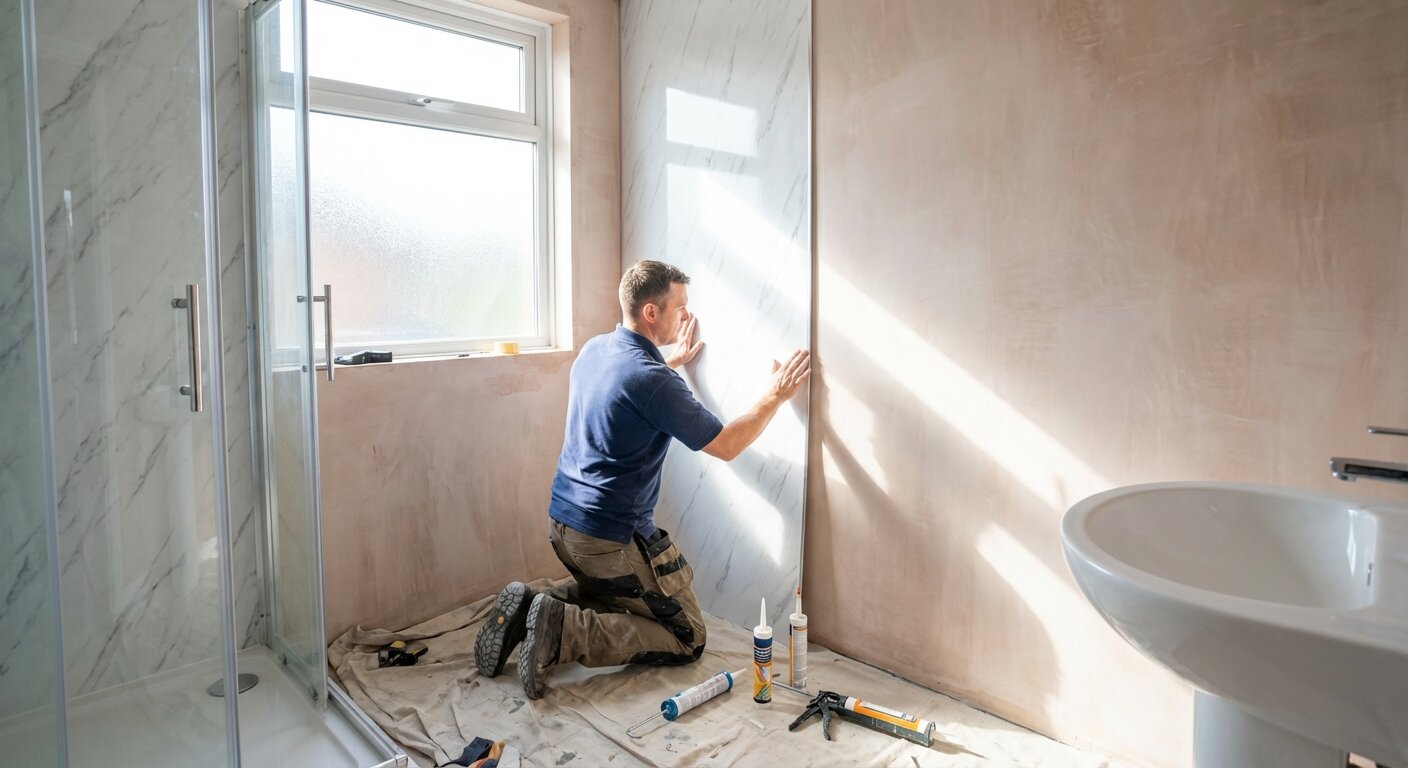
Panel Installation
- Fix timber battens over the tanking membrane at 400–600 mm centres (the batten method is preferred for wet rooms — it creates an air gap that allows any moisture to evaporate rather than being trapped behind the panels)
- Install edge trims at all corners and perimeter junctions
- Cut and fit panels, interlocking joints
- Seal every joint and edge with mould-resistant silicone sealant — this is more critical in a wet room than a standard bathroom
- Pay particular attention to the panel-to-floor junction — water will flow along this junction continuously
Floor-to-Wall Junction
This is the most critical detail in a wet room. The junction between the floor waterproofing and the wall tanking must be continuous — no gap, no interruption. The panel installation should overlap this junction, with silicone sealant providing the visible seal.
Common Wet Room Mistakes
| Mistake | Consequence | Prevention |
|---|---|---|
| Standard plasterboard used as substrate | Board degrades from moisture, even behind tanking | Use moisture-resistant or cement board only |
| No tanking behind panels | Water penetrates structure through failed panel seals | Always tank wet room walls before panelling |
| Tanking not taken to full ceiling height | Water reaches untanked area above splash zone | Tank floor to ceiling on all walls |
| Silicone sealing missed or incomplete | Water enters behind panels | Seal every edge, corner, penetration, and junction |
| Standard (non-mould-resistant) silicone used | Silicone goes mouldy within months | Use sanitary-grade anti-fungal silicone |
| Panels adhesive-fixed with no air gap | Trapped moisture behind panels cannot evaporate | Use batten method with air gap in wet rooms |
| No floor drain gradient | Water pools on the floor instead of draining | Gradient of 1:60 to 1:80 to the drain |
Panel Selection for Wet Rooms
Finish
Smooth panels are preferred for wet rooms — easier to clean when exposed to constant water and there is no texture to trap moisture or cleaning product residue.
Colour
Lighter colours show water marks and limescale less than dark colours. In a wet room with hard water, a light-coloured or stone-effect panel is the most practical choice.
Joints
If available, choose panels with click-fit joints for the tightest possible panel-to-panel seal. Tongue and groove is also suitable with proper silicone sealing at edges.
Frequently Asked Questions
Can wall panels be used in wet rooms?
Yes. PVC wall panels are inherently waterproof and are widely used in domestic and commercial wet rooms. However, wet rooms require tanking (a waterproof membrane) behind the panels as a secondary barrier, and all panel joints and edges must be sealed with silicone sealant.
Do wet room wall panels need a special IP rating?
No. IP ratings apply to electrical enclosures, not building materials. PVC wall panels are waterproof by material property — PVC-U is impermeable to water. There is no IP rating standard for wall panels.
Do I need to tank behind wall panels in a wet room?
Yes. The panels provide the visible waterproof surface, but a tanking membrane behind the panels provides secondary protection in case of sealant failure or panel damage. This two-layer approach is the industry standard for wet rooms.
What substrate should I use in a wet room?
Moisture-resistant plasterboard, cement board, or marine plywood. Standard plasterboard is NOT suitable — it will degrade from moisture even behind a tanking membrane and PVC panels.
Can I use the same panels in a wet room as a standard bathroom?
Yes — the panels are the same product. The difference is in the installation: wet rooms require tanking behind the panels, the batten method with an air gap is preferred, and silicone sealing must be more thorough and comprehensive.
Related Kalsi Products
- Wall Panelling Range — panels suitable for wet rooms
- Smooth Panels — preferred for wet room installations
- Colour Range — choose a practical wet room colour
- Installation Guides — wet room installation guidance
- Technical Resources — waterproofing and compliance data