Tongue and Groove vs Click-Fit: Wall Panel Fixing Methods
Wall panels connect using one of two joint systems: tongue and groove (T&G), where a protruding tongue on one panel slides into a recessed groove on the adjacent panel, or click-fit, where interlocking profiles snap together with an audible click. Both methods create a tight, water-resistant joint without screws, nails, or adhesive at the joint itself. The practical differences are in installation speed (click-fit is faster), joint tightness (click-fit is typically tighter), and the ability to disassemble (click-fit panels can be unclipped; T&G panels are harder to separate once fixed).
Understanding how panels connect matters because the joint type affects waterproofing, ease of installation, and future maintenance. In a bathroom or shower, the joint between panels is a potential water ingress point, so the joint system must be reliable. Both T&G and click-fit systems have been used successfully in millions of bathroom installations, but they work differently and have distinct advantages.
How Tongue and Groove Works
The Mechanism
One edge of the panel has a protruding tongue (a thin strip of material extending beyond the panel face). The opposite edge has a groove (a channel cut into the panel edge that receives the tongue from the adjacent panel).
During installation:
- Apply adhesive to the wall (or fix to battens)
- Position the first panel and secure it
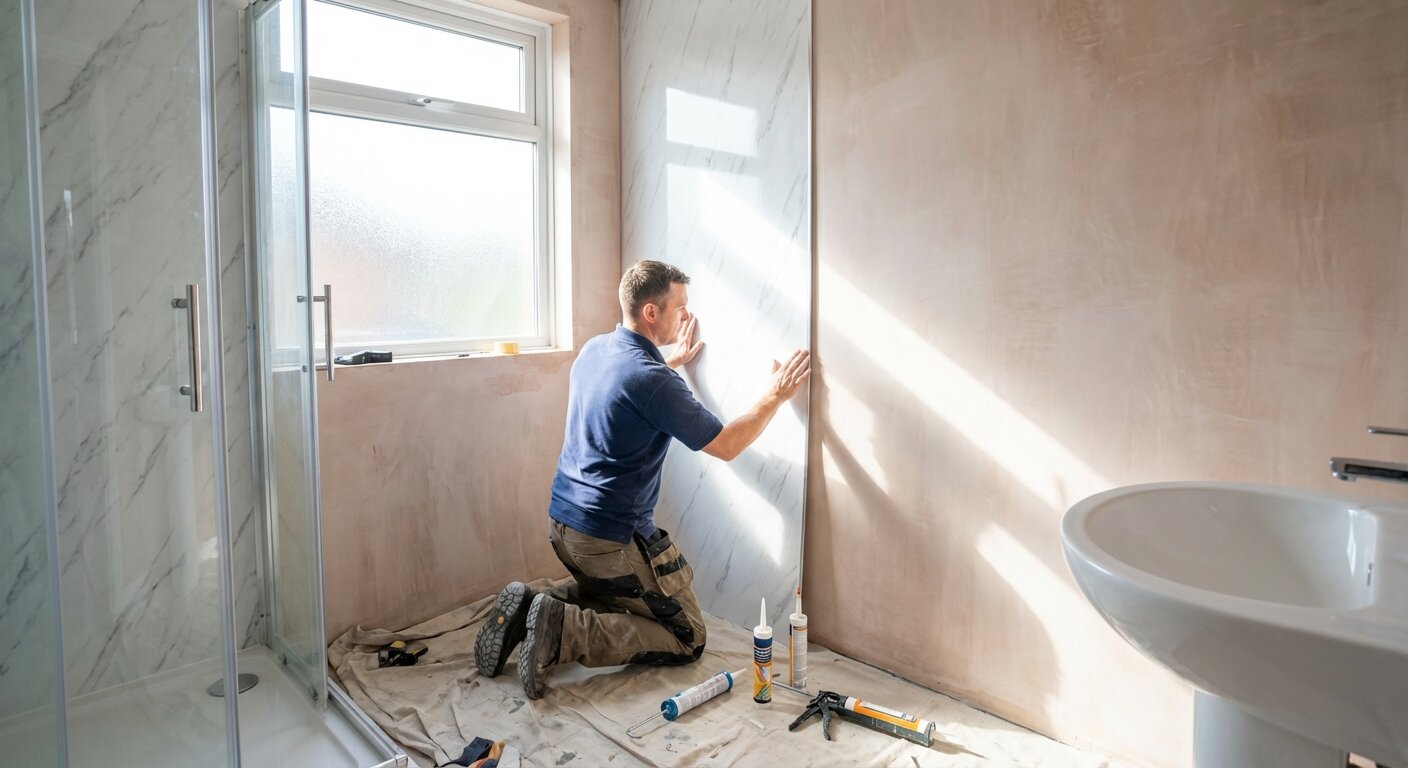
- Slide the second panel’s groove over the first panel’s tongue
- Push until the panel faces are flush
- Secure the second panel through its tongue edge (hidden by the next panel)
- Repeat across the wall
Joint Characteristics
- Joint tightness: Good when properly fitted. The tongue fills the groove, but the fit depends on manufacturing tolerance — some brands are tighter than others
- Water resistance: Good. Water runs down the face and over the joint without penetrating, provided the panels are pushed fully together
- Visibility: The joint line may be visible as a fine line on the panel face, depending on the panel design and colour
- Disassembly: Difficult. Once fixed to the wall (especially with adhesive), separating T&G panels often damages the tongue or groove
How Click-Fit Works
The Mechanism
Click-fit panels have profiled edges with a locking mechanism. One edge has a shaped hook or lip; the opposite edge has a corresponding channel or recess. The panels are angled together and pressed until the profiles engage with a definitive “click.”
During installation:
- Apply adhesive or fix battens to the wall
- Position and secure the first panel
- Angle the second panel and engage the bottom edge of the click profile
- Press or gently tap the panel until it clicks into place
- The locking mechanism holds the panels together mechanically
- Repeat across the wall
Joint Characteristics
- Joint tightness: Very good. The locking mechanism pulls panels together, creating a tighter joint than standard T&G
- Water resistance: Excellent. The mechanical lock compresses the joint, reducing the gap to near zero
- Visibility: Minimal. The tight lock means the joint line is less visible than a standard T&G joint
- Disassembly: Possible. Click-fit panels can be unclipped by reversing the installation angle — useful for replacing a damaged panel or accessing services behind the panels
Side-by-Side Comparison
| Feature | Tongue and Groove | Click-Fit |
|---|---|---|
| Installation method | Slide together | Angle and click |
| Speed of installation | Moderate | Fast |
| Joint tightness | Good | Very good |
| Water resistance | Good (relies on fit) | Excellent (mechanical compression) |
| Visible joint line | Fine line visible | Minimal or invisible |
| Disassembly | Difficult (may damage panels) | Possible (unclip and remove) |
| Replacement of single panel | Requires removing all panels from that point | Can remove and replace individual panels |
| Manufacturing tolerance | Varies — some brands fit tighter than others | Typically consistent (click gives feedback) |
| Adhesive at joint needed? | No (but adhesive on wall) | No (but adhesive on wall) |
| Suitable for showers? | Yes (with edge silicone sealing) | Yes (with edge silicone sealing) |
| Cost | Standard | Slight premium (5–15% more) |
Which Is Better for Bathrooms?
Both systems are suitable for bathrooms, including shower enclosures. The key waterproofing comes from the panel material itself (PVC is impermeable) and the edge sealing (silicone at all perimeter junctions), not from the panel-to-panel joint.
Choose Tongue and Groove If:
- You are working to a tight budget (T&G panels are typically 5–15% cheaper)
- The installation is permanent and unlikely to need future panel replacement
- You are familiar with T&G from other materials (timber cladding, flooring)
- The panel manufacturer only offers T&G in your chosen colour or finish
Choose Click-Fit If:
- You want the fastest possible installation
- Future access behind the panels may be needed (for plumbing, electrics)
- You may need to replace individual panels in future (rental properties, commercial)
- You want the tightest possible joint with the least visible seam
- You value the audible “click” feedback that confirms a proper joint (helpful for less experienced installers)
Installation Tips for Each System
Tongue and Groove Tips
- Check the fit before fixing: Dry-fit two panels together before applying adhesive. The tongue should slide into the groove with firm hand pressure — not loose, not impossibly tight
- Push panels fully home: An incompletely seated T&G joint leaves a gap that is visible and potentially allows water passage. Use a panel offcut against the panel face and tap with a rubber mallet to push panels fully together
- Fix through the tongue: When using screws or staples, fix through the tongue edge — the next panel’s groove covers the fixings, keeping the face clean
- Start from a straight edge: Begin the first panel with the groove edge into a corner trim and the tongue facing outward. Each subsequent panel adds by engaging its groove over the previous tongue
Click-Fit Tips
- Angle correctly: Most click-fit profiles require the new panel to be angled at about 20–30° before pressing into place. Read the manufacturer’s instructions — forcing at the wrong angle can damage the profile
- Listen for the click: The definitive click confirms a fully engaged joint. If the panel does not click, it is not properly seated — do not force it; reposition and try again
- Work in sequence: Click-fit panels must be installed in order. You cannot insert a panel in the middle of a run — always work from one side to the other
- Temperature matters: PVC is slightly less flexible in cold conditions. If installing in an unheated space during winter, allow panels to acclimatise to room temperature for a few hours before fitting — cold PVC is more brittle and the click profile may not engage as smoothly
Mixed Systems
Some manufacturers offer panels with T&G on the long edges and click-fit on the short edges (or vice versa). This is less common in wall panelling than in flooring, but it does exist. If using a mixed-profile panel, follow the manufacturer’s specific installation sequence.
It is also common to mix systems within a room — for example, click-fit panels on the shower walls (for the tightest joint and potential future replacement) and T&G on the remaining walls (for cost saving). There is no technical issue with mixing systems, provided each wall uses one consistent system.
Joint Visibility: Does It Matter?
On plain, solid-colour panels, the joint line between panels is visible regardless of the joint type — it appears as a fine vertical line where two panels meet. This is not a defect; it is inherent to panel construction.
On patterned panels (marble effect, tile effect, wood grain), the joint is less visible because the pattern provides visual distraction. Some premium panel ranges are designed with “seamless” joints where the pattern is continuous across panels, making the joint virtually invisible.
If joint visibility is a concern:
- Choose a patterned finish rather than a plain solid colour
- Use click-fit for the tightest possible joint
- Ensure panels are fully engaged during installation — even a 0.5 mm gap is visible on a plain surface
Frequently Asked Questions
How do wall panels connect?
Wall panels connect using tongue and groove (one panel’s tongue slides into the next panel’s groove) or click-fit (panels angle together and lock with a click). Both methods create a water-resistant joint without screws or adhesive at the joint itself.
Which is more waterproof — tongue and groove or click-fit?
Click-fit is typically tighter due to the mechanical locking compression. However, both systems are waterproof for bathroom use. The critical waterproofing comes from the PVC material itself and the silicone sealing at panel edges, not the panel-to-panel joint.
Can I replace a single click-fit panel?
Yes — click-fit panels can be unclipped by reversing the installation angle. Remove panels from one end until you reach the damaged panel, replace it, and refit the others. T&G panels are harder to remove without damage, often requiring the panel to be cut out and a new panel fitted with adhesive.
Do I need adhesive as well as the click-fit joint?
The click-fit joint holds panels together mechanically but does not fix them to the wall. You still need adhesive on the wall surface (or battens and screws) to hold the panels in position. The joint system is for panel-to-panel connection; the wall fixing is separate.
Can I tell the difference between T&G and click-fit once installed?
In most cases, no. Both systems produce a wall surface with fine vertical lines between panels. Click-fit joints are typically tighter (thinner visible line), but the difference is subtle once the panels are installed and sealed.
Related Kalsi Products
- Wall Panelling Range — T&G and click-fit options
- Smooth Panels — available in both joint types
- Embossed Cladding — premium textured panels
- Installation Guides — fitting instructions for both joint systems
- Wall Panelling Calculator — calculate quantities for your project