Common Drainage Problems & How to Fix Them
Drainage keeps blocking for one of five main reasons: fat, oil, and grease build-up (the leading cause in domestic drains), tree root intrusion, physical damage to the pipe (cracks, collapse, or displacement), incorrect gradient (too flat for self-cleansing), or foreign objects flushed into the system. In UK homes, the single biggest culprit is the accumulation of fats and oils from kitchen sinks, which solidify in the cool underground pipe and gradually narrow the bore until solid waste can no longer pass. The fix depends on the cause — some are DIY-friendly, others need professional intervention.
A well-designed and correctly installed drainage system should function without problems for decades. When issues do occur, they usually have identifiable causes and proven solutions. Understanding why drains fail helps you fix the immediate problem and prevent it from recurring.
Problem 1: Blocked Drains (Fats, Oil, and Grease)
Symptoms
- Toilets flush slowly or back up
- Sinks drain sluggishly
- Gurgling sounds from plugholes
- Foul smell from gullies
- Water backing up in the lowest fixture
Cause
Fat, oil, and grease (FOG) from cooking enter the drain via the kitchen sink. In the cold underground pipe, they solidify and coat the pipe walls. Over months and years, the coating thickens until the pipe bore is significantly reduced. Add some food debris, wet wipes, or sanitary products, and you have a solid blockage.
Fix
- Rod the drain — insert drain rods through the nearest inspection chamber and push through the blockage
- High-pressure jetting — a professional drain jetter blasts water at high pressure to cut through fat deposits and flush them to the sewer (£100–250 for a domestic call-out)
- Enzyme treatment — biological drain cleaner breaks down fat over time (preventative rather than curative)
Prevention
- Never pour cooking oil or fat down the kitchen sink — collect in a container and bin it
- Run hot water after washing greasy dishes
- Fit a grease trap under the kitchen sink (especially on commercial properties)
- Do not flush wet wipes, nappies, sanitary products, or cotton buds
Problem 2: Tree Root Intrusion
Symptoms
- Recurring blockages in the same section of drain
- Slow drainage that gets worse over time
- CCTV survey reveals roots visible inside the pipe
Cause
Tree roots seek moisture. If a drain joint has the slightest gap, leak, or seal failure, roots find it and grow into the pipe. Once inside, they expand, catch debris, and eventually block the pipe entirely. Willows, poplars, and oak trees are the worst offenders, but any tree within 5–10 m of a drain can cause problems.
Fix
- Mechanical root cutting — a specialist drain company uses a rotating cutter to slice through roots inside the pipe (£150–400)
- Re-lining — a cured-in-place liner (CIPP) seals the pipe from inside, covering the root entry points and preventing re-intrusion (£500–2,000 depending on length)
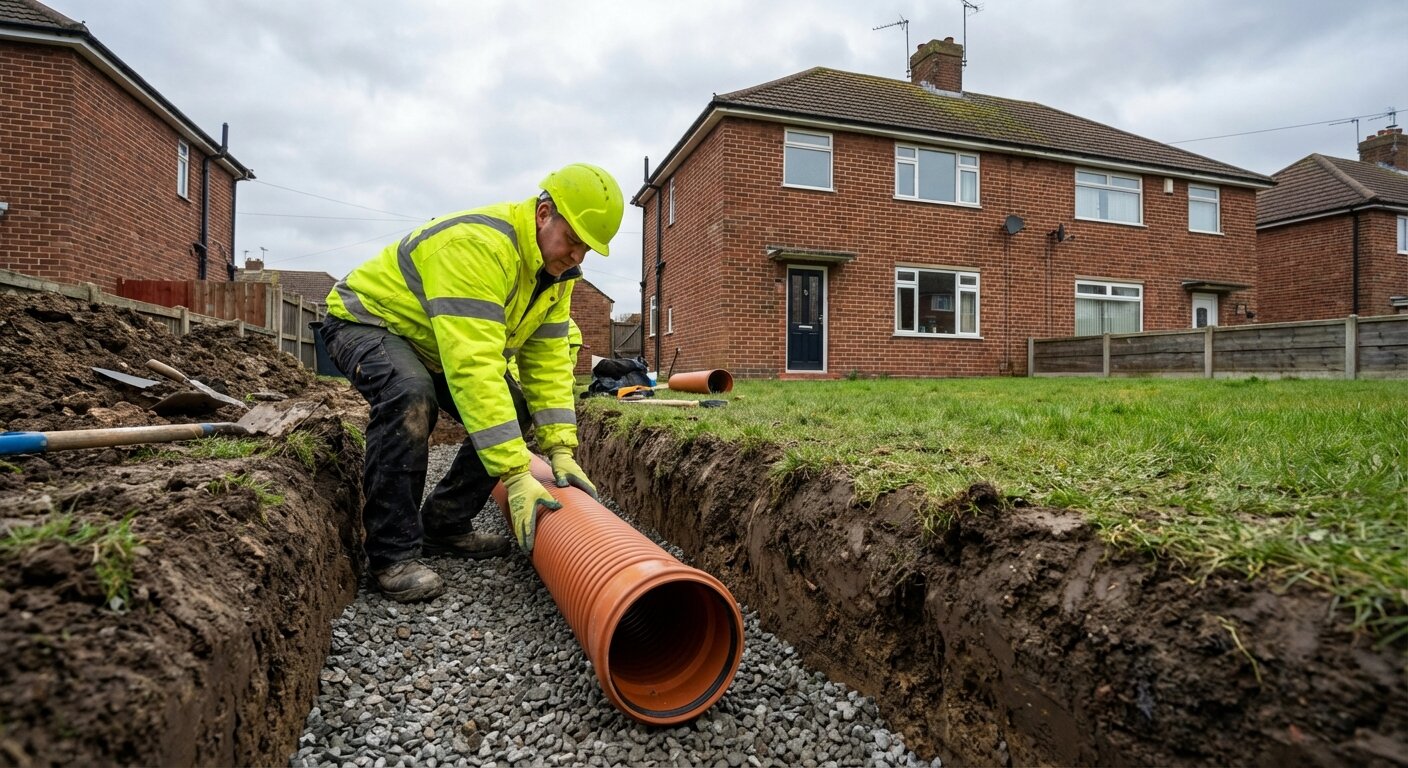
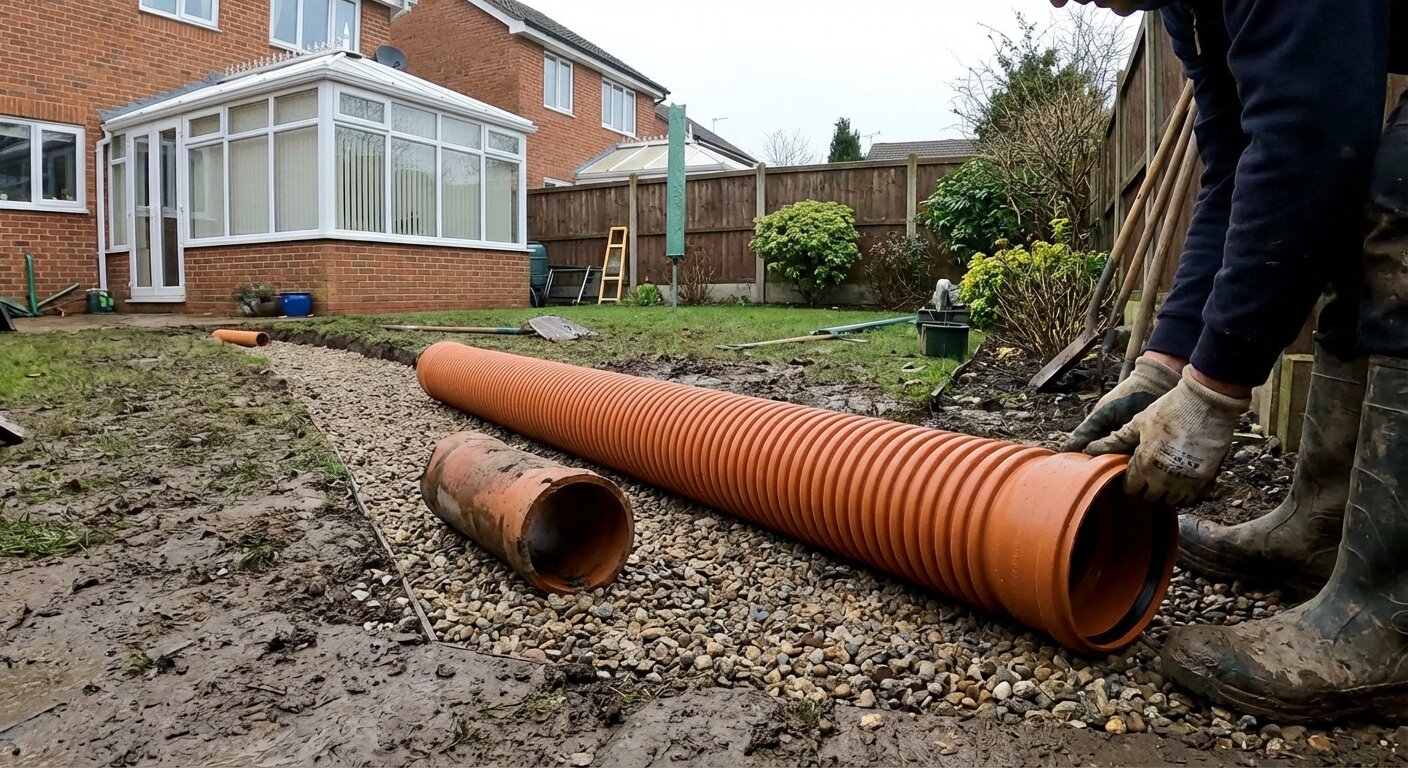
- Pipe replacement — for severe root damage, excavate and replace the affected section with new PVC-U pipe and sealed joints
Prevention
- Do not plant trees within 5 m of a drain run
- If trees already exist near drains, have a CCTV survey every 3–5 years
- Use modern ring-seal push-fit joints (less vulnerable than old mortar joints)
Problem 3: Pipe Damage (Cracks, Collapse, Displacement)
Symptoms
- Recurring blockages at the same point
- Sinkholes or depressions in the ground above the drain
- Foul smell near the drain route
- CCTV survey shows cracking, displacement, or collapse
Cause
- Ground movement — settlement, subsidence, or vibration from traffic
- Inadequate bedding — pipe resting on hard points rather than granular bed
- Heavy surface loads — vehicles driven over a drain with insufficient cover depth
- Old pipe material — pitch fibre deforms, cast iron corrodes, old clay joints fail
Fix
- Minor cracks/displacement — re-line with a CIPP liner (no excavation)
- Significant damage — excavate and replace the damaged section with new PVC-U
- Full collapse — excavate the entire affected length and relay with new pipe and proper bedding
Problem 4: Bad Smells
Symptoms
- Foul sewage odour near gullies, inspection chambers, or inside the house
- Smell worse in warm weather
Cause
| Source | Explanation |
|---|---|
| Dry trap | The water seal in a gully, U-bend, or trap has evaporated (common in unused bathrooms/gullies) |
| Failed seal | An inspection chamber cover is not seated properly, allowing gas to escape |
| Broken pipe | A crack in the pipe leaks sewer gas into the ground, which rises to the surface |
| Missing trap | A waste pipe discharges into the drain without a trapped gully |
| Blocked vent | The soil stack vent (at roof level) is blocked, causing air to draw through traps |
Fix
- Dry trap — run water into the fixture or gully to refill the trap
- Failed seal — refit the inspection chamber cover; replace the rubber seal if damaged
- Broken pipe — repair or replace the damaged section
- Missing trap — install a trapped gully on any untrapped connection
- Blocked vent — clear the soil stack vent (check for bird nests, debris)
Problem 5: Overflowing Gullies
Symptoms
- Water pools around a gully during rain or when fixtures discharge
- The gully grid has standing water visible
Cause
- Blocked gully — debris, leaves, silt, or fat accumulated in the gully trap
- Undersized gully — the gully cannot handle the flow rate
- Downstream blockage — the pipe leaving the gully is blocked or flat
Fix
- Remove the gully grate and clear debris from the trap
- Flush through with a hose to clear the outlet pipe
- If the gully is still slow, rod the pipe leaving the gully
- Replace the gully if it is cracked, damaged, or undersized
Problem 6: Drain Backflow (Sewage Coming Up)
Symptoms
- Sewage or dirty water comes up through ground-floor fixtures (toilet, shower tray, bath)
- Inspection chambers are full to ground level
- Occurs during or after heavy rain
Cause
- Sewer surcharge — the public sewer is overwhelmed (usually by heavy rainfall on combined systems) and backs up into your drain
- Downstream blockage — a blockage in the public sewer or your own drain between the house and the sewer
Fix
- During an event — do not use water; close off fixtures if possible
- After the event — contact your water company if the cause is a public sewer surcharge (they are responsible for the public sewer)
- Preventative — install a non-return valve or anti-flood valve on your drain to prevent backflow from the sewer
- Long-term — if surcharge is recurring, contact the water company about sewer capacity
When to Call a Professional
| Problem | DIY? | Professional? |
|---|---|---|
| Unblocking a gully | ✓ | |
| Rodding a simple blockage | ✓ (if you have drain rods) | |
| Persistent or recurring blockage | ✓ (CCTV survey + jetting) | |
| Tree root intrusion | ✓ (root cutting + relining) | |
| Bad smell from unknown source | ✓ (drain survey) | |
| Sewer backflow | ✓ (water company + specialist) | |
| Collapsed drain | ✓ (excavation + replacement) |
Frequently Asked Questions
Why does my drainage keep blocking?
The most common causes are fat/grease build-up from kitchen waste, tree root intrusion through damaged joints, flushing inappropriate items (wipes, sanitary products), and insufficient pipe gradient. A CCTV drain survey identifies the specific cause and guides the correct solution.
How much does it cost to unblock a drain?
A professional drain unblocking (jetting) typically costs £100–250 for a standard domestic call-out. If a CCTV survey is needed, add £150–300. Root cutting is £150–400. Pipe replacement (excavation) starts at £500+ depending on length and depth.
Can I unblock a drain myself?
Simple blockages can be cleared with drain rods available from DIY stores (£20–40). Insert the rods through the nearest inspection chamber and push through the blockage. If rodding does not clear it, or the blockage recurs within weeks, call a professional with jetting equipment and a CCTV camera.
How do I stop tree roots blocking my drain?
Preventatively, avoid planting trees within 5 m of drain runs. For existing tree/drain conflicts, root cutting followed by pipe relining (CIPP) seals the entry points. In severe cases, the pipe must be replaced and the tree’s roots managed or the tree removed.
What causes a foul smell from drains?
Usually a dry trap (water seal evaporated), a failed inspection chamber seal, a cracked pipe, or a blocked soil stack vent. Run water into unused gullies and fixtures to refill traps. Check inspection chamber covers are seated correctly. If the smell persists, a drain survey is needed to find the source.