Commercial Wall Panelling: Care Homes, Hotels and More
The best wall panelling for care homes is PVC-U panelling with a smooth, non-porous surface that can be cleaned with standard disinfectants, installed without grout joints where bacteria can harbour, and specified to meet the fire performance requirements of Approved Document B. PVC wall panels are now widely used in care homes, hotels, hospitals, schools, student accommodation, and public buildings because they deliver the combination of hygiene, durability, speed of installation, and low maintenance that commercial environments demand — at a significantly lower cost than ceramic tiling.
Commercial wall finishes face demands that domestic bathrooms do not. They must withstand heavy daily cleaning with industrial chemicals, resist damage from wheelchairs, trolleys, and heavy use, meet stringent fire safety standards, and maintain their appearance over years of intensive use. PVC wall panelling meets all of these requirements, which is why it has largely replaced tiles as the preferred wall finish in new-build and refurbished commercial washrooms across the UK.
Why Commercial Environments Choose Panels
Hygiene: The Primary Reason
In care homes, hospitals, and food preparation areas, hygiene is non-negotiable. Wall surfaces must be easy to clean, resistant to bacterial growth, and capable of withstanding regular disinfection.
Why panels outperform tiles on hygiene:
- No grout joints: Grout is porous, absorbs moisture, and harbours bacteria and mould. PVC panels have no grout — the surface is continuous and non-porous
- Chemical resistance: PVC-U resists most commercial cleaning agents and disinfectants without surface degradation
- Wipe-clean surface: A single pass with a damp cloth and disinfectant cleans the entire surface. No scrubbing grout lines
- Antimicrobial options: Some PVC panels include antimicrobial additives that inhibit bacterial growth on the surface
Speed of Installation
Commercial projects run on tight schedules. Every day of construction delays opening, increases costs, and disrupts operations.
| Installation Method | Time for 50 m² Washroom |
|---|---|
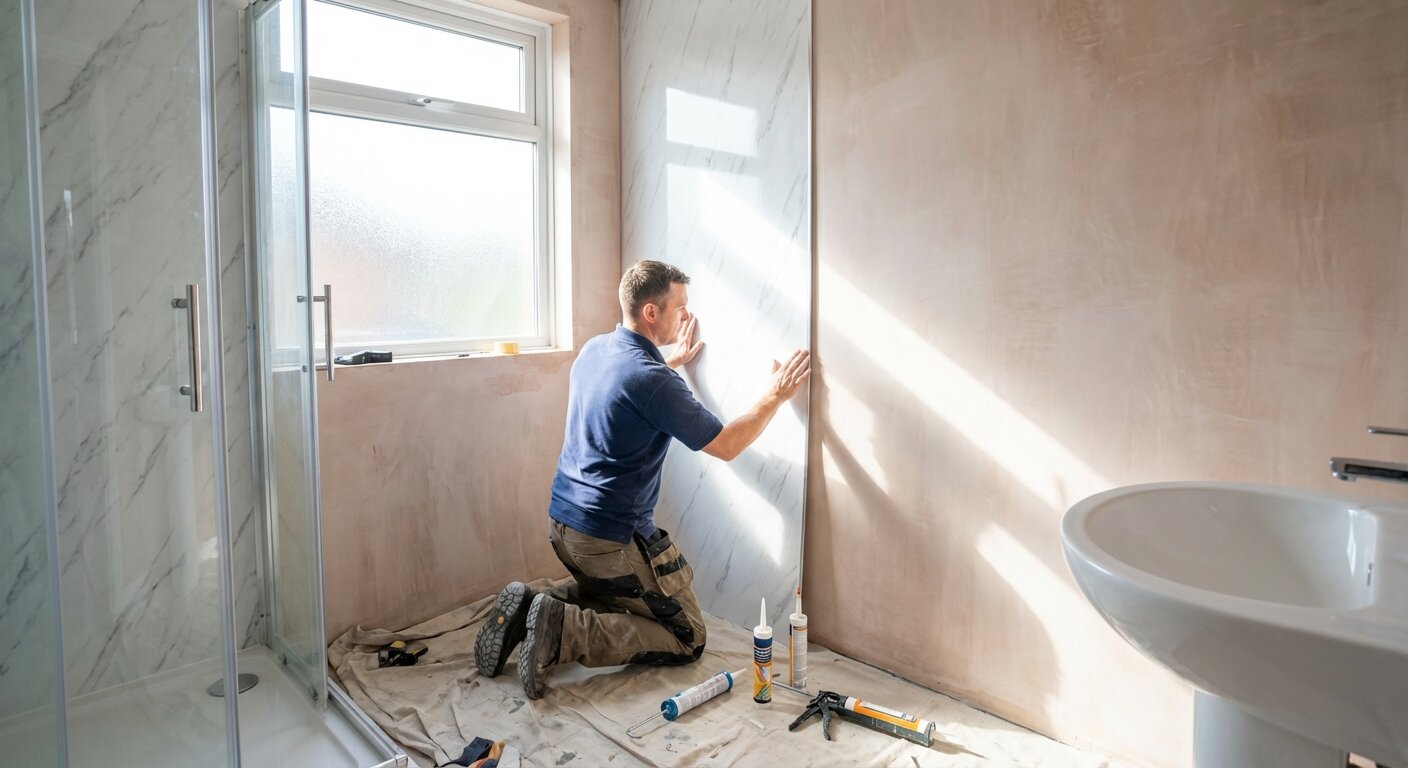
| PVC wall panels | 1–2 days |
| Ceramic tiles | 5–7 days |
| Hygienic wall cladding (specialist) | 2–3 days |
Panels install 3–5× faster than tiles. For a hotel refurbishing 20 bathrooms, this means the project completes weeks earlier.
Cost-Effectiveness
| Cost Element | PVC Panels | Ceramic Tiles |
|---|---|---|
| Materials per m² | £15–40 | £25–80 |
| Labour per m² | £10–25 | £25–50 |
| Maintenance (annual) | Minimal | Grout repair/regrouting |
| Total installed per m² | £25–65 | £50–130 |
Over a typical 15-year lifecycle, the total cost of ownership (including maintenance) for panels is approximately 40–60% less than tiles.
Sector-Specific Requirements
Care Homes
Care home bathrooms and washrooms face unique challenges:
- Frequent cleaning — surfaces cleaned multiple times daily
- Mobility equipment — wheelchairs, hoists, and walking frames can impact walls
- Infection control — Care Quality Commission (CQC) inspectors assess hygiene standards
- Resident dignity — bathrooms should look clean, modern, and welcoming
Panel specification for care homes:
- Smooth finish (easier to clean than textured)
- Light, warm colours (welcoming, non-institutional)
- Wall-to-ceiling coverage (no exposed plaster for moisture to attack)
- Silicone sealing at all edges and fixtures
- Consider impact-resistant panels (thicker gauge) at wheelchair height
Hotels and Hospitality
Hotel bathrooms must balance aesthetics with durability:
- Guest expectations — the bathroom is often the first thing guests judge
- Turnaround speed — rooms must be cleaned quickly between stays
- Maintenance windows — refurbishment must minimise room downtime
Panel specification for hotels:
- Premium finishes — marble effect, stone effect, double embossed for luxury feel
- Consistent specification across all rooms (bulk purchasing reduces cost)
- Quick-fit installation method for bathroom pod construction
- Consider colour combinations that align with brand identity
Healthcare (Hospitals, Clinics, Dental Surgeries)
Healthcare environments have the most stringent hygiene requirements:
- NHS Estates guidance specifies seamless, non-porous wall finishes in clinical areas
- Infection Prevention and Control (IPC) teams require surfaces that can be decontaminated
- Chemical resistance — walls must withstand chlorine-based disinfectants, hydrogen peroxide, and other clinical cleaning agents
Panel specification for healthcare:
- Smooth, sealed joints (minimum silicone at all panel junctions)
- Chemical-resistance certification
- Light colours for visibility of contamination
- Fire Class B-s1, d0 or better where required by the fire risk assessment
Schools and Education
School washrooms endure high-volume use and occasional vandalism:
- Impact resistance is a priority
- Easy graffiti removal — PVC surfaces can be cleaned of most marker pen and paint
- Bright, cheerful colours for younger age groups
- Budget-conscious — panels offer best value for large-scale washroom refurbishment
Student Accommodation
Similar to rental properties but at scale:
- Speed of summer turnaround — all maintenance completed in the vacation window
- Durability — panels withstand student-level care (or lack of it)
- Standardisation — same specification across hundreds of rooms reduces cost and simplifies maintenance
Fire Safety Compliance
Fire performance is the most critical compliance requirement for commercial wall panelling. Approved Document B (Fire Safety) sets requirements for wall and ceiling linings in different building types.
Fire Classification
PVC wall panels are tested to BS EN 13501-1 and classified as:
| Class | Description | Typical Application |
|---|---|---|
| B-s1, d0 | Very limited contribution to fire, low smoke, no flaming droplets | Required in escape routes, high-risk buildings |
| C-s3, d2 | Limited contribution to fire | Acceptable in many commercial applications |
| D-s2, d0 | Some contribution to fire | Lower-risk areas only |
Care homes and hotels typically require Class B or C linings in corridors, escape routes, and communal areas. Individual rooms may accept Class C or D depending on the fire risk assessment.
Always check the specific fire classification of the panel you are specifying. Not all PVC panels achieve the same fire rating — it depends on the formulation, thickness, and any fire-retardant additives.
Fire Risk Assessment
Under the Regulatory Reform (Fire Safety) Order 2005, the “responsible person” (building owner or manager) must conduct a fire risk assessment. The wall lining specification is part of this assessment. Work with your fire risk assessor to confirm the required fire classification for each area before specifying panels.
Specification Checklist
When specifying PVC wall panelling for a commercial project:
| Requirement | What to Check |
|---|---|
| Fire classification | BS EN 13501-1 rating suitable for the building type and location |
| Chemical resistance | Compatible with the cleaning agents used on site |
| Impact resistance | Panel thickness and rigidity suitable for the expected use |
| Colour and finish | Aligned with design requirements and brand identity |
| Installation method | Adhesive, battens, or mechanical fixing (depends on substrate) |
| Accessibility | Panels accessible for replacement if damaged |
| Compliance documentation | Test certificates, declarations of performance available |
| Warranty | Manufacturer warranty covering the intended application |
Frequently Asked Questions
What wall panelling for care homes?
PVC-U wall panelling with a smooth, non-porous surface, suitable fire classification (typically Class B or C to BS EN 13501-1), and resistance to commercial cleaning agents. Smooth panels are preferred for hygiene — no textured surface for bacteria to harbour in. Light, warm colours create a welcoming, non-institutional environment.
Do PVC wall panels meet fire regulations?
Yes, when correctly specified. PVC panels are tested to BS EN 13501-1 and classified according to their fire performance. Different products achieve different ratings — always check the specific classification of the panel you are specifying and confirm it meets the requirements of your fire risk assessment.
Are PVC panels suitable for hospitals?
Yes. Many NHS and private healthcare facilities use PVC wall panelling in washrooms, utility rooms, and clinical areas. The key requirements are a non-porous surface, chemical resistance to clinical disinfectants, and seamless joints. Specialist hygienic cladding systems (a premium tier of PVC panelling) are available for the most demanding clinical environments.
How long do commercial wall panels last?
15–25 years in commercial use, depending on the intensity of use and cleaning regime. In care homes and hotels with daily cleaning, 15–20 years is typical. In lower-use commercial environments (offices, reception areas), 20+ years is achievable.
Can panels be replaced individually?
Yes. Damaged panels can be removed and replaced without disturbing adjacent panels. This is a significant advantage over tiles, where replacing one tile often damages the surrounding tiles and grout.
Related Kalsi Products
- Wall Panelling Range — full commercial and domestic range
- Smooth Panels — preferred for hygiene-critical applications
- Embossed Cladding — premium finishes for hospitality
- Colour Range — full colour and finish options
- Technical Resources — fire test certificates and compliance data