Shiplap vs Weatherboard Cladding: What Is the Difference?
The difference between shiplap and weatherboard cladding lies primarily in their profile design, how boards overlap, and the visual effect they create on a façade. Shiplap uses a rebated or tongued joint where boards sit flush against one another, producing a clean, contemporary finish with a subtle shadow line. Weatherboard — also called featheredge or lap cladding — features tapered boards that overlap from the bottom up, creating a more pronounced stepped profile with deeper shadow lines that suit traditional and coastal architectural styles.
Both profiles are available in PVC-U, timber, and composite materials, and both deliver effective weather protection when installed correctly. Choosing between them depends on the look you want, the building’s architectural context, and the level of ongoing maintenance you are prepared to accept.
Understanding the Two Profiles
Shiplap Cladding
Shiplap boards are machined with a rebate (a stepped notch) along the top and bottom edges. When one board is placed above another, the rebate locks the two together so the face of the cladding sits in a single plane. The result is a flat, uniform wall surface broken only by narrow shadow lines at each joint.
Key characteristics of shiplap cladding include:
- Flat face appearance — boards sit in the same plane, giving a sleek, modern look
- Tongued or rebated joint — provides a mechanical interlock that resists wind-driven rain
- Narrow shadow lines — subtle rather than dramatic, suiting contemporary designs
- Available in PVC-U, timber, and composite — PVC-U shiplap is the lowest-maintenance option
Shiplap is sometimes referred to as “channel cladding” or “V-joint cladding” depending on the exact profile detail, though these are technically slightly different. True shiplap has a simple rebated overlap without a decorative groove.
Weatherboard Cladding
Weatherboard — known in some regions as clapboard, bevel siding, or lapped cladding — uses boards that taper from a thick bottom edge to a thin top edge. Each board overlaps the one below it by approximately 30–40 mm, shedding water away from the joints.
Key characteristics of weatherboard cladding include:
- Tapered profile — thicker at the bottom, thinner at the top
- Pronounced shadow lines — the overlap creates deep, horizontal shadows
- Traditional aesthetic — associated with New England, coastal, and heritage architecture
- Excellent water shedding — the angled face naturally directs water away from joints
- Available in PVC-U and timber — PVC-U weatherboard replicates the look without the rot risk
Weatherboard is the classic profile seen on seaside cottages, barn conversions, and Arts-and-Crafts-style homes throughout the UK.
Head-to-Head Comparison
| Feature | Shiplap Cladding | Weatherboard Cladding |
|---|---|---|
| Profile shape | Flat boards with rebated overlap | Tapered boards with lapped overlap |
| Shadow line | Subtle, narrow | Deep, pronounced |
| Aesthetic | Contemporary, clean | Traditional, characterful |
| Weather resistance | Good — rebate resists wind-driven rain | Excellent — angled face sheds water naturally |
| Typical board depth | 150–170 mm | 150–200 mm |
| Installation | Bottom-up; fix through face or secret-nail | Bottom-up; face-fix through overlap |
| PVC-U availability | Yes — wide colour range | Yes — typically fewer colour options |
| Maintenance (PVC-U) | Occasional wash only | Occasional wash only |
| Maintenance (timber) | Repaint/stain every 3–5 years | Repaint/stain every 3–5 years |
| Best suited to | New builds, modern extensions, garden rooms | Coastal properties, heritage renovations, rural settings |
Visual Impact and Architectural Context
The most important distinction between these two profiles is the look they deliver from the street.
When to Choose Shiplap
Shiplap suits projects where a clean, modern appearance is the priority. Its flat face and minimal shadow lines work well on:
- Contemporary new builds — where crisp lines complement large glazed areas
- Garden rooms and home offices — where a neat, uniform finish keeps the design simple
- Extensions on modern properties — where the cladding needs to match an existing flat-faced render or panel system
- Commercial frontages — where a professional, unfussy look is required
In PVC-U, shiplap is available in woodgrain and smooth finishes across a wide colour palette, from white and cream through to anthracite grey, black, and various woodgrain effects such as golden oak and rosewood.
When to Choose Weatherboard
Weatherboard is the natural choice for projects where character and tradition matter:
- Coastal and seaside properties — the classic clapboard look is synonymous with British coastal architecture
- Period property renovations — weatherboard sympathetically replaces deteriorating original timber
- Barn conversions and rural buildings — the profile complements agricultural and heritage settings
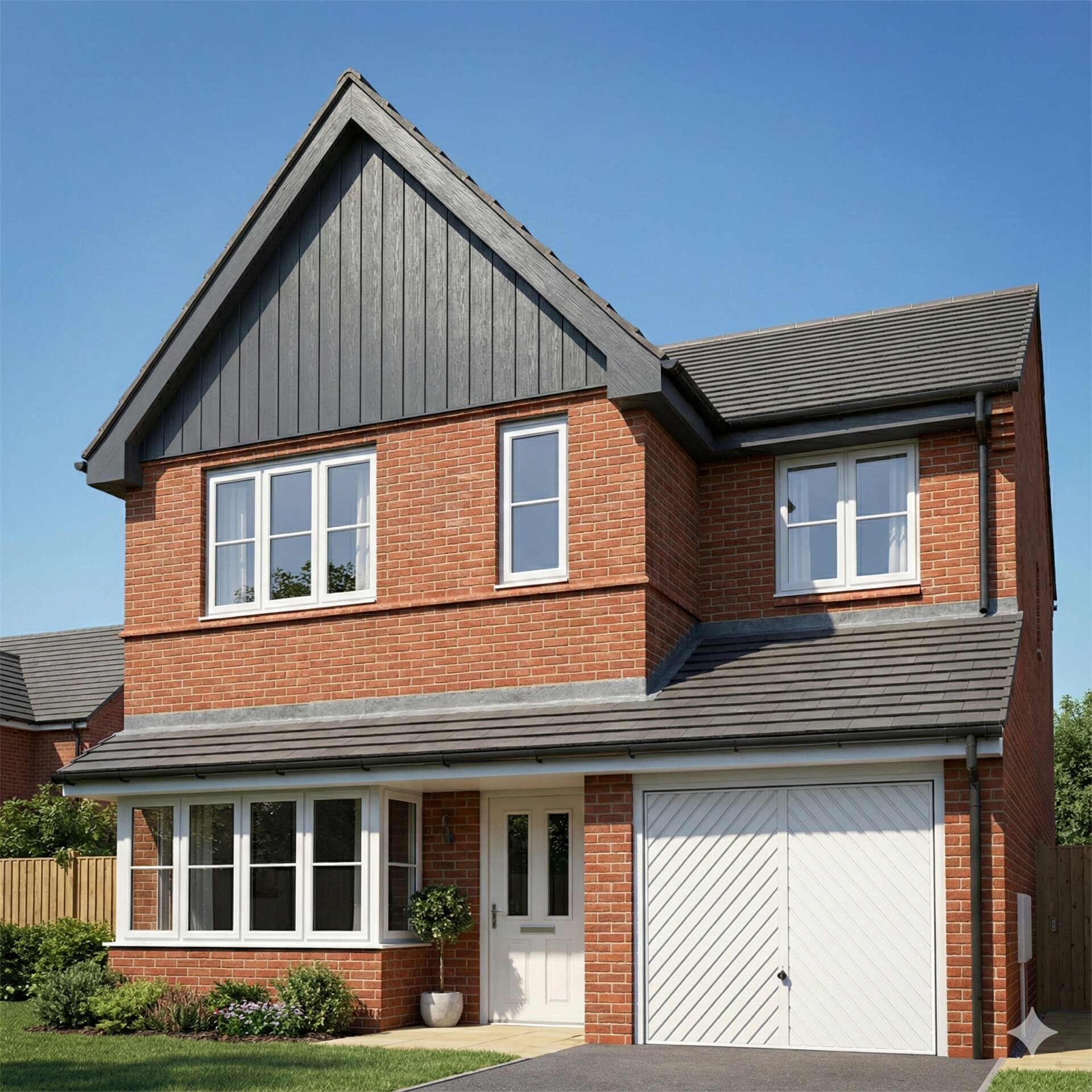
- Feature walls and gable ends — weatherboard can be used as an accent on otherwise rendered or brick facades
PVC-U weatherboard faithfully replicates the tapered profile of traditional timber without the ongoing maintenance burden of sanding, priming, and repainting every few years.
Material Options: PVC-U, Timber, or Composite?
Both shiplap and weatherboard profiles are manufactured in several materials. The material you choose has a significant impact on lifespan, maintenance, and total cost of ownership.
PVC-U Cladding
PVC-U is the most popular material for both profiles in the UK market. Boards are extruded from unplasticised polyvinyl chloride with UV stabilisers and colour pigments added during manufacture.
- Lifespan: 25–40 years with minimal maintenance
- Maintenance: Wash with warm soapy water once or twice a year
- Rot and insect resistance: Immune — PVC-U does not decay or attract woodworm
- Colour stability: Modern co-extruded boards hold their colour well; look for products with a minimum 10-year colour-fast guarantee
- Fire rating: Typically Euroclass E or D-s2,d0 depending on formulation
Timber Cladding
Traditional timber cladding — typically western red cedar, larch, or treated softwood — offers a natural aesthetic but demands regular upkeep.
- Lifespan: 15–30 years depending on species, treatment, and maintenance schedule
- Maintenance: Sand and repaint or re-stain every 3–5 years; replace damaged boards as needed
- Rot and insect resistance: Requires pressure treatment or natural durability (Class 1–2 species)
- Fire rating: Combustible unless treated with fire-retardant coatings
Composite Cladding
Composite boards blend wood fibres or flour with polymers and binding agents. They offer a middle ground between timber’s natural look and PVC-U’s low maintenance.
- Lifespan: 25–30 years
- Maintenance: Low — occasional washing; no painting required
- Weight: Heavier than PVC-U, which can affect handling and installation speed
- Cost: Typically the most expensive of the three options
Installation Considerations
Both profiles follow similar installation principles, but there are important differences in fixing methods.
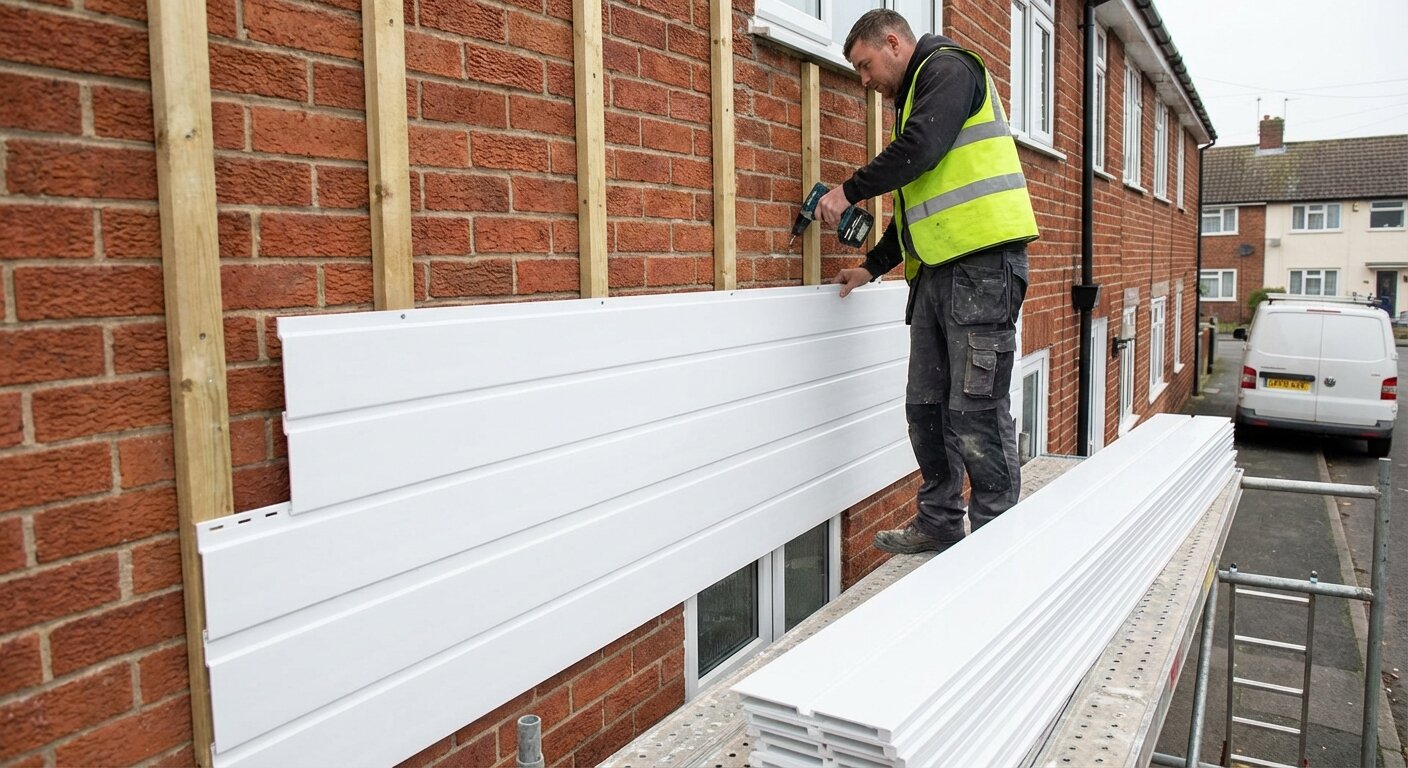
Shiplap Installation
- Fix battens vertically at 400–600 mm centres to create the ventilation cavity (minimum 25 mm behind the boards as recommended by BS 8104 and Approved Document C)
- Start at the bottom with a starter strip or the first board slightly below the damp-proof course
- Interlock boards by sliding the rebate of the upper board over the lower board’s top edge
- Fix through the face with stainless steel nails or screws at each batten crossing, or use secret nailing through the rebate where the profile allows
- Use external corner trims and J-channels to finish edges and openings neatly
Weatherboard Installation
- Fix battens vertically at 400–600 mm centres to create the ventilation cavity
- Install a tilting fillet (a thin wedge) at the base to kick the first board out to the correct angle
- Fix each board from the bottom up, ensuring a consistent overlap (typically 30–40 mm)
- Face-fix with stainless steel nails driven through the overlap zone so fixings are covered by the board above
- Trim corners with purpose-made corner pieces or mitred boards
For both profiles, maintaining a ventilation gap behind the cladding is critical to prevent moisture build-up within the wall construction. Refer to our guide on cladding ventilation gaps for detailed technical advice.
Performance in UK Weather Conditions
The UK’s temperate maritime climate — with its frequent rain, occasional frost, and variable wind speeds — puts real demands on external cladding. Both shiplap and weatherboard in PVC-U are well suited to these conditions, but their performance characteristics differ slightly:
- Wind-driven rain: Weatherboard’s angled face sheds water more actively; shiplap’s rebated joint resists penetration through mechanical interlock. Both perform well when installed over a correctly detailed ventilated cavity.
- Thermal movement: PVC-U expands and contracts with temperature changes. Both profiles accommodate this through their joint design, but installers should allow appropriate expansion gaps at abutments (typically 5–8 mm per 5 m length depending on manufacturer guidance).
- UV exposure: Both profiles are equally affected by UV. Choose boards with co-extruded caps or through-coloured formulations for the best long-term colour retention.
- Frost resistance: PVC-U is unaffected by freeze-thaw cycles, giving it a clear advantage over timber in frost-prone locations.
Cost Considerations
While we do not quote specific prices — as these vary by supplier, region, and project volume — the general cost hierarchy for UK cladding projects is:
- PVC-U shiplap — typically the most affordable per square metre
- PVC-U weatherboard — marginally more expensive due to the tapered extrusion process
- Timber shiplap or weatherboard — similar material cost to PVC-U but significantly higher lifetime cost due to maintenance
- Composite shiplap — the highest material cost, offset by low maintenance
When budgeting, remember to include battens, fixings, trims, corner pieces, and any necessary breather membrane or insulation upgrades, as these can add 20–30% to the cladding material cost alone.
Frequently Asked Questions
Can I mix shiplap and weatherboard on the same building?
Yes, and this is an increasingly popular design technique. Using weatherboard on the ground floor and shiplap on the upper storey — or weatherboard on a feature gable with shiplap elsewhere — creates visual interest and can help define different zones of a façade.
Which profile is easier to install?
Shiplap is generally considered slightly easier to install because the rebated joint self-aligns the boards. Weatherboard requires more care to maintain consistent overlap spacing across a run. Both are straightforward for competent installers.
Do I need planning permission to clad my house?
In most cases, adding cladding to an existing dwelling falls under permitted development rights, provided the materials are similar in appearance to the existing exterior. However, properties in conservation areas, listed buildings, and those subject to Article 4 directions may require planning permission. Always check with your local planning authority before starting work.
Is PVC-U cladding suitable for coastal environments?
Absolutely. PVC-U is unaffected by salt spray, will not corrode, and requires no additional protective treatments in coastal locations. This makes it an excellent alternative to timber, which can deteriorate rapidly in salt-laden air without diligent maintenance.
How long does PVC-U cladding last?
With proper installation and an occasional wash, PVC-U shiplap and weatherboard cladding typically lasts 25–40 years. Many manufacturers offer guarantees of 10–20 years on colour stability and structural performance.
Explore Kalsi’s Cladding Range
Kalsi Plastics manufactures both shiplap and weatherboard profiles in a range of colours and finishes suitable for residential and commercial projects across the UK. To find the right profile for your project: