External PVC Cladding: Why It Is Replacing Timber
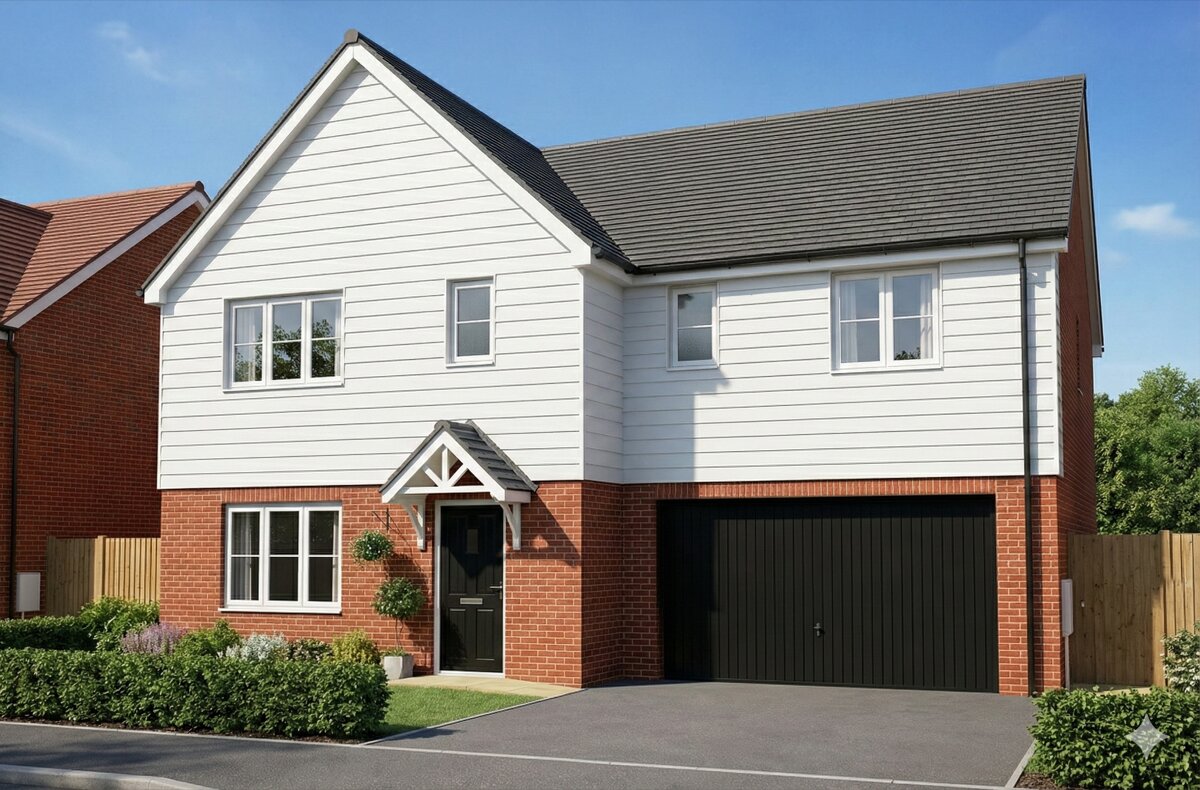
PVC cladding is widely considered a better choice than wood for most UK external cladding applications. It offers superior durability, requires virtually no maintenance beyond an occasional wash, is immune to rot and insect attack, and delivers a lower total cost of ownership over its 25–40 year lifespan. While timber cladding retains a loyal following for its natural appearance, the practical advantages of modern PVC-U cladding have made it the default specification for new builds, extensions, garden rooms, and renovation projects across the country.
This guide explains exactly why the shift from timber to PVC-U is happening, compares the two materials across every metric that matters, and helps you decide which is right for your next project.
The Scale of the Shift
The UK external cladding market has changed dramatically over the past two decades. Timber cladding — once the default choice for everything from agricultural buildings to suburban homes — now accounts for a shrinking share of new installations. Several factors are driving this transition:
- Labour shortages — skilled painters and decorators are increasingly difficult to hire, making maintenance-intensive timber less practical
- Changing insurance requirements — some insurers view untreated or poorly maintained timber cladding as a fire risk, particularly on multi-storey buildings
- Homeowner expectations — modern buyers expect low-maintenance exteriors that look good for decades without intervention
- Product improvements — PVC-U cladding now replicates woodgrain textures so convincingly that many people cannot distinguish it from real timber at normal viewing distances
- Building regulation pressures — post-Grenfell scrutiny of cladding fire performance has increased demand for products with documented Euroclass fire ratings
What Is PVC-U External Cladding?
PVC-U (unplasticised polyvinyl chloride) cladding consists of rigid plastic boards extruded in profiles that replicate traditional timber cladding styles — primarily shiplap and weatherboard. The boards are typically 150–200 mm wide and manufactured in lengths of 2.5–5 m.
Modern PVC-U cladding uses a co-extrusion process where a colour-fast outer skin is bonded to a structural core during manufacture. This co-extruded cap provides UV resistance and colour stability, while the core delivers rigidity and impact resistance. The result is a board that looks like painted or stained timber but behaves like an engineered plastic product.
Key Properties of PVC-U Cladding
- Density: Approximately 1.3–1.4 g/cm³ (lighter than most hardwoods, similar to softwood)
- Thermal expansion: Approximately 0.06–0.08 mm per metre per °C — expansion gaps must be allowed at abutments
- Fire performance: Typically Euroclass D-s2,d0 or E, depending on formulation (self-extinguishing — PVC-U does not support flame spread once the ignition source is removed)
- Water absorption: Effectively zero — PVC-U is non-porous
- UV resistance: Co-extruded caps provide minimum 10-year colour-fast performance; some manufacturers guarantee 20 years
PVC-U vs Timber: The Full Comparison
| Factor | PVC-U Cladding | Timber Cladding |
|---|---|---|
| Lifespan | 25–40 years | 15–30 years (with maintenance) |
| Maintenance | Wash once or twice a year | Sand, prime, repaint every 3–5 years |
| Rot resistance | Immune | Susceptible — requires treatment |
| Insect resistance | Immune | Susceptible to woodworm and beetle |
| Water absorption | Zero | Absorbs moisture unless sealed |
| Colour options | 20+ colours including woodgrains | Unlimited (but requires repainting) |
| Fire rating | Euroclass D-s2,d0 or E | Combustible (Euroclass E–F unless treated) |
| Thermal movement | Expands/contracts with temperature | Expands/contracts with moisture and temperature |
| Environmental impact | Recyclable; long lifespan reduces replacement waste | Renewable resource if FSC/PEFC certified |
| Weight per m² | 3–5 kg | 5–12 kg depending on species and thickness |
| Installation speed | Fast — lightweight, consistent dimensions | Moderate — may need acclimatisation, more cutting variation |
| Lifetime cost | Lower (no repainting, no replacement boards) | Higher (ongoing paint, repairs, eventual replacement) |
Why PVC-U Wins on Maintenance
The maintenance burden is the single biggest reason timber cladding is losing ground. Consider what a typical timber-clad house requires over a 30-year period:
Timber Maintenance Schedule (Typical)
- Year 0: Initial installation, prime and paint or stain
- Year 3–5: First repaint — sand back, fill defects, prime bare patches, apply two coats of exterior paint
- Year 6–10: Second repaint — same process, plus replace any boards showing signs of rot or splitting
- Year 11–15: Third repaint — by now, some original boards may need replacement; check fixings for corrosion
- Year 16–20: Fourth repaint — rot may be advancing in sheltered, damp areas; increasing replacement costs
- Year 21–25: Fifth repaint — structural assessment of the entire cladding system may be necessary
- Year 26–30: Likely full replacement of the cladding system
Over 30 years, the cumulative cost of repainting alone — materials plus labour — typically exceeds the original cost of the timber cladding itself. Add in board replacements and the total can be two to three times the initial investment.
PVC-U Maintenance Schedule (Typical)
- Annually or biannually: Wash with warm soapy water and a soft cloth or sponge
- Every 5–10 years: Inspect fixings and trims; replace any damaged components (rare)
- Year 25–40: Cladding may show some colour fading; replace if desired, though structurally it will still be sound
The contrast is stark. For most homeowners and landlords, the low-maintenance promise of PVC-U is the deciding factor.
Durability in UK Weather
The UK’s maritime climate presents specific challenges that favour PVC-U over timber:
Rain and Moisture
The UK receives an average of 1,100 mm of rainfall per year, with western regions receiving significantly more. Timber cladding must be continuously sealed to prevent moisture absorption. When paint films crack or seal coatings fail, water penetrates the wood, leading to:
- Wet rot — softening and decay of the timber fibres
- Dry rot (Serpula lacrymans) — a fungal infection that can spread rapidly through structural timbers
- Staining and discolouration — from tannin bleed, algae, and mould growth
PVC-U absorbs no water whatsoever. Rain runs off the surface, and even prolonged exposure to standing water causes no deterioration.
Wind
Wind-driven rain is more penetrating than vertical rainfall. Both PVC-U and timber cladding systems handle this through their profile design (overlap joints) and the ventilated cavity behind the boards. However, PVC-U’s dimensional stability means joints remain tight over time, while timber joints can open as boards shrink and swell with moisture cycling.
UV and Temperature
PVC-U does expand and contract with temperature — approximately 3–4 mm per 5 m board length across a 50°C temperature range. Installers must allow for this with expansion gaps at abutments and trims. Modern co-extruded boards resist UV yellowing and chalking far better than earlier PVC formulations.
Timber is less affected by temperature but is significantly affected by moisture-related movement (swelling and shrinking across the grain), which can cause cupping, warping, and splitting.
Frost
Freeze-thaw cycles cause particular problems for timber that has absorbed moisture. Ice crystals forming within the wood fibres cause physical damage that accelerates decay. PVC-U is completely unaffected by frost.
When Timber Still Makes Sense
Despite PVC-U’s practical advantages, timber cladding remains the right choice in certain situations:
- Listed buildings and conservation areas — planning authorities may require natural timber to maintain the building’s historic character
- High-end architectural projects — where the unique grain, texture, and natural ageing (silvering) of timber is a deliberate design feature
- Sustainability-driven specifications — FSC or PEFC-certified timber from managed forests has a lower embodied carbon than PVC-U, which is derived from fossil fuels
- Natural material preferences — some clients simply prefer the look and feel of real wood, and are willing to accept the maintenance commitment
In these cases, selecting a naturally durable species — such as western red cedar (Durability Class 2) or European larch (Durability Class 3–4) — will reduce, though not eliminate, the maintenance burden compared to treated softwood.
Installation: PVC-U Advantages
PVC-U cladding offers several practical advantages during installation:
Consistency
Every PVC-U board is manufactured to the same dimensions. There is no grain variation, no cupping, no bowing, and no need to acclimatise boards on site before fixing. This consistency speeds up installation and reduces waste.
Weight
PVC-U boards are lighter than most timber equivalents, making them easier to handle at height — particularly relevant on scaffolded work.
Cutting
PVC-U cuts cleanly with standard woodworking tools — a fine-tooth circular saw or mitre saw produces clean edges without splintering. No planing is required.
Fixing
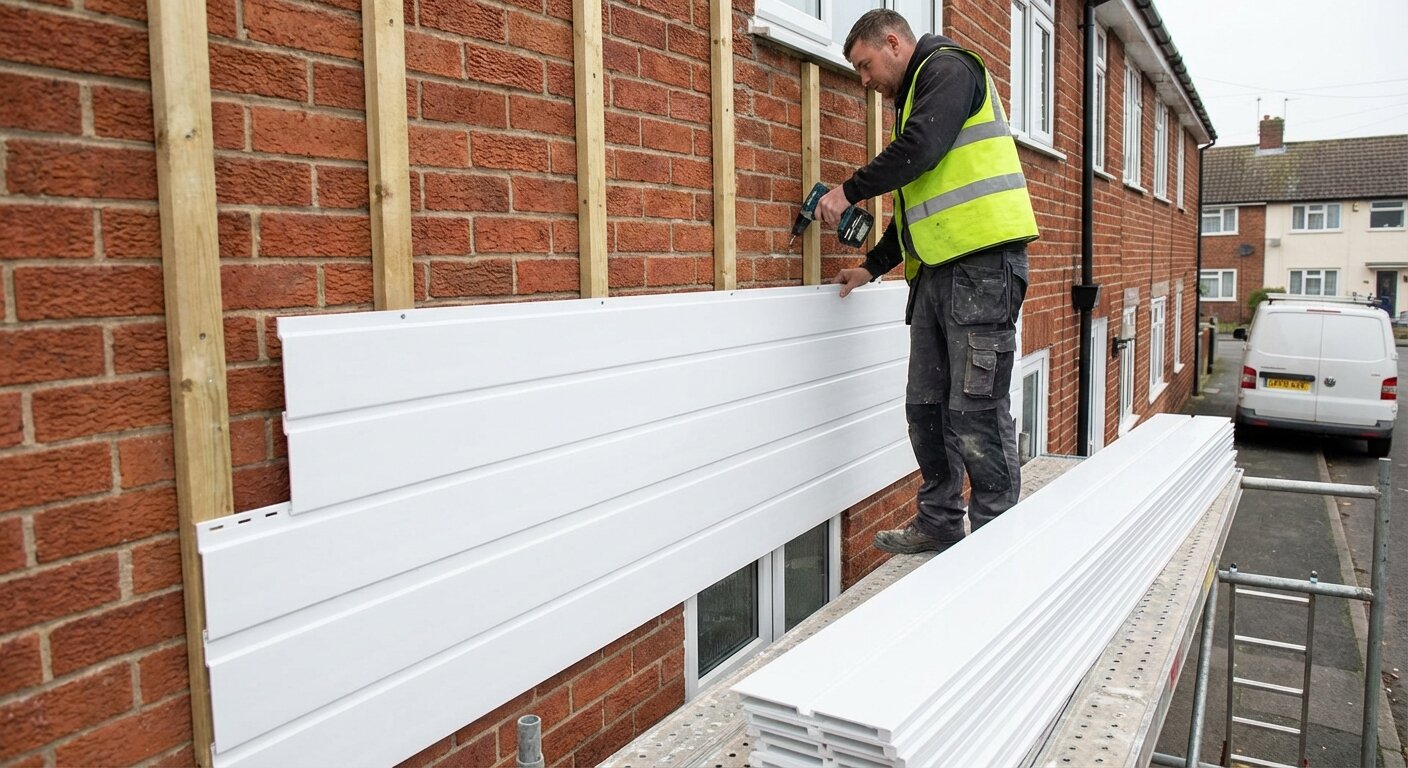
Boards are face-fixed or secret-fixed to treated timber battens at 400–600 mm centres. Stainless steel or hot-dip galvanised fixings are recommended to prevent corrosion staining. A minimum 25 mm ventilation cavity must be maintained behind the boards in accordance with BS 8104 and Approved Document C of the Building Regulations.
Trims and Accessories
PVC-U cladding systems include purpose-made trims — external corners, internal corners, J-channels, starter strips, and ventilation strips — that create a clean, finished appearance without the need for site-fabricated timber details.
Fire Performance
Following the Grenfell Tower tragedy in 2017 and subsequent changes to Building Regulations (Approved Document B), fire performance of external cladding has come under intense scrutiny. While the most stringent requirements apply to buildings over 18 m in height, fire performance is a consideration for all projects.
PVC-U cladding is self-extinguishing — it chars and melts when exposed to flame but does not support independent combustion once the ignition source is removed. Typical Euroclass ratings are D-s2,d0 or E, depending on the exact formulation.
Untreated timber is combustible (Euroclass E or F) and will support flame spread. Fire-retardant treated timber can achieve better ratings but at additional cost and with periodic retreatment requirements.
For buildings under 18 m in height — which covers the vast majority of UK housing — PVC-U cladding meets the requirements of Approved Document B without additional fire barriers in most configurations. Always verify compliance with your building control body for the specific project.
Environmental Considerations
The environmental comparison between PVC-U and timber is nuanced:
- Embodied carbon: Timber has lower embodied carbon at the point of manufacture, particularly if sourced from managed forests with FSC or PEFC certification
- Lifespan emissions: PVC-U’s longer lifespan and zero maintenance requirement mean fewer replacement cycles and no paint or stain products over the building’s life
- End of life: PVC-U is recyclable — many manufacturers now operate take-back schemes. Timber can be composted or used as biomass fuel
- Toxicity: Modern PVC-U formulations are lead- and cadmium-free, using calcium-zinc stabiliser systems instead
There is no clear environmental winner. The best choice depends on the weighting given to embodied carbon versus lifecycle impact, and on the specific products being compared.
Frequently Asked Questions
Can PVC-U cladding be painted?
PVC-U cladding does not require painting, and painting is generally not recommended as paint does not adhere well to the smooth, non-porous surface. If a colour change is desired, replacement with boards in the new colour is the standard approach. Some specialist coatings designed for PVC-U are available but are not widely used.
Does PVC-U cladding fade over time?
All coloured materials experience some degree of colour change with prolonged UV exposure. Modern co-extruded PVC-U cladding is formulated to minimise this, and most manufacturers guarantee colour stability for 10–20 years. Darker colours tend to show fading more noticeably than lighter shades.
Is PVC-U cladding noisy in the wind?
Correctly installed PVC-U cladding should not produce noise. If boards are inadequately fixed or expansion gaps are not properly managed, thermal movement can occasionally cause clicking sounds. Following the manufacturer’s installation instructions prevents this.
Can I clad over existing timber with PVC-U?
In some cases, yes — provided the existing timber is structurally sound and properly treated. However, best practice is to remove the old cladding, inspect and repair the substrate, and install the PVC-U system with new battens and a proper ventilation cavity. This ensures the new installation performs as intended and complies with Building Regulations.
How do I recycle old PVC-U cladding?
PVC-U is fully recyclable. Contact your supplier or local waste management provider to find PVC-U recycling facilities. Organisations such as Recovinyl operate collection and recycling networks across the UK.
Explore Kalsi’s PVC-U Cladding Range
Kalsi Plastics manufactures a comprehensive range of PVC-U external cladding profiles in colours and finishes to suit any project: