MDPE Pipe Trench Depth and Regulations (WRAS Compliant)
How Deep Should MDPE Water Pipe Be Buried?
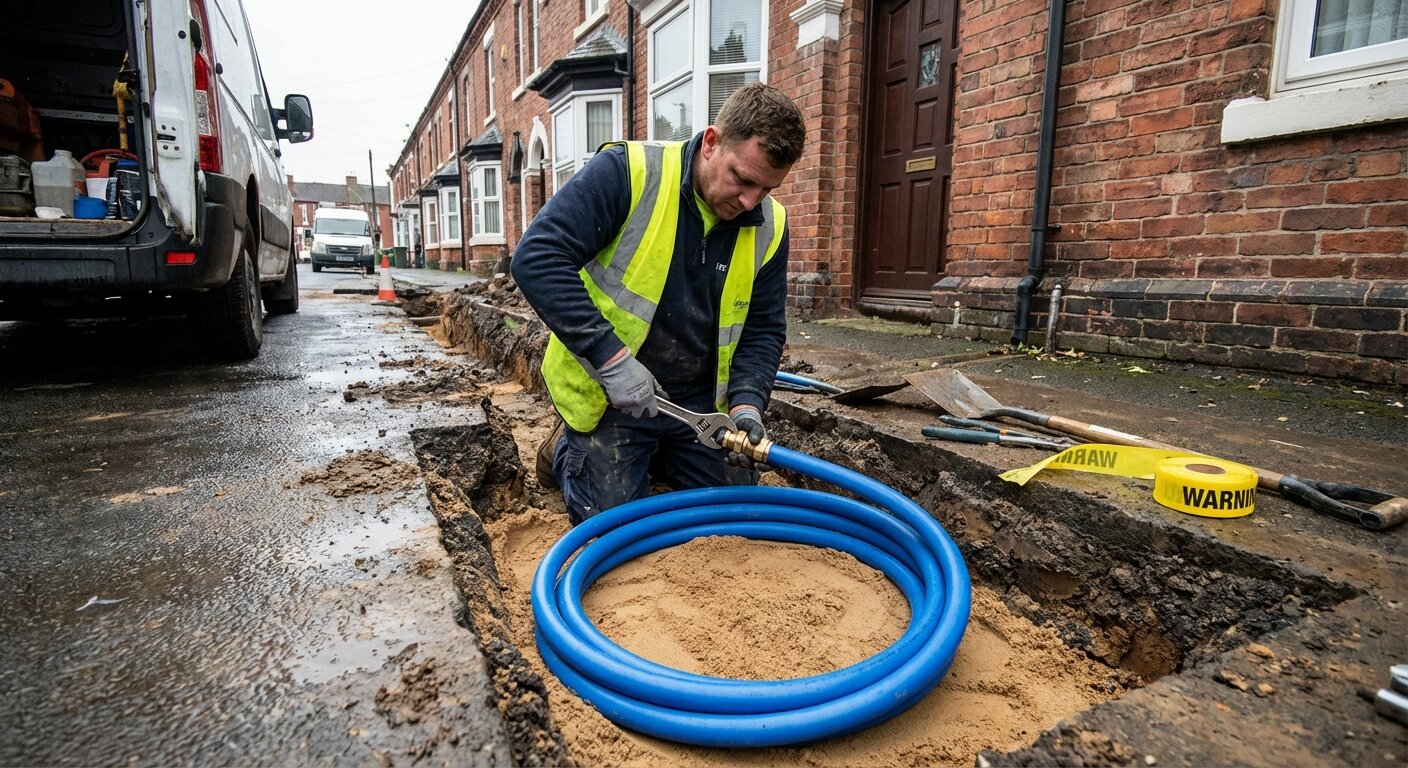
MDPE water pipe should be buried at a minimum depth of 750mm (0.75 metres) below finished ground level in gardens, footpaths, and soft landscaping. Under roads, driveways, and other areas subject to vehicular traffic, the minimum cover increases to 900mm (0.9 metres). These depths protect the pipe from frost damage, mechanical impact from surface activity, and accidental damage during routine gardening or landscaping work.
These minimum cover requirements are specified in Water UK’s standard conditions for water supply and are referenced in Building Regulations Approved Document G (Sanitation, hot water safety, and water efficiency). Individual water companies may impose additional requirements based on local ground conditions, so it is always worth checking with your local provider before starting excavation.
Why Burial Depth Matters
Getting the trench depth right is not just about following regulations — it directly affects the performance, reliability, and longevity of your water supply. There are three principal reasons for burying MDPE pipe at the correct depth:
Frost Protection
Water freezing inside a pipe can cause it to split or deform, disrupting supply and requiring costly excavation and repair. The 750mm minimum cover depth is designed to keep the pipe below the frost penetration zone for most of the UK.
In typical UK conditions, ground frost penetrates to approximately 300–450mm below the surface during normal winters. The 750mm minimum cover provides a substantial safety margin against even the most severe frost events. In exposed upland areas of Scotland, northern England, or Wales where frost penetration may be deeper, some water companies specify a deeper minimum — occasionally up to 900mm even in non-trafficked areas.
Protection from Mechanical Damage
Activities such as digging, rotavating, fence post installation, and garden landscaping regularly disturb ground to depths of 300–500mm. Burying the pipe at 750mm or deeper keeps it below the depth of most routine surface activity, significantly reducing the risk of accidental damage.
Under roads and driveways, the loads from vehicular traffic can transmit forces deep into the ground. The 900mm minimum cover under trafficked areas protects the pipe from these concentrated loads and provides space for proper bedding and backfill material to distribute forces evenly.
Separation from Other Services
Below-ground services — electricity cables, gas pipes, telecommunications ducting, and drainage — are all buried at different depths. Maintaining the correct depth for water supply helps ensure adequate separation between different services, reducing the risk of accidental damage during future excavation work.
Water UK and the National Joint Utilities Group (NJUG) recommend a minimum horizontal separation of 350mm between parallel services and a minimum of 150mm vertical clearance at crossing points. Achieving these separations is much easier when each service is installed at its correct specified depth.
Regulatory Framework
Building Regulations — Approved Document G
Approved Document G covers the provision of water supply to buildings. Section G1 requires that a building must have a supply of wholesome water for drinking, cooking, and food preparation. While the document does not prescribe specific trench depths in detail, it references compliance with Water Company requirements and the Water Supply (Water Fittings) Regulations 1999.
In practice, the trench depth requirements are set by the local water company and by the Water UK specifications that most water companies adopt as their standard.
Water Supply (Water Fittings) Regulations 1999
These regulations (applicable in England and Wales) require that all water fittings and installations are designed and installed so as to prevent contamination, waste, misuse, or undue consumption of water. Proper burial depth is a fundamental part of preventing contamination (by keeping the pipe protected) and preventing waste (by avoiding freeze damage and accidental impact).
Water UK — Standard Specifications
Water UK publishes standard specifications that most water companies adopt for new connections and service pipe installations. The current specification requires:
| Installation Location | Minimum Cover (Top of Pipe to Finished Ground Level) |
|---|---|
| Gardens, footpaths, soft landscaping | 750mm |
| Roads and driveways | 900mm |
| Agricultural land | 900mm (to account for ploughing depth) |
| Under buildings (where unavoidable) | Pipe must be ducted through the building fabric |
Scottish Water Byelaws
In Scotland, the Water Byelaws 2014 apply instead of the Water Fittings Regulations. The depth requirements are substantially similar, with a minimum cover of 750mm in soft ground and 900mm under roads. Scottish Water may specify additional requirements for highland and upland areas where frost penetration is more severe.
Trench Construction: Best Practice
Achieving the correct depth is only part of proper trench construction. The pipe also needs appropriate bedding and backfill to ensure it is properly supported and protected.
Trench Width
The trench should be wide enough to lay the pipe without forcing it into position or creating tight bends. A minimum trench width of 200mm (or the pipe outside diameter plus 200mm, whichever is greater) is recommended. This provides space for bedding material to be placed around the pipe and properly compacted.
Pipe Bedding
The pipe must be laid on a bed of granular material — typically sharp sand or pea gravel (10mm nominal size). The bedding layer should be at least 100mm deep and levelled before the pipe is placed. This provides uniform support along the pipe’s entire length and prevents point loading from stones or hard spots in the trench bottom.
Pipe Surround
After laying the pipe, granular bedding material should be placed and carefully compacted around and over the pipe to a depth of 100mm above the pipe crown (the top of the pipe). This creates a protective envelope that distributes loads evenly and prevents sharp objects in the backfill from contacting the pipe.
Warning Tape
A detectable warning tape should be laid in the trench approximately 300mm above the pipe, within the backfill material. This tape — typically blue and printed with “CAUTION — WATER MAIN BELOW” or similar — serves as an early warning during future excavation work. If a digger or spade encounters the warning tape, the operator knows to proceed with extreme caution because a water pipe is nearby.
Most water companies require warning tape as a standard condition of connection. Some also require marker posts at the surface to indicate the pipe route, particularly in open land or agricultural settings.
Backfill
Above the granular surround and warning tape, the remainder of the trench can be backfilled with excavated material, provided it is free from:
- Stones or rubble larger than 40mm
- Frozen material
- Organic matter (which will decompose and leave voids)
- Contaminated soil
The backfill should be placed in layers of no more than 150mm and lightly compacted to prevent future settlement. Excessive compaction directly over the pipe should be avoided, as this can create concentrated loads on the pipe.
Ducting Under Buildings
Where an MDPE pipe must pass through or under a building (for example, entering through a floor slab or foundation wall), it should be routed through a protective duct — typically a larger-diameter pipe or sleeve. The duct protects the MDPE pipe from structural loads and allows it to be replaced in future without demolishing part of the building fabric.
The annular space between the MDPE pipe and the duct should be sealed at both ends to prevent the ingress of water, vermin, and gas. Proprietary sealing systems are available for this purpose.
Special Situations
Shallow Cover Where 750mm Cannot Be Achieved
In some situations — particularly where existing services, rock, or structural foundations prevent excavation to 750mm — it may not be possible to achieve the standard minimum cover. In these cases, the pipe should be protected using additional measures:
- Concrete protection slabs placed over the pipe to distribute surface loads
- Ducting through rigid protective conduit
- Additional insulation (closed-cell foam lagging) to provide frost protection where cover is reduced
- Route diversion to avoid the obstruction and achieve full depth elsewhere
Any reduction in cover depth below the specified minimum should be agreed with the local water company before installation. Water companies will typically require evidence of the protective measures in place before approving the connection.
Shared Trenches with Other Services
MDPE water pipe may share a trench with other services provided that the minimum separation distances are maintained:
| Adjacent Service | Minimum Horizontal Separation | Minimum Vertical Separation at Crossings |
|---|---|---|
| Gas pipe | 350mm | 150mm |
| Electricity cable | 350mm | 150mm |
| Telecommunications | 350mm | 150mm |
| Drainage | 350mm | 150mm |
Where a water pipe crosses above or below a drainage pipe, the water pipe should ideally cross above the drain to prevent contamination in the event of a drain leak. Where this is not possible, the water pipe should be ducted or protected for a distance of at least 1 metre either side of the crossing point.
Rising Mains and Sloping Sites
On sloping sites, the pipe should follow the natural ground profile where possible, maintaining the minimum cover throughout. Where the pipe must rise sharply (for example, up a steep bank), thrust blocks or anchor points may be needed to prevent the pipe from moving due to pressure forces at changes of direction.
Air valves or air release points should be provided at high points in the pipe run where air pockets could accumulate and restrict flow.
Pressure Testing Before Backfilling
Before any trench is backfilled, the complete pipe installation — including all joints and fittings — should be pressure tested to confirm there are no leaks. The standard test procedure for a domestic water supply is:
- Fill the pipe with water, expelling all air
- Pressurise to 1.5 times the maximum working pressure (typically 15 bar for a domestic service connected to a PN12.5 pipe)
- Maintain pressure for a minimum of one hour
- Monitor for any pressure drop — a sustained drop indicates a leak that must be found and repaired
Only once the pressure test has been passed should the trench be backfilled. Attempting to locate a leak after backfilling is far more expensive and disruptive than testing with the pipe exposed.
Frequently Asked Questions
Can I bury MDPE pipe at less than 750mm depth?
Not without additional protective measures and agreement from the local water company. Reduced cover increases the risk of frost damage and mechanical impact. If full depth cannot be achieved due to site constraints, concrete protection slabs, ducting, or insulation must be used to compensate.
Does trench depth change for different pipe sizes?
The minimum cover requirement is the same regardless of pipe size — 750mm in soft ground and 900mm under roads. However, larger pipes require wider trenches and more bedding material, which may affect excavation costs.
Do I need to use sand bedding, or can I lay the pipe directly on soil?
Sand or pea gravel bedding is strongly recommended and required by most water companies. Laying pipe directly on uneven or stony ground can create point loads that may damage the pipe over time. The bedding layer provides uniform support and protects the pipe from sharp objects in the trench bottom.
What colour warning tape should I use for water pipes?
Blue warning tape printed with “CAUTION — WATER MAIN BELOW” or similar wording. The tape should be laid approximately 300mm above the pipe within the backfill material. This is a standard requirement for water supply installations in the UK.
How close can a water pipe be to a drainage pipe?
Water pipes should maintain a minimum horizontal separation of 350mm from drainage pipes. At crossing points, a minimum vertical separation of 150mm is required, with the water pipe preferably running above the drain. Where this is not achievable, ducting or additional protection should be provided.
Related Kalsi Products
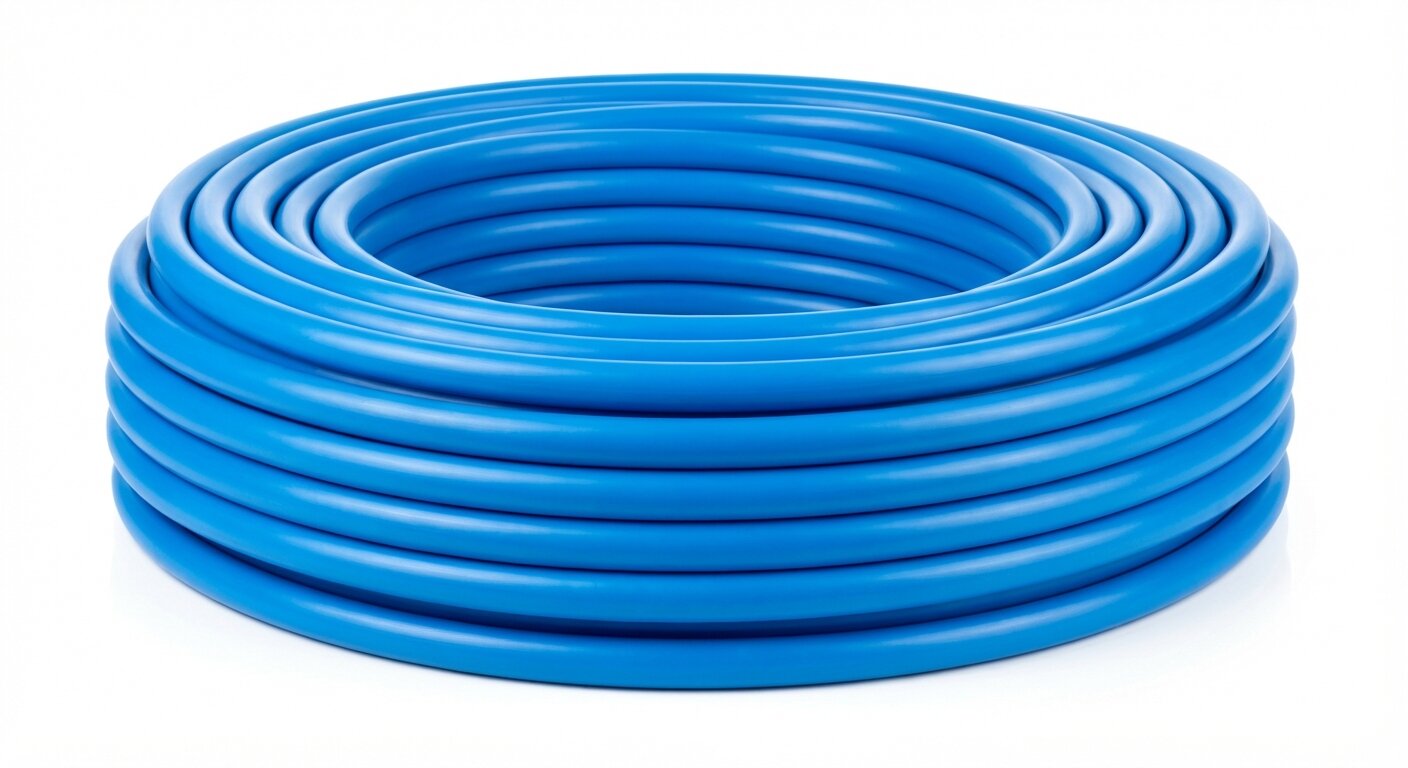
- MDPE Pipe Range — Blue MDPE pipe for potable water supply in all standard sizes
- MDPE Fittings — Compression fittings, couplings, and adaptors
- Underground Drainage Systems — Complete below-ground drainage solutions
- Installation Guides — Step-by-step guidance for MDPE and drainage installations
- Technical Resources — Product datasheets and regulatory reference information