Blue vs Black MDPE Pipe: What Is the Difference?
What Is the Difference Between Blue and Black MDPE?
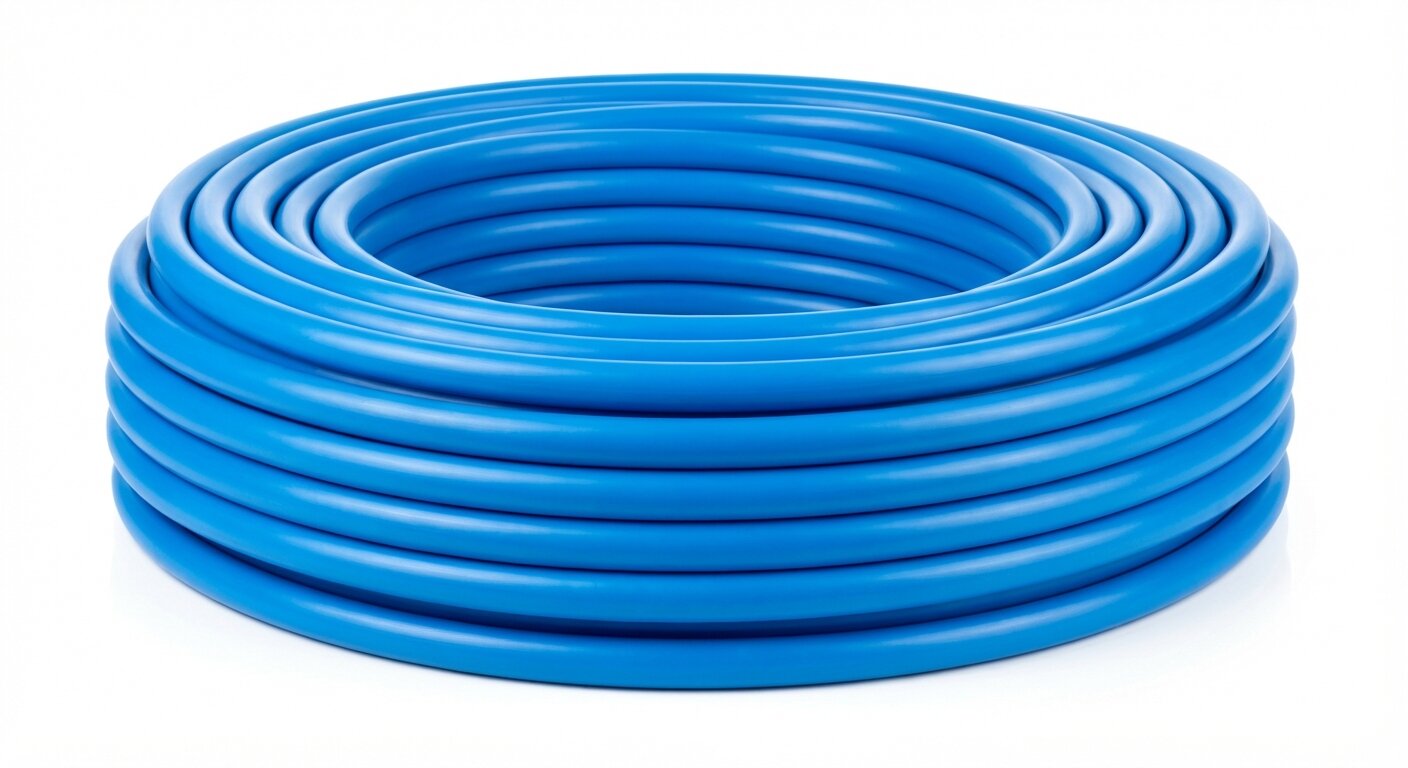
The difference between blue and black MDPE pipe is primarily one of colour coding to indicate the pipe’s intended application. Blue MDPE pipe is designated for potable (drinking) water supply and must be WRAS approved. Black MDPE pipe is used for non-potable applications such as gas distribution, cable ducting, and industrial water. The colour coding system is mandated by UK regulations to prevent cross-contamination between potable water supplies and other services.
Both blue and black MDPE pipes are manufactured from the same base material — medium density polyethylene — and share very similar physical and mechanical properties. The key difference lies not in the pipe’s performance characteristics but in its regulatory approval, colour identification, and the specific application it is certified for.
Why Colour Coding Matters
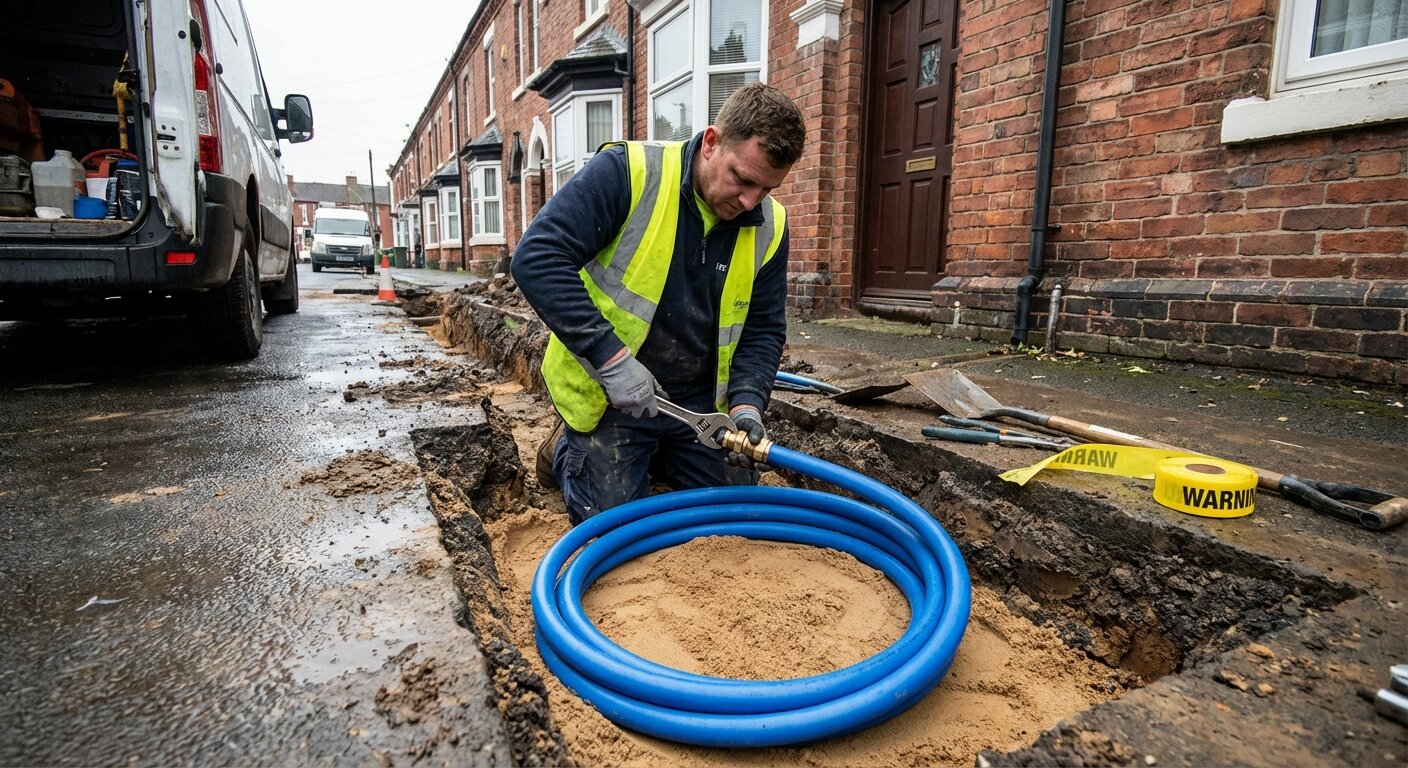
The UK’s utility colour coding system exists for one critical reason: safety. When an excavation exposes buried pipes, workers need to identify instantly what each pipe carries. Confusing a water supply pipe with a gas pipe, or connecting a non-potable supply to a drinking water system, can have serious consequences.
The standard colour coding for below-ground services in the UK is:
| Colour | Service |
|---|---|
| Blue | Potable water supply |
| Yellow | Gas |
| Black | Non-potable water, general purpose, or specific industrial applications |
| Brown/Orange | Electricity cables |
| Green | Telecommunications |
| Red/Purple | Reclaimed or non-potable water (increasingly used) |
This colour coding is referenced in the National Joint Utilities Group (NJUG) guidelines and is standard practice across UK water companies, gas networks, and other utility providers.
Blue MDPE Pipe: Potable Water Supply
What Is Blue MDPE Used For?
Blue MDPE pipe is specifically manufactured and approved for conveying drinking water. It is the standard material for:
- Service pipes from the boundary stop tap to the internal stop tap of a property
- Communication pipes from the water main to the boundary (installed by the water company)
- Distribution mains within private estates and developments
- Agricultural water supplies for livestock drinking water
- Rainwater harvesting systems where the supply connects to a potable top-up
Blue MDPE pipe is manufactured to BS EN 12201 (Plastics piping systems for water supply — Polyethylene) and must carry WRAS approval to confirm it is suitable for contact with drinking water.
WRAS Approval Explained
WRAS (Water Regulations Advisory Scheme) approval means the pipe has been tested and verified to comply with the Water Supply (Water Fittings) Regulations 1999 (England and Wales) or the Water Byelaws 2014 (Scotland). This testing ensures:
- The pipe material does not leach harmful substances into drinking water
- The pipe meets mechanical performance requirements (pressure rating, impact resistance, stress crack resistance)
- The pipe is manufactured under quality-controlled conditions with ongoing surveillance
Using non-WRAS-approved pipe for potable water supply is a regulatory offence under the Water Fittings Regulations. Water companies have the power to refuse connection or disconnect supply if non-approved materials are used.
Blue MDPE Technical Specifications
Blue MDPE pipe for potable water is typically manufactured in PE80 grade material with the following common specifications:
| Property | Typical Value |
|---|---|
| Material grade | PE80 (MRS 8.0 MPa) |
| Colour | Blue (solid or with co-extruded stripes) |
| Standard | BS EN 12201 |
| Common SDR ratings | SDR 11 (PN12.5), SDR 17 (PN10) |
| Available sizes | 20mm, 25mm, 32mm, 50mm, 63mm (in coils) |
| Coil lengths | 25m, 50m, 100m, 150m |
| Density | 0.930–0.940 g/cm³ |
| Operating temperature | 0°C to 40°C (designed for cold water only) |
| Design life | Minimum 50 years at rated pressure and temperature |
Black MDPE Pipe: Non-Potable Applications
What Is Black MDPE Used For?
Black MDPE pipe without any coloured stripe markings is used for non-potable applications where WRAS approval is not required. Common uses include:
- General-purpose below-ground pipework where the fluid is not drinking water
- Irrigation systems where potable water quality is not required
- Cable ducting and conduit applications
- Industrial process water and cooling systems
- Drainage and land drainage applications
Black MDPE with a Blue Stripe
It is important to distinguish between plain black MDPE and black MDPE with a blue stripe. Black pipe with a co-extruded blue stripe is manufactured to the same standard as blue MDPE pipe (BS EN 12201) and carries the same WRAS approval. The blue stripe indicates potable water suitability.
This variant exists because some water companies and regions historically preferred black pipe with identification stripes rather than solid-colour pipe. In practice, black-with-blue-stripe MDPE is functionally identical to solid blue MDPE for potable water purposes.
Black MDPE with a Yellow Stripe
Black MDPE pipe with a yellow stripe is designated for gas distribution and is manufactured to a completely different standard — BS EN 1555 (Plastics piping systems for the supply of gaseous fuels — Polyethylene). This pipe must never be used for water supply, and water-rated pipe must never be used for gas. The material grades and testing requirements are different even though the base polymer is similar.
Detailed Comparison: Blue vs Black MDPE
| Property | Blue MDPE | Black MDPE (plain) | Black MDPE (blue stripe) |
|---|---|---|---|
| Primary application | Potable water supply | Non-potable / industrial | Potable water supply |
| Standard | BS EN 12201 | Various (application dependent) | BS EN 12201 |
| WRAS approved | Yes (required) | No | Yes |
| Material grade | PE80 or PE100 | PE80 or PE100 | PE80 or PE100 |
| Pressure ratings | PN10, PN12.5, PN16 | Varies | PN10, PN12.5, PN16 |
| UV resistance | Moderate (designed for burial) | Good (carbon black provides UV protection) | Good (carbon black provides UV protection) |
| Available sizes | 20mm–63mm coils, larger in lengths | 20mm–63mm coils, larger in lengths | 20mm–63mm coils, larger in lengths |
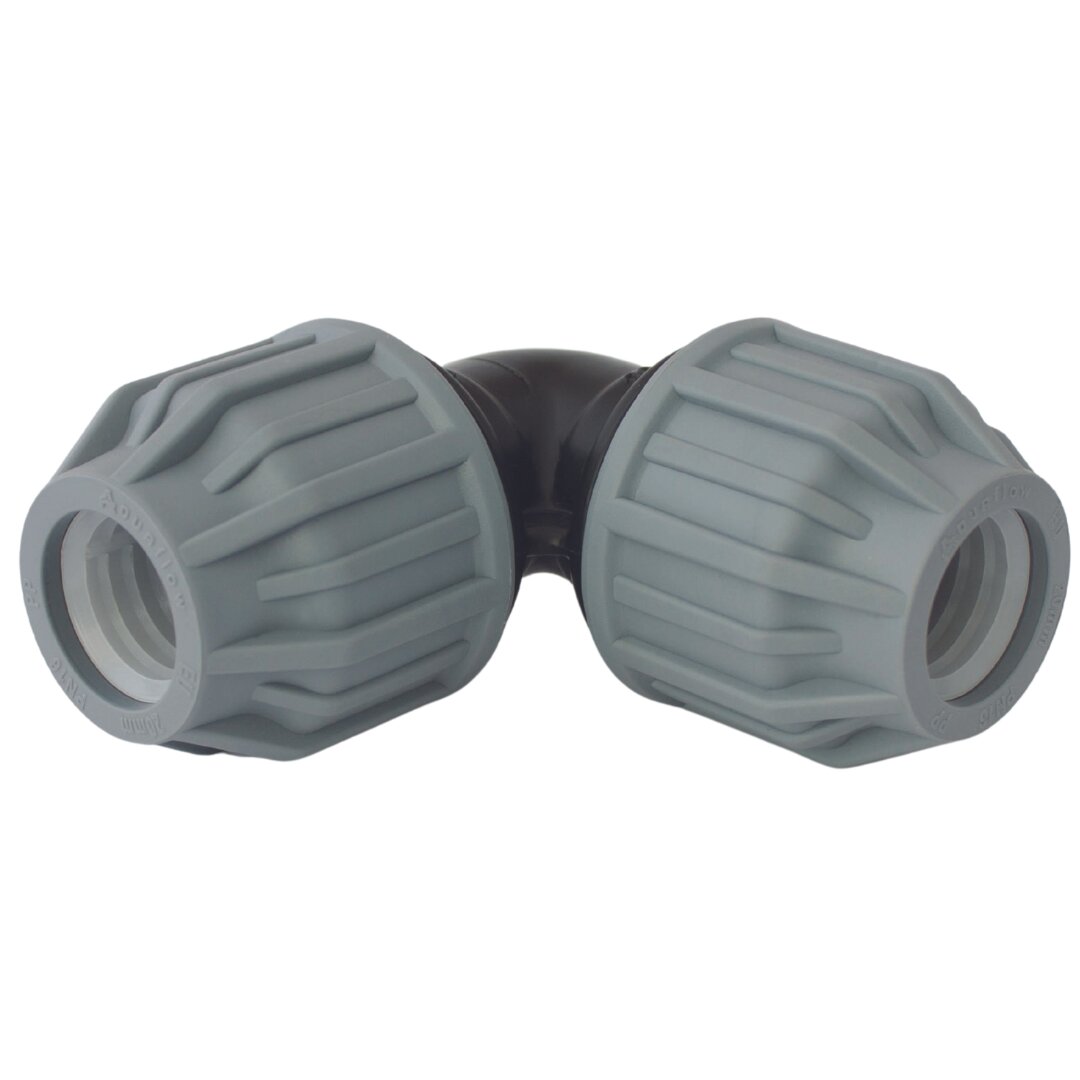
| Fittings compatibility | Standard MDPE compression fittings | Standard MDPE compression fittings | Standard MDPE compression fittings |
UV Resistance: Where Black Has an Advantage
One genuine physical difference between blue and black MDPE is UV resistance. Black polyethylene contains carbon black as a pigment, which provides significantly better protection against ultraviolet degradation compared to the blue pigment used in potable water pipe.
In practice, this difference is largely academic because MDPE pipe is designed to be buried underground, where UV exposure is not a factor. However, if any section of pipe will be exposed above ground for an extended period (which should be avoided where possible), black pipe will resist UV degradation better than blue.
For any above-ground sections that cannot be avoided, the pipe should be protected from direct sunlight using insulation or ducting, regardless of colour.
Regulatory Framework
Water Supply (Water Fittings) Regulations 1999
These regulations apply in England and Wales and require that every water fitting installed in connection with a water supply must be of an appropriate quality and standard. Regulation 4 specifically states that no fitting shall be installed that is likely to cause contamination, waste, misuse, or undue consumption of water.
For MDPE pipe, this means using WRAS-approved blue MDPE (or black with blue stripe) for all potable water installations. The regulations are enforced by local water companies, which have powers of inspection and enforcement.
Building Regulations — Approved Document G
Approved Document G (Sanitation, hot water safety, and water efficiency) of the Building Regulations covers the provision of wholesome water to buildings. It references compliance with the Water Fittings Regulations and the use of approved materials for potable water installations. Specifiers should ensure that MDPE pipe used for water supply is clearly identified and approved for purpose.
Water Industry Act 1991
The Water Industry Act provides the legislative framework that underpins water companies’ duties to supply wholesome water and their powers to enforce the Water Fittings Regulations. Property owners who install non-compliant materials may face enforcement action, including disconnection of the water supply.
Common Mistakes and Misconceptions
”Black pipe is stronger than blue pipe”
This is a misconception. When manufactured to the same SDR and material grade, blue and black MDPE pipe have identical mechanical properties. The colour pigment does not affect strength, pressure rating, or service life.
”Any blue pipe can be used for water”
Not all blue pipes are WRAS approved. Some imported blue polyethylene pipe may not comply with BS EN 12201 or carry WRAS approval. Always check the pipe markings for the WRAS approval number, manufacturing standard, and material grade before use.
”Black MDPE can be used for drinking water if it’s the right size”
Plain black MDPE without a blue stripe is not approved for potable water supply, regardless of size or pressure rating. Even if the base material is the same PE80 compound, the manufacturing line, quality control, and certification are different. Using non-approved pipe for drinking water is a regulatory offence.
”Gas pipe and water pipe are interchangeable”
Absolutely not. Although both may be made from polyethylene, gas pipe (yellow stripe, BS EN 1555) and water pipe (blue or blue stripe, BS EN 12201) are manufactured to different standards with different testing requirements. Cross-use is dangerous and illegal.
How to Identify MDPE Pipe Correctly
All MDPE pipe should carry printed markings along its length at regular intervals. These markings typically include:
- Manufacturer’s name or trademark
- Manufacturing standard (e.g., BS EN 12201)
- Material designation (e.g., PE80 or PE100)
- SDR and pressure rating (e.g., SDR 11 / PN12.5)
- Outside diameter and wall thickness
- WRAS approval number (for potable water pipe)
- Date of manufacture
If the pipe markings are unclear, missing, or do not include a WRAS approval number, do not use the pipe for potable water supply. Contact the supplier to confirm the pipe’s certification status before installation.
Frequently Asked Questions
Can I use blue MDPE pipe for non-potable applications?
Yes, there is no restriction on using blue MDPE for non-potable purposes — it simply means you are using a higher-specification pipe than strictly necessary. However, for clarity and cost efficiency, it makes sense to use black MDPE for non-potable applications and reserve blue for drinking water.
Can I join blue MDPE pipe to black MDPE pipe?
If both pipes are the same outside diameter and manufactured to the same SDR, standard compression fittings will connect them without issue. However, you should not mix potable and non-potable pipe within a single drinking water supply installation. All pipe in a potable water system should be WRAS approved.
Is black MDPE cheaper than blue MDPE?
Plain black MDPE may be marginally less expensive than blue MDPE because it does not require WRAS certification and the associated quality control and testing. However, the price difference is typically small and should never be a reason to use non-approved pipe for drinking water installations.
What happens if I use the wrong colour pipe?
Using non-WRAS-approved pipe for potable water is a breach of the Water Supply (Water Fittings) Regulations 1999. Your water company can refuse to connect your supply, issue an enforcement notice requiring the non-compliant pipe to be replaced, or in serious cases disconnect the water supply entirely. Beyond regulatory consequences, using incorrect pipe risks contaminating drinking water.
How long does MDPE pipe last underground?
Both blue and black MDPE pipe are designed for a minimum service life of 50 years when installed correctly at the rated pressure and temperature. Many polyethylene pipe installations have been in continuous service since the 1970s without issue, suggesting that real-world service life may significantly exceed the 50-year design standard.
Related Kalsi Products
- MDPE Pipe Range — Blue MDPE pipe for potable water supply
- MDPE Fittings — Compression fittings for all standard MDPE sizes
- Underground Drainage Systems — PVC-U below-ground drainage pipe and fittings
- Technical Resources — Datasheets and technical specifications
- Downloads — Product datasheets and installation guidance