Kitemark Certification: What It Means for Building Products
What Does Kitemark Mean?
The BSI Kitemark is a registered certification mark owned by the British Standards Institution (BSI). When a building product carries the Kitemark symbol, it means the product has been independently tested and verified to meet the requirements of a specific British Standard, and that the manufacturer’s quality management system is subject to ongoing surveillance by BSI — including unannounced factory audits and periodic re-testing. The Kitemark is not a self-declaration; it is an earned certification backed by continuous, independent verification.
For specifiers, builders, and homeowners, the Kitemark provides a simple, reliable indicator that a building product will perform as claimed. In an industry where products from multiple manufacturers and multiple countries compete for specification, the Kitemark cuts through marketing claims and provides objective evidence of quality.
How the Kitemark Scheme Works
The BSI Kitemark scheme is one of the most rigorous product certification programmes in the world. It involves multiple stages of assessment, testing, and ongoing monitoring — far more extensive than a simple one-off product test.
Stage 1: Application and Initial Assessment
The manufacturer applies to BSI for Kitemark certification of a specific product or product range against a named British Standard (for example, BS EN 607:2023 for PVC-U eaves gutters or BS EN 1401 for underground drainage pipe). BSI reviews the application and confirms which tests and assessments will be required.
Stage 2: Product Testing
Representative samples of the product are submitted to BSI’s testing laboratories (or an approved third-party laboratory) for comprehensive testing against every requirement of the relevant standard. For plastic building products, this typically includes:
- Dimensional checks — Verifying that the product’s dimensions are within the tolerances specified in the standard
- Material properties — Testing the physical and chemical properties of the PVC-U or polyethylene compound (density, melt flow rate, impact resistance, tensile strength)
- Impact resistance — Drop tests at specified temperatures (typically 0°C and -10°C for external products) to verify resistance to cracking
- UV resistance — Accelerated weathering tests to verify colour stability and resistance to degradation under simulated sunlight exposure
- Chemical resistance — Exposure to specified chemicals to verify the material does not degrade
- Pressure testing — For pipe products, sustained pressure tests at elevated temperatures to verify long-term performance
- Fire performance — Testing to BS 476 or equivalent fire classification standards
Stage 3: Factory Assessment
A BSI auditor visits the manufacturing facility to assess the quality management system. This includes reviewing:
- Raw material sourcing and incoming inspection procedures
- Production process controls and in-line testing
- Finished product testing and inspection
- Calibration of measuring and testing equipment
- Traceability systems (linking finished products back to raw material batches)
- Non-conformance handling and corrective action procedures
- Staff training and competence records
The factory assessment verifies that the manufacturer has the systems and processes in place to consistently produce products that meet the standard — not just the samples submitted for testing.
Stage 4: Certification
If the product passes all tests and the factory assessment is satisfactory, BSI issues a Kitemark licence. This authorises the manufacturer to apply the Kitemark symbol to the certified product, along with the relevant standard number and licence number.
Stage 5: Ongoing Surveillance
This is what sets Kitemark apart from most other certification schemes. After initial certification, BSI conducts:
- Regular announced audits — Typically twice per year, reviewing the manufacturer’s quality systems and testing records
- Unannounced audits — BSI auditors can visit the factory without prior notice to conduct spot checks on production and quality control
- Market surveillance testing — BSI periodically purchases products from the open market (builders’ merchants, distributors) and tests them against the standard. This verifies that the products actually reaching customers are identical to the samples submitted for certification
- Annual review — The Kitemark licence is reviewed annually, and the manufacturer must demonstrate continued compliance to maintain certification
If surveillance testing reveals non-conformities, BSI can suspend or withdraw the Kitemark licence until the issues are resolved. This ongoing accountability is the Kitemark’s greatest strength.
Why Kitemark Matters for Building Products
Specifier Confidence
Architects, engineers, and building surveyors specify thousands of products across a typical construction project. They cannot personally test every product — they rely on certification to provide assurance. The Kitemark is widely recognised and trusted within the UK construction industry as evidence that a product has been independently verified to meet its claimed performance standard.
Building Regulations Compliance
While Building Regulations do not specifically require Kitemark certification, they do require that building products are fit for purpose and comply with the relevant standards. Using Kitemark-certified products provides a clear paper trail demonstrating compliance. Building control officers recognise the Kitemark and are far less likely to question a Kitemark-certified product than an uncertified one.
For rainwater systems, the relevant Building Regulation is Approved Document H (Drainage and waste disposal). For roofline products, Approved Document C (Site preparation and resistance to contaminants and moisture) applies. Underground drainage falls under Approved Document H, and water supply products under Approved Document G (Sanitation, hot water safety, and water efficiency).
Warranty and Insurance
Many building warranty providers (such as NHBC, Premier Guarantee, and LABC Warranty) look favourably on the use of Kitemark-certified products. Some warranty schemes may require third-party certification for specific products as a condition of cover. Using certified products reduces the risk of warranty claims resulting from product failure.
Professional Indemnity
For architects and specifiers, recommending Kitemark-certified products provides a degree of protection if a product subsequently fails. The specifier can demonstrate that they exercised due diligence by selecting a product that carried independent third-party certification at the time of specification.
Kitemark vs Other Certifications
Several certification schemes operate in the UK building products market. Understanding the differences helps in making informed specification decisions.
BBA (British Board of Agrément) Certification
BBA certification is an assessment-based scheme that evaluates innovative or non-standard building products. Where a product falls outside the scope of an existing British Standard (or is a novel application of an existing material), BBA certification provides independent assessment of its fitness for purpose.
Key difference from Kitemark: BBA certification is typically used for products where no applicable British Standard exists, or where the product is innovative. Kitemark certification is used where a clear British Standard applies. Some products may carry both certifications.
WRAS Approval
WRAS (Water Regulations Advisory Scheme) approval is specific to products that come into contact with drinking water. WRAS testing verifies that materials do not contaminate potable water and that the product meets the mechanical requirements of the Water Supply (Water Fittings) Regulations 1999.
Key difference from Kitemark: WRAS is specific to water supply products; Kitemark covers a much broader range of building products. A product can carry both Kitemark and WRAS approval — and for water supply products like MDPE pipe and fittings, having both provides the highest level of assurance.
CE/UKCA Marking
CE marking (now replaced by UKCA marking for products placed on the GB market) indicates that a product complies with the relevant harmonised European standard. However, CE/UKCA marking is often based on the manufacturer’s self-declaration of conformity rather than independent third-party testing.
Key difference from Kitemark: CE/UKCA marking can be self-declared; Kitemark requires independent verification. A product can carry CE/UKCA marking without any external body having physically tested it. Kitemark provides a significantly higher level of assurance.
ISO 9001 (Quality Management)
ISO 9001 is a quality management system standard — it certifies that a company has effective quality management processes in place. However, it does not certify the performance of any specific product.
Key difference from Kitemark: ISO 9001 certifies systems; Kitemark certifies products. A manufacturer can be ISO 9001 certified while producing products that do not meet the relevant performance standards. Kitemark addresses both the product and the system.
What Products Should Carry Kitemark?
For plastic building products, Kitemark certification is available and recommended for:
| Product Category | Relevant Standard | Kitemark Available? |
|---|---|---|
| PVC-U eaves gutters and fittings | BS EN 607:2023 | Confirm current BSI scheme and certificate scope |
| Rainwater piping systems | Current declared standard required | Confirm current BSI scheme and certificate scope |
| Underground drainage pipe | BS EN 1401 | Yes |
| Soil and waste pipe | BS EN 1329 / BS EN 1455 | Yes |
| PVC-U pressure pipe | BS EN 1452 | Yes |
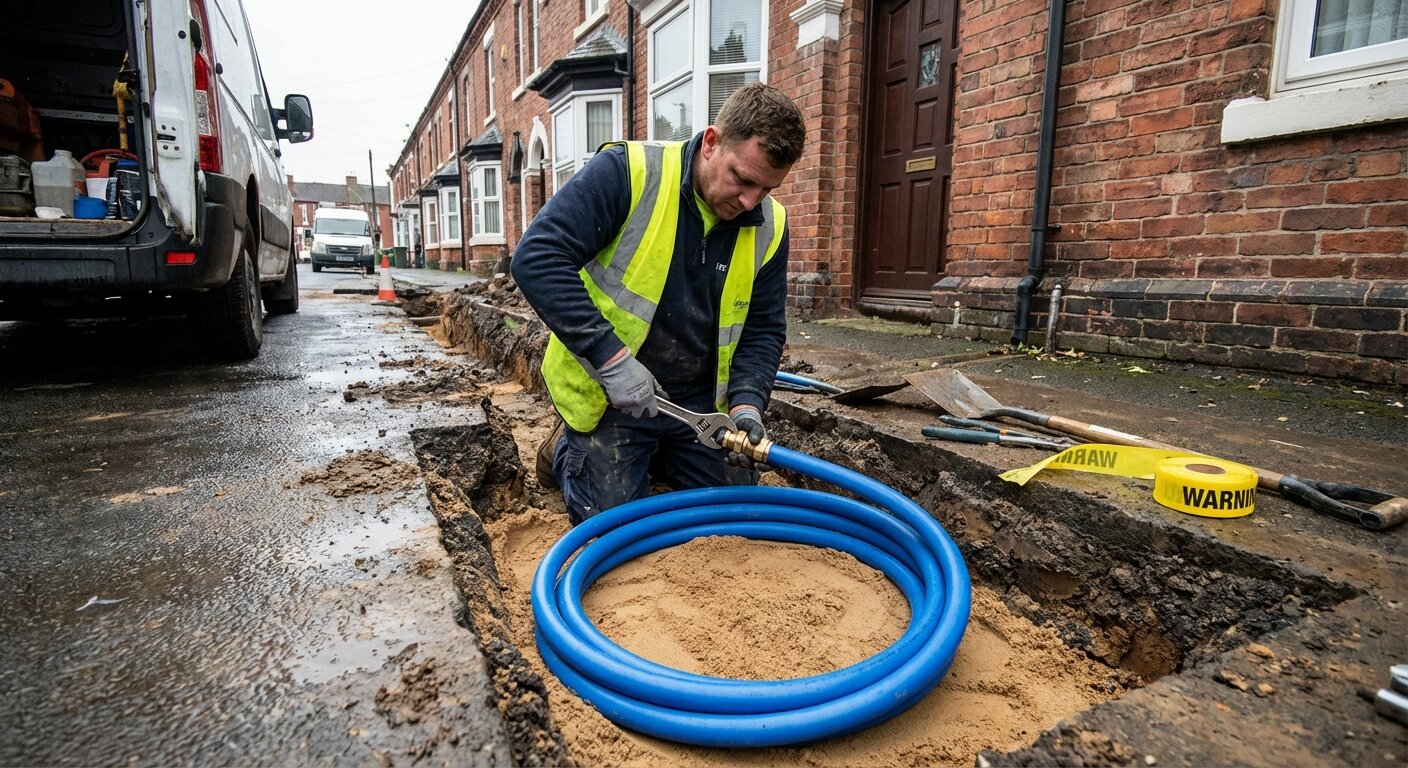
| MDPE water supply pipe | BS EN 12201 | Yes |
| Window profiles | BS 7412 | Yes |
Not all product categories have Kitemark schemes available. For products without a Kitemark option, BBA certification or other third-party assessment may be the most appropriate form of independent verification.
Kalsi Plastics and Certification
Kalsi Plastics is committed to independent verification of product quality. Certification applies to the products and standards identified on each current certificate; it should not be assumed to cover an entire brand or range. Ask Kalsi Technical for the current certificate and exact product scope before quoting a Kitemark or other third-party approval.
We encourage specifiers and installers to ask for evidence of certification when comparing products from different manufacturers. The presence or absence of independent certification is one of the clearest indicators of a manufacturer’s commitment to quality.
Frequently Asked Questions
Is Kitemark certification compulsory for building products?
No. There is no legal requirement for building products to carry Kitemark certification in the UK. However, Building Regulations require that products are fit for purpose and comply with relevant standards. Kitemark certification is one of the simplest and most widely recognised ways to demonstrate compliance.
How long does a Kitemark licence last?
A Kitemark licence is renewed annually, subject to satisfactory surveillance audit results and continued compliance with the relevant standard. The manufacturer must maintain its quality systems and pass both announced and unannounced audits to retain the licence.
Can imported products carry the Kitemark?
Yes, in theory. Any manufacturer, regardless of location, can apply for Kitemark certification. However, the requirement for regular factory audits (including unannounced visits) makes the Kitemark scheme significantly more onerous and expensive for manufacturers outside the UK. In practice, very few imported building products carry Kitemark certification.
Does Kitemark guarantee the product will last?
Kitemark certification verifies that a product meets the performance requirements of a British Standard at the point of manufacture. It does not provide a guarantee or warranty in the consumer sense. However, the standards against which products are tested include requirements for durability, UV resistance, and long-term mechanical performance — all of which contribute to a long service life.
Where can I check if a product is Kitemark certified?
BSI maintains a public directory of Kitemark-certified products and manufacturers on their website. You can search by manufacturer, product type, or Kitemark licence number to verify that a product’s Kitemark claim is genuine.
Related Kalsi Products
- Rainwater Systems — PVC-U rainwater systems with current declarations and certification scope available from Kalsi Technical
- Roofline Products — Fascia, soffit, and bargeboards manufactured to British Standards
- Underground Drainage — BS EN 1401 compliant drainage pipe and fittings
- Soil and Waste — Certified soil and waste pipe systems
- Technical Resources — Certification details and product datasheets