Gutter Brackets & Fittings: Complete Guide to Accessories
The gutter brackets you need depend on your gutter profile, fascia type, and how the system is supported. For most domestic installations on a timber or PVC fascia board, matching fascia brackets spaced at no more than 600mm centres are the correct choice. Reduce the spacing to 300mm in areas of heavy snow or extreme weather conditions. Properties without a fascia board use rafter-arm brackets that fix directly to the rafter feet. Beyond brackets, a complete gutter installation requires union joints, running outlets, stop ends, angles, and downpipe fittings — and getting the right combination ensures a watertight, long-lasting system.
Guttering is a system of components, not just a length of gutter. The fittings hold it together, keep it aligned, and connect it to the downpipes. Understanding what each fitting does — and how many you need — saves trips to the merchants and prevents costly on-site delays.
Bracket Types
1. Fascia Brackets
The standard bracket for 90% of domestic installations. It screws directly to the fascia board (timber or PVC over timber) and supports the gutter from below.
Key features:
- Clip mechanism that grips the gutter’s front lip and rear edge
- Screw-fixed to the fascia with 30–40 mm stainless steel screws
- Available for every gutter profile (half-round, ogee, square-line, deep flow, etc.)
- Must match the specific gutter profile — a half-round bracket does not fit ogee gutter
Spacing: Maximum 600mm centres for fascia brackets, reduced to 300mm in areas of heavy snow or extreme weather conditions, with additional support within 150mm of unions, outlets, angles and stop ends.
2. Rafter-Arm Brackets (Top-Fix)
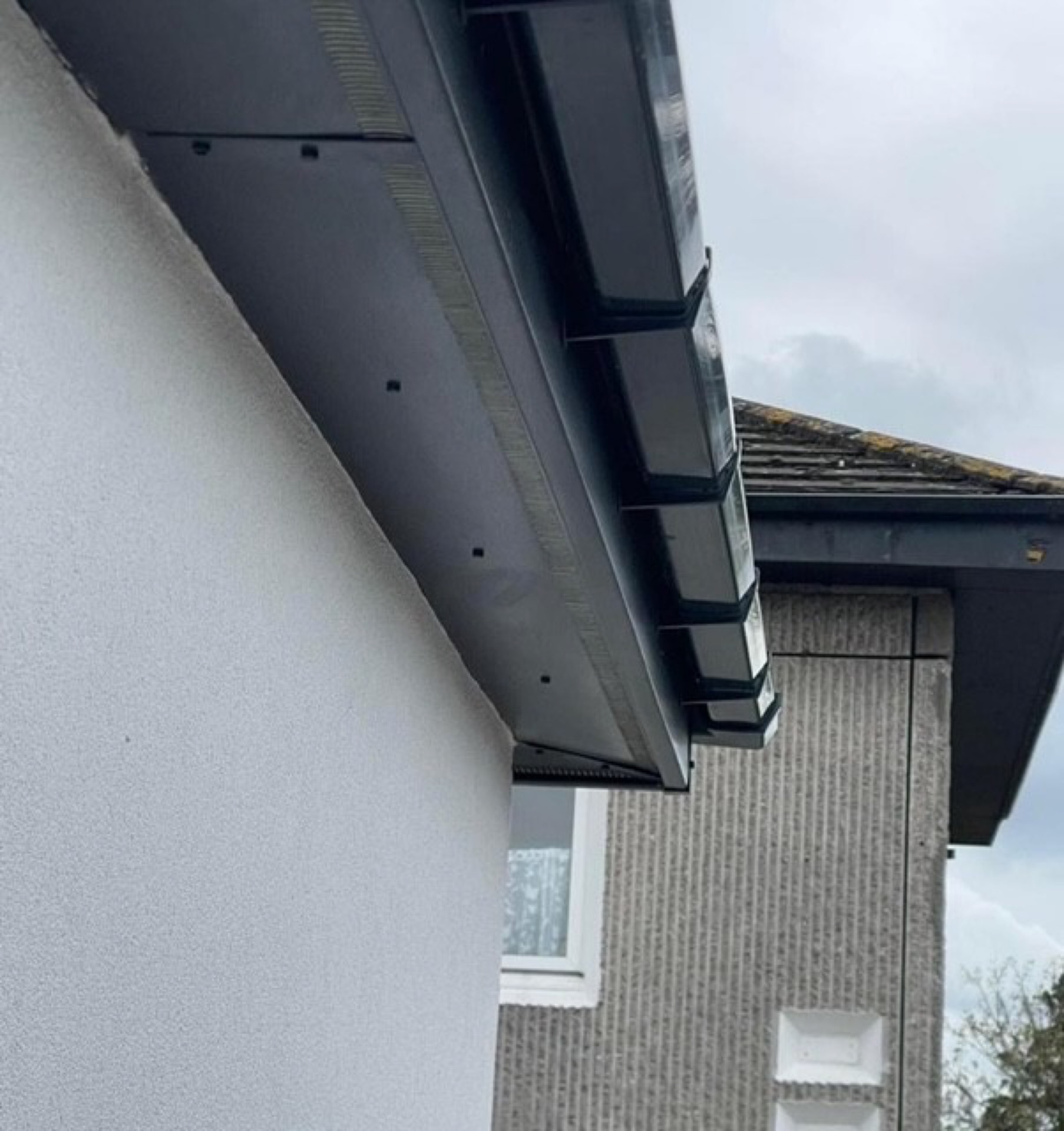
Used where there is no fascia board, or where the fascia is too thin or weak to support the gutter. The bracket has a long arm that extends back and screws to the top of the rafter foot or the roof deck.
Key features:
- Adjustable arm length — can be bent to set the correct fall
- Sits beneath the roof tiles, projecting forward to support the gutter
- Common on older properties, barn conversions, and open-eaves designs
- More time-consuming to install because you may need to lift roof tiles
When to use:
- No fascia board present
- Fascia board is damaged and cannot be replaced immediately
- Open-eaves architectural style (exposed rafter feet)
- Heavy-duty installations where the fascia alone cannot support the loaded gutter weight
3. Rise-and-Fall Brackets
Adjustable brackets that allow you to set the gutter height precisely without bending or repositioning the bracket. A screw mechanism raises or lowers the gutter cradle.
Key features:
- Fine-tune the fall after the bracket is fixed
- Useful on uneven fascia boards or where rafter heights vary
- More expensive than standard brackets but save time on difficult installations
4. Side-Fix Brackets
Fix to the side of the rafter rather than the fascia face. Used on some rafter-exposed designs and specific architectural details.
5. Driven-In Brackets
Metal or plastic brackets driven into a mortar joint or masonry wall. Used on properties where the gutter runs along a wall rather than a fascia — common on some commercial and agricultural buildings.
Bracket Spacing Guide
| Gutter Profile | Standard Conditions | Heavy Snow or Extreme Weather | Near Fittings |
|---|---|---|---|
| Mini (76 mm) | Maximum 600mm | Maximum 300mm | Within 150mm |
| Half round (112 mm) | Maximum 600mm | Maximum 300mm | Within 150mm |
| Square line (114 mm) | Maximum 600mm | Maximum 300mm | Within 150mm |
| Ogee (116 mm) | Maximum 600mm | Maximum 300mm | Within 150mm |
| Deep flow | Maximum 600mm | Maximum 300mm | Within 150mm |
| Hi-cap | Maximum 600mm | Maximum 300mm | Within 150mm |
| Kommercial 160 | Maximum 600mm | Maximum 300mm | Within 150mm |
“Near fittings” means placing an extra bracket within 150 mm of every angle, union, running outlet, or stop end. These fittings create stress points where the gutter changes direction or joins — supporting them prevents sagging and leaks.
Gutter Fittings: The Complete List
Union Joints
Join two lengths of gutter in a straight line. The most frequently used fitting.
Types:
- Standard union — slip-over joint with rubber seal and clip mechanism
- Expansion union — designed with extra movement allowance for long runs in hot/cold climates
Key points:
- Always use the moulded insertion marks and leave the manufacturer’s specified expansion allowance between gutter ends
- On long, dark coloured or sun-facing runs, allow around 10-15mm movement where required
- Ensure the seal is correctly seated before clipping
- One union per gutter joint (every 2 m or 4 m depending on gutter length)
For more detail on hot weather movement, see PVC Gutter Expansion and Contraction in Extreme Heat.
Running Outlets
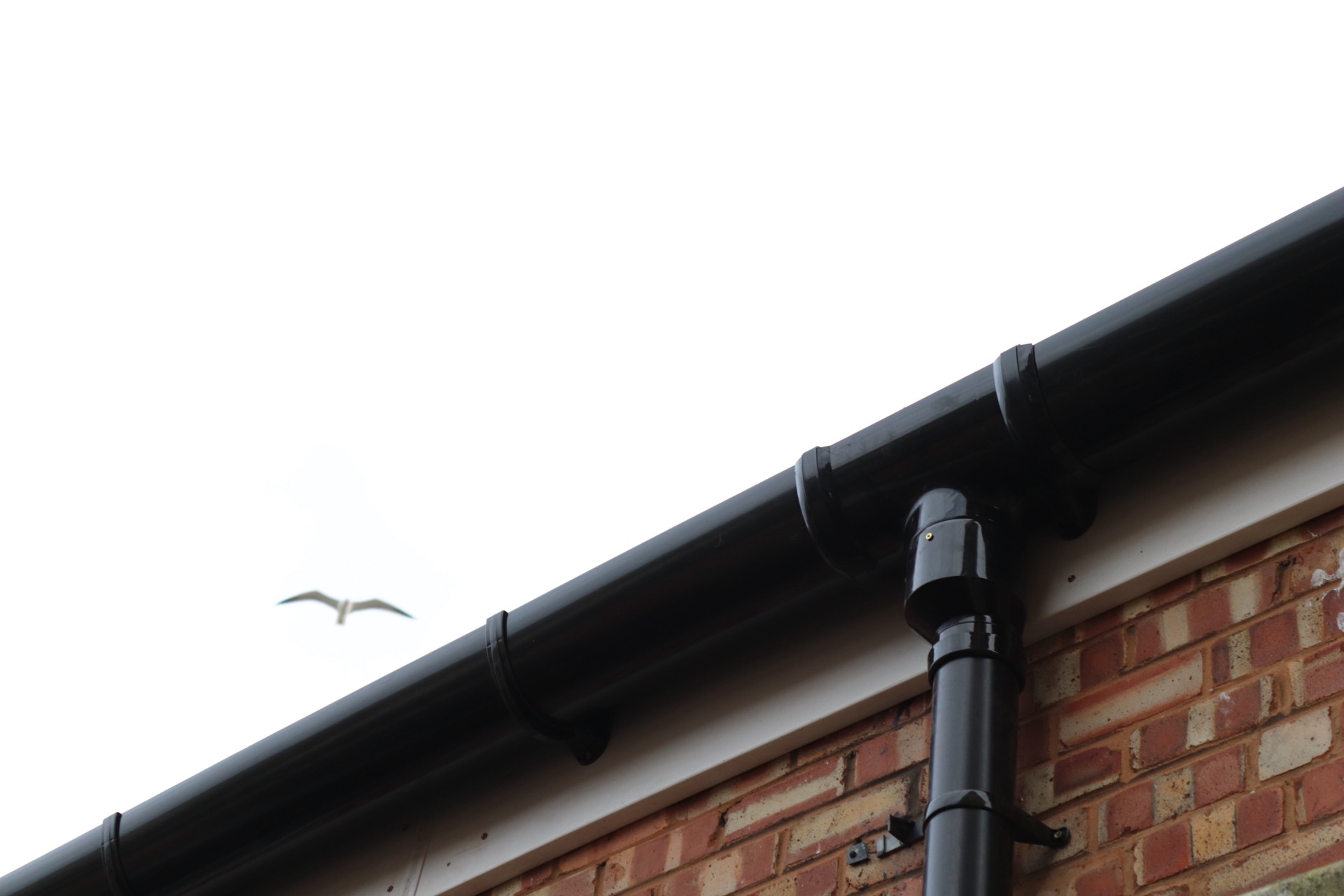
The fitting that connects the gutter to the downpipe. It has an integral outlet spigot that accepts the downpipe or offset bend.
Types:
- Standard running outlet — cuts into the gutter run; some require a hole to be cut in the gutter
- Prefabricated running outlet — a union-style fitting with the outlet moulded in; no cutting required
Positioning: At the lowest point of each gutter run (where the fall directs water).
Stop Ends
Seal the open ends of a gutter run.
Types:
- External stop end — fits over the gutter end from outside
- Internal stop end — fits inside the gutter (less common in PVC)
- Universal stop end — fits either left or right end
- Handed stop ends — specific to left or right; check before ordering
Tip: Apply a thin bead of silicone sealant inside the stop end before pressing into place for extra security.
Internal Angles (90°)
Connect two gutter runs at an inside corner — typically where the house meets a rear extension or where an L-shaped building turns inward.
External Angles (90°)
Connect two gutter runs at an outside corner — where the building projects outward (e.g., bay windows, front porches).
135° Angles
For corners that are not a right angle — common on bay windows (45° splay = 135° gutter angle) and angled extensions.
Gutter Guard / Leaf Mesh
Mesh strips that sit over or inside the gutter to prevent leaves and debris from entering. Available in various materials (plastic, aluminium, stainless steel) and fitting methods (clip-on, push-in, screwed).
Downpipe Fittings
Offset Bends (112.5° / Swan Neck)
Angled fittings that transition the downpipe from the gutter line (which projects beyond the fascia) back to the wall face. Two offset bends with a short connecting pipe create a “swan neck.”
Downpipe Clips / Brackets
Fix the downpipe to the wall at regular intervals (maximum 1,800 mm spacing). Types:
| Clip Type | Use |
|---|---|
| Pipe clip | Standard round downpipe — wraps around the pipe |
| Square pipe clip | Square downpipe systems |
| Stand-off clip | Holds the pipe away from the wall (for thick render or uneven walls) |
| Ear-band clip | Heritage-style bracket visible below the clip — period detail |
Pipe Shoe (Bottom Outlet)
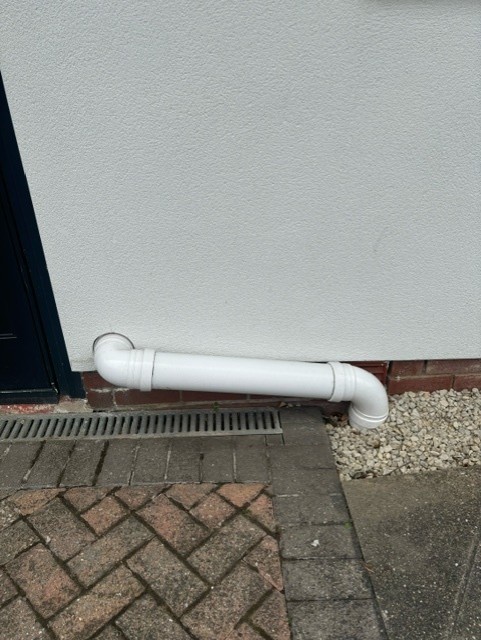
An angled fitting at the bottom of the downpipe that directs water away from the wall base into a drain gully, splash block, or soakaway.
Branch / Tee Connector
Joins two downpipes into one — used where two downpipes from different levels merge before reaching the drain.
Hopper Heads
Open-topped boxes that collect water from one or more sources (multiple pipes, overflow pipes) and funnel it into a single downpipe. Common on older and period properties as a decorative feature.
Access Pipes
Downpipe sections with a removable access panel for clearing blockages without dismantling the entire pipe run.
How Many Fittings Do You Need?
Use this checklist per gutter run:
| Component | Quantity Rule |
|---|---|
| Fascia brackets | 1 per 600mm maximum, or 1 per 300mm in heavy snow/extreme weather, plus fitting support |
| Union joints | 1 per gutter joint (every 2 m or 4 m length) |
| Running outlets | 1 per downpipe position |
| Stop ends | 1 per open end (2 per straight run, 1 if run connects to angle) |
| Angles | 1 per corner |
| Downpipe lengths | Gutter outlet to drain ÷ pipe length |
| Offset bends | 2 per swan neck (1 swan neck per downpipe) |
| Downpipe clips | 1 per 1,800 mm + 1 near top and 1 near bottom |
| Pipe shoes | 1 per downpipe |
Worked Example: Single Elevation, 8 m Run
| Component | Quantity | Calculation |
|---|---|---|
| Fascia brackets | 15 standard / 28 severe | Based on 600mm maximum, or 300mm for heavy snow/extreme weather, plus fitting support |
| Gutter lengths (4 m) | 2 | 8 m ÷ 4 m |
| Union joints | 1 | Where two 4 m lengths meet |
| Running outlet | 1 | At the low end |
| Stop ends | 2 | One at each open end (but 1 if angular return exists) |
| Offset bends | 2 | Swan neck |
| Connecting pipe (short) | 1 | Between swan neck bends |
| Downpipe (2.5 m lengths) | As needed | Height from gutter to ground ÷ 2.5 m |
| Downpipe clips | 3–4 | Based on height |
| Pipe shoe | 1 | Bottom of downpipe |
Browse the complete range of Kalsi Plastics rainwater system fittings organised by gutter profile.
Choosing the Right Fixings
Screws for Fascia Brackets
| Fascia Material | Screw Type | Size |
|---|---|---|
| Timber fascia | Stainless steel wood screw | 30–40 mm |
| PVC fascia over timber | Stainless steel wood screw (through PVC into timber) | 40–50 mm |
| PVC fascia without timber backing | Not recommended — use rafter-arm brackets | — |
Always use stainless steel screws. Plated or galvanised screws can rust over time, staining the PVC and eventually losing grip.
Fixings for Downpipe Clips
| Wall Type | Fixing Method |
|---|---|
| Solid brick / block | Wall plug (brown 7 mm) + stainless screw |
| Cavity brick (soft mortar) | Wall plug + longer screw (50 mm+) |
| Rendered wall | Through render into masonry — wall plug + screw |
| Timber frame with cladding | Direct screw into stud (use stud finder) |
Frequently Asked Questions
What gutter brackets do I need?
For most homes, fascia brackets matched to your gutter profile (half-round, ogee, square-line, etc.) are correct. Space them at no more than 600mm centres, reducing to 300mm in areas of heavy snow or extreme weather conditions. If you have no fascia board or the fascia is in poor condition, use suitable rafter-arm brackets fixed to the rafter feet. Always add extra support within 150mm of fittings.
How many gutter brackets per metre?
The 600mm maximum gives approximately 1.7 fascia brackets per metre in standard conditions. The 300mm maximum for heavy snow or extreme weather gives approximately 3.4 per metre. Round up and add support near fittings, outlets, stop ends and angles.
Can I reuse old gutter brackets?
If the existing brackets are in good condition, match the new gutter profile, and are securely fixed to a sound fascia, you can reuse them. However, if you are changing gutter profile (e.g., from half-round to ogee), old brackets will not fit. Given their low cost (£1–3 each), replacing brackets during a gutter change is good practice.
What is a running outlet?
A running outlet is the fitting that connects the gutter to the downpipe. It sits in the gutter line at the lowest point (where the fall directs water) and has a downward-pointing spigot that accepts the downpipe or offset bend. It is the most important fitting in the system — without it, there is no way for water to leave the gutter.
Do I need different brackets for different gutter profiles?
Yes. Each gutter profile has its own matching bracket designed to grip the specific shape. A half-round bracket does not fit an ogee gutter. Always ensure the brackets you buy are from the same system as your gutter — mixing brands or profiles leads to a poor fit, rattling in wind, and potential leaks.