Half Round vs Ogee Guttering: Which Is Best?
The main difference between half-round and ogee guttering is the profile shape and visual style. Half-round gutters have a simple, curved U-shape that suits most modern and traditional properties. Ogee gutters — also called K-style or moulded — have an S-shaped decorative front face that mimics period plasterwork. In terms of performance, ogee profiles typically carry marginally more water than a half-round of the same nominal width because of their deeper cross-section. Both are available in PVC-U, but capacity, declarations and certification scope vary by product. The choice should take account of aesthetics, roof area, rainfall and current technical data.
This is one of the most common questions homeowners and installers ask when specifying a rainwater system. Both profiles are widely available, similarly priced, and straightforward to install. But each has strengths that make it better suited to certain property types, architectural styles, and practical requirements.
Profile Shape — The Key Difference
Half Round
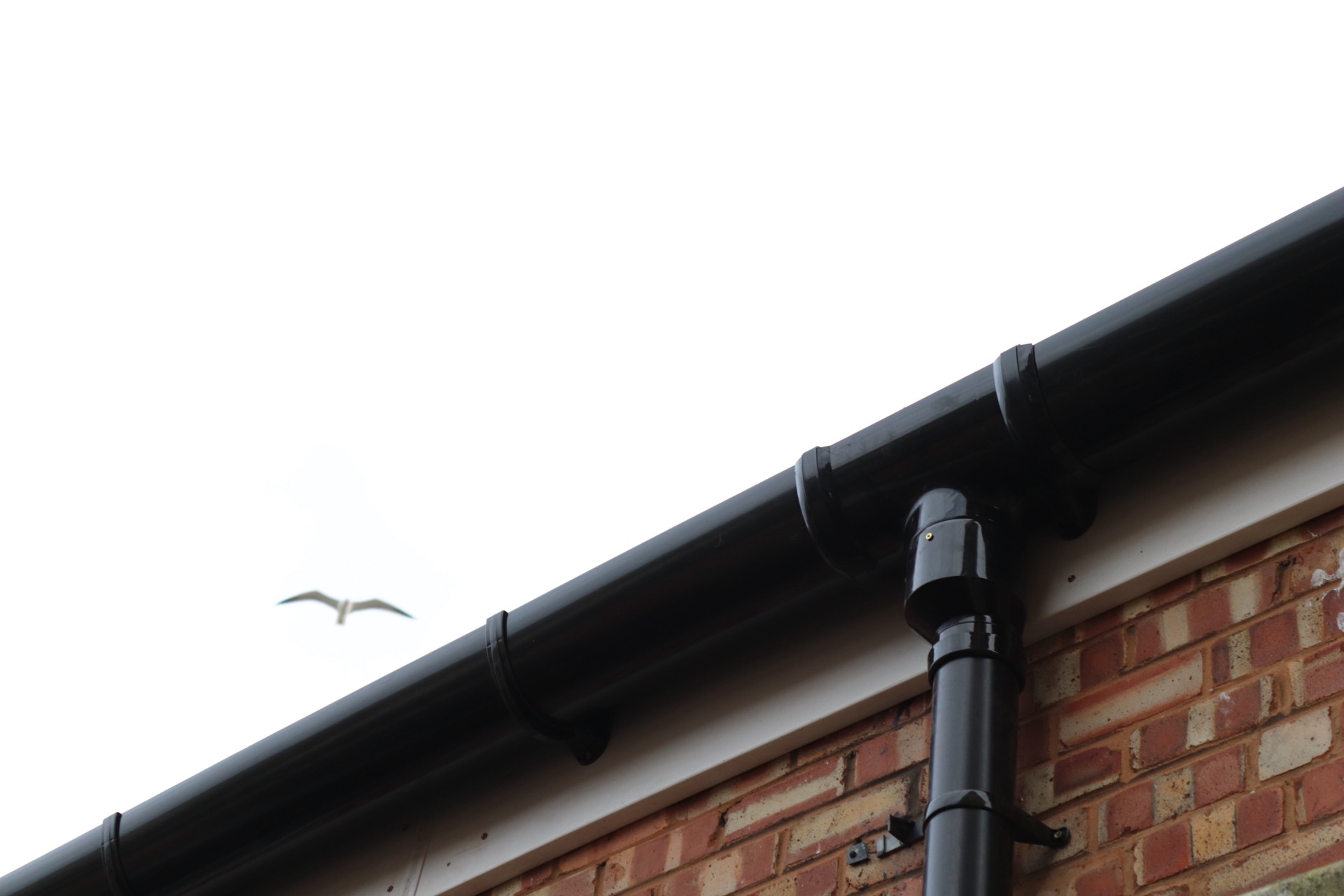
The half-round profile is exactly what it sounds like — a semi-circular gutter. It is the most traditional shape in the UK and has been used for centuries in cast iron, aluminium, and now PVC-U. The profile is symmetrical, clean, and understated.
Characteristics:
- Semi-circular cross-section
- Smooth, uniform curve inside and out
- Visible from ground level as a neat, arched line
- Brackets mount inside the gutter or clip onto the back edge
Ogee
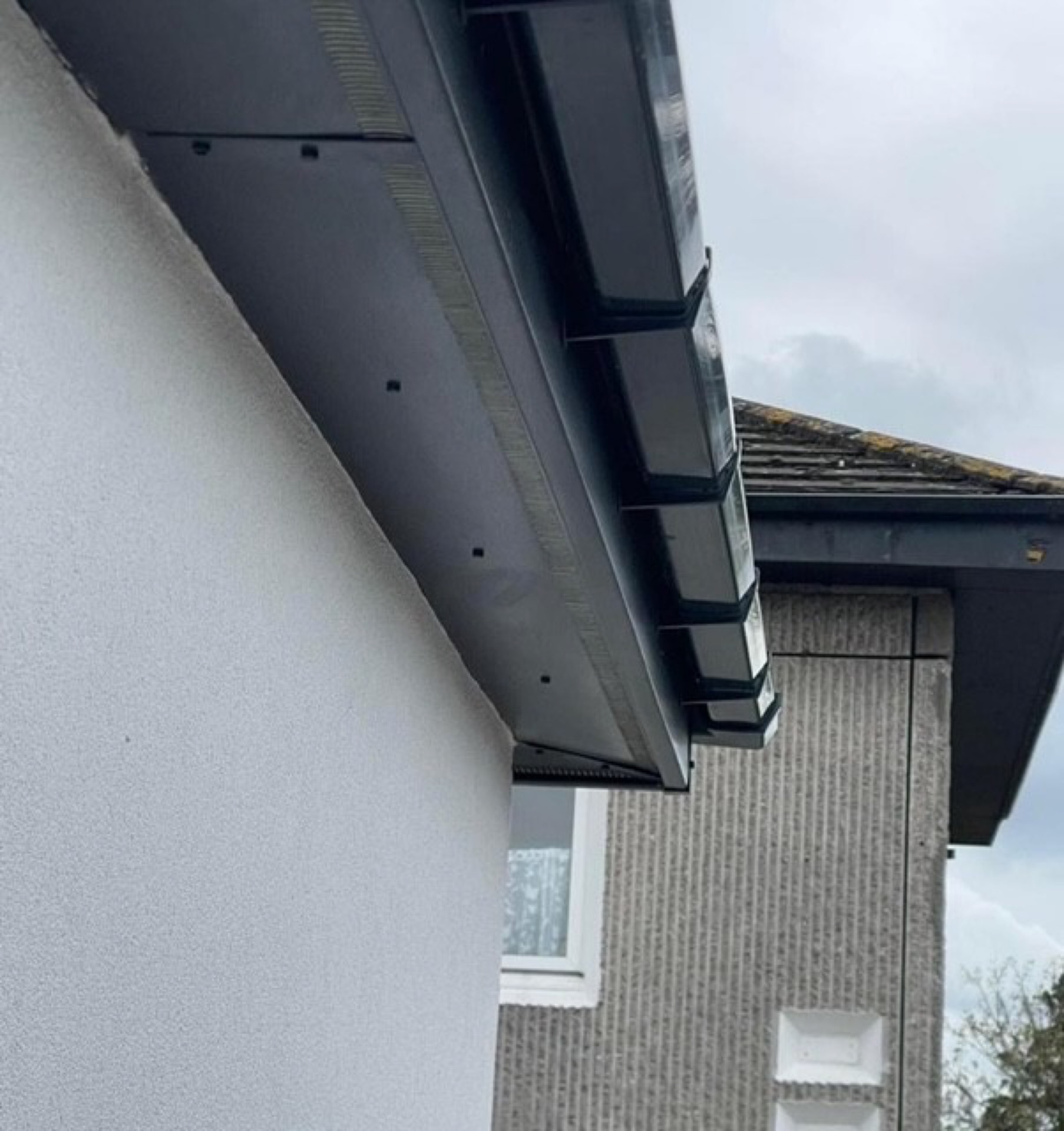
The ogee profile has a decorative front face with a double-curve (S-shape) that overhangs the fascia board. The rear sits flat against the fascia while the front projects outward with a moulded profile. It looks more substantial and ornamental than a half round.
Characteristics:
- Flat rear, decorative moulded front face
- Deeper overall depth than a half-round of the same width
- Visible profile is more prominent and architectural
- Brackets are typically concealed behind the front profile
Head-to-Head Comparison
| Feature | Half Round (112 mm) | Ogee (116 mm) |
|---|---|---|
| Profile shape | Semi-circular | S-curve / decorative |
| Flow capacity | ~0.9 l/s | ~1.1 l/s |
| Max effective roof area (at 75 mm/h) | ~43 m² | ~53 m² |
| Visual style | Clean, understated, modern | Ornamental, traditional, substantial |
| Best property types | New builds, modern estates, terraced, bungalows | Victorian, Edwardian, detached, period-style |
| Bracket visibility | Visible (fascia or rafter-arm) | Mostly concealed |
| Colour range | White, black, brown, grey, anthracite | White, black, brown, grey, anthracite |
| Typical cost per metre | £3–5 | £4–7 |
| Ease of installation | Very easy — clips and unions | Easy — similar system, slightly heavier |
| Cleaning | Simple — smooth interior, no ledges | Slightly harder — decorative front catches dirt |
Flow Capacity
Because the ogee profile is deeper and has a broader cross-section, it holds and channels more water than a same-width half round. For most domestic installations, either profile handles the required flow rate comfortably. The difference becomes meaningful on larger properties:
- A 50 m² effective roof area needs ~1.04 l/s at 75 mm/h
- Half-round (0.9 l/s) — slightly under-capacity as a single run
- Ogee (1.1 l/s) — comfortably within capacity
For properties in that 45–55 m² range, ogee gives you a useful margin. Above 60 m², both profiles fall short and you should consider deep-flow or hi-cap systems regardless of preference.
Aesthetics and Property Style
This is where most decisions are actually made. Few homeowners choose their guttering profile based on flow rate tables — they choose based on what looks right.
When Half Round Works Best
- New-build estates — the clean, simple profile matches contemporary architectural styles
- Bungalows — the low roofline makes guttering more visible, and half-round’s slimness avoids a top-heavy look
- Terraced houses — half round is the default replacement profile for most UK terraces, maintaining visual consistency along the street
- Modern extensions — where clean lines and minimal visual clutter are the design goal
- Sheds and outbuildings — simple, cheap, effective
When Ogee Works Best
- Victorian and Edwardian houses — the decorative profile echoes period cast-iron mouldings
- Detached properties — the heavier visual weight suits larger elevations
- Period-style new builds — developers often specify ogee on estates with a traditional aesthetic
- Conservation areas — where planning conditions may require a profile that resembles original cast iron (Kalsi’s cast-iron-effect range takes this further)
- High-end refurbishments — where the roofline is a visible selling point
Installation Differences
Both profiles use the same basic installation method: fascia brackets at no more than 600mm centres, reduced to 300mm in areas of heavy snow or extreme weather conditions, plus unions to join lengths, stop ends, running outlets, and downpipe connections.
Half Round
- Union clips join lengths — simple push-fit with seals
- Fascia brackets have a cradle that wraps the bottom of the gutter
- Rafter-arm brackets are available where there is no fascia board
- Cutting is straightforward with a fine-toothed hacksaw
Ogee
- Union joints sit behind the decorative front — less visible from ground level
- Fascia brackets clip onto the flat rear and are hidden by the front overhang
- Fascia bracket spacing must not exceed 600mm, or 300mm in areas of heavy snow or extreme weather conditions
- Cutting requires a clean, straight line because the moulded face shows imperfections more easily
For experienced installers, there is no significant difference in time or difficulty between the two. A first-time DIYer may find half round slightly more forgiving because the symmetrical shape makes alignment easier.
Colour and Material Options
Both profiles are manufactured in PVC-U by Kalsi Plastics and are available in a standard colour range:
| Colour | Half Round | Ogee |
|---|---|---|
| White | ✓ | ✓ |
| Black | ✓ | ✓ |
| Brown | ✓ | ✓ |
| Grey | ✓ | ✓ |
| Anthracite grey | ✓ | ✓ |
| Caramel | ✓ | ✓ |
Both profiles use external-grade PVC-U and will not rust. Routine inspection and cleaning are still required. Aquaflow rainwater guarantee periods are 5 years for coloured products, 10 years for cast-effect products and 15 years for white products. Full written terms apply.
Browse the full Kalsi rainwater systems range to see both profiles with all available fittings.
Cost Comparison
Ogee is typically 15–25% more expensive than half round, measured per linear metre of gutter and fittings. This is because:
- The profile uses slightly more material (deeper, heavier cross-section)
- Fittings are more complex moulds
- It is perceived as a premium product
For a full-house gutter replacement on a typical 3-bed semi:
| Item | Half Round | Ogee |
|---|---|---|
| Gutter (approx. 25 m total) | £75–125 | £100–175 |
| Fittings (angles, unions, outlets, stop ends) | £40–60 | £55–80 |
| Downpipes & accessories | £50–80 | £50–80 |
| Materials total | £165–265 | £205–335 |
The difference is relatively modest — £40–70 on materials for the average house. Labour costs are the same for both profiles. Given that a full roofline replacement typically costs £2,000–4,000 including scaffolding and labour, the gutter profile choice makes up a small percentage of the total project cost.
Mixing Profiles — Can You?
Technically, you should not mix profiles on the same elevation because the fittings are not interchangeable. Half-round unions do not fit ogee gutters and vice versa. However, you can use different profiles on different elevations if the property style warrants it — for example, ogee on the front elevation and half-round on the rear where it is less visible.
Each elevation needs its own self-contained gutter run with matched fittings. Where two runs meet at an internal or external angle, both must be the same profile.
The Verdict
| Scenario | Recommended Profile |
|---|---|
| Budget-conscious replacement | Half round |
| Modern new-build | Half round |
| Period property | Ogee |
| High kerb appeal / front of house | Ogee |
| Sheds, outbuildings, lean-tos | Half round (or mini gutter) |
| Large detached home | Ogee (or step up to deep-flow) |
| Conservation area | Ogee or cast-iron effect |
There is no wrong answer. Both half round and ogee guttering perform the same function, meet the same British Standards, and last just as long. If you want understated and cost-effective, go half round. If you want visual impact and a premium feel, go ogee.
Frequently Asked Questions
What’s the difference between half round and ogee guttering?
Half round has a simple semi-circular profile, while ogee has a decorative S-curved front face. Ogee holds slightly more water and looks more ornamental. Half round is the more common, lower-cost option suited to most modern properties, while ogee is the preferred choice for period-style homes.
Is ogee guttering better than half round?
Neither is objectively better — they serve the same purpose. Ogee has marginally higher flow capacity and a more decorative appearance. Half round is simpler, cheaper, and easier for DIY installation. Choose based on your property’s style and your budget rather than performance.
Can I replace half round gutters with ogee?
Yes. If your existing brackets and fascia board are in good condition, you simply remove the half-round gutter and fittings, install new ogee brackets at the correct centres, and fit the ogee system. You will need new fittings throughout — the two profiles are not interchangeable.
What size ogee gutter do I need?
Standard ogee gutter (116 mm nominal) handles an effective roof area of up to about 53 m² at 75 mm/h rainfall intensity. For larger roofs, consider a deep-flow or hi-cap system. The calculation method is the same as for any other profile — see our gutter sizing guide.
Do ogee gutters block more easily?
The decorative front ledge can collect debris slightly more than a smooth half-round interior, but the difference is minimal. Both profiles benefit from regular cleaning (twice a year) and leaf guards if the property is near trees. The key factor in blockage is downpipe size and outlet frequency, not gutter profile.