External Cladding Building Regulations: Fire and Ventilation
Yes, you generally need to comply with Building Regulations when installing external cladding. The specific requirements depend on the type of building, its height, its use, and whether the cladding installation constitutes a material alteration or a change that affects the building’s energy performance, fire safety, or structural integrity. The most relevant Approved Documents are Part B (Fire Safety), Part C (Site preparation and resistance to contaminants and moisture), and Part L (Conservation of fuel and power). On residential buildings under 18 metres, PVC-U cladding typically complies without difficulty, but understanding the regulations ensures your installation is both safe and lawful.
This guide explains the regulatory framework for external cladding in England and Wales, with specific focus on fire safety and ventilation — the two areas that cause the most confusion and the most problems when ignored.
When Do Building Regulations Apply to Cladding?
Building Regulations apply when cladding work constitutes building work as defined by Regulation 3 of the Building Regulations 2010. In practical terms, this means:
Cladding Work That Requires Building Regulations Approval
- New buildings — all external cladding on new constructions must comply
- Extensions — cladding on extensions is covered as part of the extension’s overall Building Regulations submission
- Material alterations — adding cladding to an existing building where it affects the building’s structural integrity, fire safety, or energy performance
- Change of use — if a building’s use changes (e.g., garage converted to habitable space), the external envelope may need to be upgraded to meet current standards
- Thermal upgrades — adding insulation behind cladding triggers Part L requirements for thermal performance
Cladding Work That May Not Require Building Regulations
- Like-for-like replacement — replacing existing cladding with similar material in the same configuration may not require approval, though it is advisable to check with your local building control body
- Non-habitable outbuildings — garden sheds, small garages, and similar structures under 30 m² may be exempt from Building Regulations (but not from planning rules)
When in doubt, contact your local authority building control department or an approved inspector before starting work. Retrospective enforcement can be costly and disruptive.
Approved Document B: Fire Safety
Approved Document B is the Building Regulations guidance document that deals with fire safety in buildings. Following the Grenfell Tower fire in 2017, the requirements relating to external cladding have been significantly strengthened.
Height Thresholds
The fire safety requirements for cladding vary based on building height:
| Building Height | Key Requirements |
|---|---|
| Under 11 m (most houses) | Cladding must meet a minimum of Euroclass D-s3,d2 or national Class 0 |
| 11–18 m (low-rise flats, some commercial) | Stricter requirements; Class B-s3,d2 may be required for some components |
| Over 18 m (high-rise residential) | Cladding materials must be Class A2-s1,d0 or Class A1 (essentially non-combustible); this effectively rules out PVC-U and timber on the outer face |
For the vast majority of UK housing — detached, semi-detached, and terraced homes, bungalows, and low-rise extensions — the building height is well under 11 m, and standard PVC-U cladding meets the fire performance requirements.
Understanding Fire Classification
External cladding fire performance is assessed under BS EN 13501-1, which classifies materials based on their reaction to fire. The key classifications relevant to cladding are:
| Euroclass | Description | Typical Materials |
|---|---|---|
| A1 | Non-combustible | Stone, brick, concrete, steel |
| A2 | Limited combustibility | Some fibre cement boards, mineral wool |
| B | Very limited contribution to fire | Some treated timber, certain composites |
| C | Limited contribution to fire | Some composite materials |
| D | Medium contribution to fire | Most PVC-U cladding, some timber cladding |
| E | High contribution to fire | Untreated softwood, some foam insulation |
| F | Unclassified or fails tests | Materials not tested or failing minimum standards |
PVC-U cladding typically achieves Euroclass D-s2,d0 or Euroclass E, depending on the formulation. PVC-U is self-extinguishing — it chars and melts when exposed to flame but does not sustain combustion once the ignition source is removed. This is a significant safety advantage over timber, which supports flame spread.
Fire Barriers and Cavity Barriers
Even on low-rise buildings, fire can spread through the ventilated cavity behind cladding. The Building Regulations require cavity barriers at specific locations to prevent this:
- At the junction between the cladding and the roof (eaves level)
- Around openings (windows, doors, vents)
- At compartment wall positions (where the wall separates different dwellings or fire compartments)
- At maximum intervals specified in the Approved Document (typically every 20 m horizontally and every 20 m vertically for Class D materials)
Cavity barriers must be intumescent (expanding in fire) or non-combustible, and they must not obstruct the normal ventilation function of the cavity in non-fire conditions.
Specific Requirements for Different Building Types
Single dwellings (houses and bungalows): Standard PVC-U cladding with appropriate cavity barriers meets Approved Document B requirements for buildings under 11 m. No additional fire testing is typically required.
Flats and maisonettes (under 18 m): More detailed consideration is needed. The cladding system (boards, battens, insulation, and cavity barriers working together) may need to be assessed as a complete assembly rather than as individual materials.
Commercial and mixed-use buildings: Requirements vary by use class and building height. Specialist fire engineering advice is recommended.
Approved Document C: Moisture and Weather Resistance
Approved Document C sets out requirements for protecting buildings from moisture. For external cladding, the key requirements are:
Rainscreen Cladding Principles
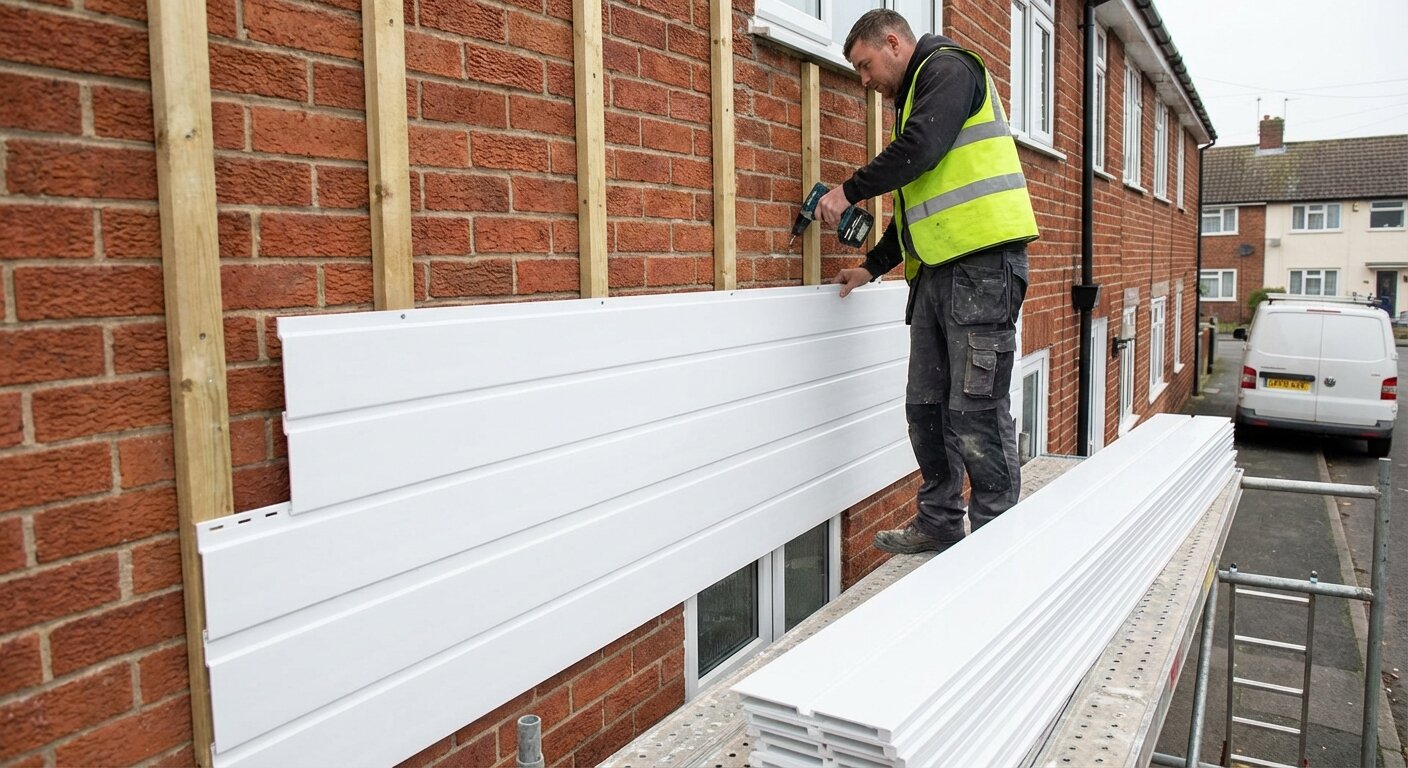
External cladding in the UK is almost always installed as a rainscreen — an outer skin separated from the structural wall by a ventilated cavity. This system works in three layers:
- Outer skin (the cladding) — sheds the majority of rainwater from the building’s surface
- Ventilated cavity — allows any moisture that penetrates the outer skin to drain and evaporate
- Inner barrier (breather membrane on timber frames, or the masonry wall itself) — provides the final line of defence against moisture reaching the building’s interior
The ventilated cavity is the critical element. Approved Document C and the supporting standard BS 8104 (Code of practice for assessing exposure of walls to wind-driven rain) recommend a minimum cavity depth of 25 mm to provide adequate drainage and ventilation.
Cavity Ventilation Requirements
The cavity must be ventilated at the top and bottom to allow air movement:
- Bottom ventilation: Leave the base of the cavity open or use a ventilated starter strip with insect mesh to prevent pest ingress while maintaining airflow
- Top ventilation: Provide ventilation at the top of the cavity — typically at the soffit junction or through a ventilated top trim
- Do not block the cavity — cavity barriers for fire stopping must be designed to allow continued ventilation in non-fire conditions (intumescent barriers expand only when heated)
Breather Membranes
On timber-frame construction, a breather membrane complying with BS 4016 or BS EN 13859-2 must be installed between the frame and the battens. This membrane is vapour-permeable (allowing moisture vapour to pass outward from the building) but water-resistant (preventing liquid water from reaching the frame).
On solid masonry construction, the masonry wall itself provides the inner moisture barrier, and a breather membrane is not normally required — though it can provide additional protection.
Approved Document L: Energy Performance
When adding cladding to an existing building, Approved Document L may apply if the work constitutes a renovation of a thermal element (the external wall).
When Part L Applies
If you are adding cladding to an existing building and the work involves replacing or substantially altering more than 50% of the wall’s surface area, you may need to upgrade the wall’s thermal performance to current standards. This typically means:
- Achieving a maximum U-value of 0.30 W/m²K for the completed wall build-up (current Part L requirement for renovated walls)
- Adding insulation within or behind the cladding system to achieve this U-value
- Ensuring that any insulation does not block the ventilation cavity
If you are simply replacing cladding without altering the wall’s thermal performance, Part L may not apply — but check with building control to confirm.
Insulation Placement
Insulation should be placed within the wall structure (between studs on timber-frame walls, or as internal or external wall insulation on masonry walls) — not in the ventilation cavity behind the cladding. The ventilation cavity must remain clear to function as a drainage and ventilation channel.
Approved Document F: Ventilation
Approved Document F covers ventilation of buildings. While it primarily addresses indoor air quality, it has implications for external cladding:
- Airbricks and ventilation grilles in the existing wall must not be blocked by the cladding system. Maintain airflow by cutting the cladding around ventilation openings and fitting matching vent covers.
- Trickle vents in windows must remain functional and unobstructed by cladding trims.
- Subfloor ventilation via airbricks must not be compromised — this is particularly important on older properties with suspended timber ground floors.
Compliance Checklist for Installers
Use this checklist to ensure your cladding installation meets Building Regulations:
| Item | Requirement | Check |
|---|---|---|
| Fire classification | Cladding material meets minimum Euroclass for building height | ☐ |
| Cavity barriers | Installed at roof junction, around openings, and at compartment walls | ☐ |
| Ventilation cavity | Minimum 25 mm clear, ventilated at top and bottom | ☐ |
| Breather membrane | Installed on timber-frame walls (BS 4016 / BS EN 13859-2) | ☐ |
| DPC clearance | Bottom of cladding at least 150 mm above ground level | ☐ |
| Airbricks maintained | All existing ventilation openings remain unobstructed | ☐ |
| Thermal performance | Wall U-value meets Part L if renovation threshold triggered | ☐ |
| Building control notification | Local authority or approved inspector notified before work commences | ☐ |
Post-Grenfell Changes: What Has Changed?
Since the Grenfell Tower fire, several significant changes have affected the cladding industry:
- Ban on combustible materials over 18 m — Regulation 7(2) of the Building Regulations now requires materials achieving minimum Class A2-s1,d0 on the external walls of buildings over 18 m containing dwellings
- Building Safety Act 2022 — introduced the Building Safety Regulator and new duty holder responsibilities for higher-risk buildings
- Increased scrutiny of product testing — manufacturers must provide clear, verified fire test data for their products
- Gateway process — higher-risk buildings must pass through three regulatory gateways during design, construction, and completion
For typical residential cladding projects (houses, bungalows, low-rise extensions, and garden rooms), these high-rise-focused changes do not directly apply. However, the increased awareness of cladding fire safety means that building control officers are more thorough in their inspections, and specifiers should be prepared to provide fire performance documentation for the products they use.
Frequently Asked Questions
Do I need building control sign-off for cladding my house?
If the cladding work constitutes a material alteration or triggers Part L requirements, yes. For a straightforward like-for-like replacement on a standard house, formal building control approval may not be required, but it is good practice to notify your local building control body and ask for their view before starting.
Can I use PVC-U cladding on a building over 18 m?
No. Buildings over 18 m containing dwellings must use materials achieving a minimum of Euroclass A2-s1,d0 on their external walls. PVC-U does not meet this threshold. Fibre cement, metal, and certain mineral-based boards are the main options for high-rise applications.
Do cavity barriers block the ventilation gap?
Cavity barriers designed for ventilated cladding systems are typically intumescent — they remain open in normal conditions, allowing air to circulate, and expand to seal the cavity only when exposed to fire temperatures. This means they do not compromise the ventilation function during normal use.
What happens if I install cladding without complying with Building Regulations?
Your local authority can serve an enforcement notice requiring you to remove or alter the non-compliant work. This can be expensive and disruptive. Non-compliant work can also cause problems when selling the property, as conveyancing solicitors routinely check for building control completion certificates.
Are there different regulations in Scotland and Northern Ireland?
Yes. Scotland uses the Building (Scotland) Regulations 2004 with separate Technical Handbooks, and Northern Ireland uses the Building Regulations (Northern Ireland) 2012. The principles are similar, but the specific document references and requirements differ. This guide covers England and Wales.