Composite vs PVC Cladding: Honest Comparison
Whether composite cladding is better than PVC depends entirely on your priorities. Composite cladding offers a more convincing natural timber appearance and slightly better thermal insulation properties, but it is heavier, more expensive, and harder to cut cleanly on site. PVC-U cladding is lighter, cheaper, easier to install, and requires the least maintenance of any cladding material — but its plastic appearance, though much improved with modern woodgrain textures, still does not match the tactile quality of a good composite board. Neither material is objectively “better” — the right choice depends on your budget, aesthetic goals, maintenance tolerance, and the specific demands of the project.
This guide provides an honest, side-by-side comparison covering every factor that matters, so you can make an informed decision rather than relying on marketing claims from either side.
What Is Composite Cladding?
Composite cladding is made from a blend of wood fibres (or wood flour) and polymer binders — typically polyethylene (PE), polypropylene (PP), or polyvinyl chloride (PVC). The wood content typically ranges from 40% to 70% by weight, with the remainder being polymer, binding agents, pigments, and UV stabilisers.
The wood-polymer blend is extruded under heat and pressure into board profiles that can mimic traditional cladding styles — shiplap, weatherboard, and flat panel. The resulting boards combine some of the visual and tactile properties of timber with the moisture resistance of plastic.
Common composite types:
- WPC (Wood-Plastic Composite) — the most common; uses PE or PP as the polymer base
- PVC-Wood Composite — uses PVC as the polymer; slightly different properties from PE-based composites
- Co-extruded composite — has a separate outer cap (like co-extruded PVC-U) for enhanced UV and moisture resistance
What Is PVC-U Cladding?
PVC-U (unplasticised polyvinyl chloride) cladding is made entirely from rigid plastic — there is no wood content. Boards are extruded in profiles that replicate traditional timber cladding styles, with colour and texture applied through co-extrusion (solid colours) or foil wrapping (woodgrain effects).
PVC-U cladding has been the dominant external cladding material in the UK market for over two decades, valued for its low cost, zero maintenance, and proven durability.
Head-to-Head Comparison
| Factor | Composite Cladding | PVC-U Cladding |
|---|---|---|
| Material composition | 40–70% wood fibre + polymer binders | 100% rigid PVC |
| Weight per m² | 6–12 kg | 3–5 kg |
| Typical board width | 150–200 mm | 150–200 mm |
| Lifespan | 25–30 years | 25–40 years |
| Maintenance | Wash annually; occasional scrubbing for algae | Wash annually; no additional treatment |
| Rot resistance | High (but not immune — wood content can absorb moisture in some products) | Immune — zero moisture absorption |
| Insect resistance | High (polymer encapsulation protects wood fibres) | Immune |
| Fire performance | Varies — typically Euroclass D or E | Typically Euroclass D-s2,d0 or E (self-extinguishing) |
| UV resistance | Good (co-extruded products better) | Good (co-extruded products excellent) |
| Thermal expansion | Moderate (less than PVC-U due to wood fibre content) | Higher (approximately 0.06–0.08 mm/m/°C) |
| Colour options | Moderate range (typically 8–15 colours) | Wide range (20+ colours including woodgrains) |
| Texture/feel | More natural — wood fibres add tactile warmth | Smoother — feels like plastic even with woodgrain texture |
| Cutting on site | Can be dusty and harder on saw blades | Cuts cleanly with standard woodworking tools |
| Relative cost | Higher (30–60% more per m² than PVC-U) | Lower |
| Recyclability | Limited — mixed material is harder to recycle | Fully recyclable |
Where Composite Wins
Natural Appearance and Feel
This is composite’s primary advantage. The wood fibre content gives composite boards a tactile warmth and visual depth that PVC-U cannot fully replicate. When you touch a composite board, it feels more like wood. When you look at it from close range, the grain pattern has a natural randomness that foil-wrapped PVC-U lacks.
For projects where the cladding will be viewed and touched at close quarters — entrance porches, feature walls, low-level garden room walls — this difference in perceived quality can justify the price premium.
Thermal Movement
Composite cladding exhibits less thermal expansion and contraction than PVC-U because the wood fibres within the matrix restrict the polymer’s natural tendency to expand. This means:
- Smaller expansion gaps are needed at abutments
- Less risk of buckling on south-facing elevations in hot weather
- Joints remain tighter across temperature cycles
For dark colours on heavily sun-exposed walls, composite’s lower thermal movement can be a significant practical advantage.
Stiffness and Impact Resistance
Composite boards are generally stiffer than PVC-U boards of the same thickness, due to the wood fibre reinforcement. They are less likely to flex in wind and better resist denting from moderate impacts. This makes them a reasonable choice for ground-level cladding in areas where accidental impacts from wheelie bins, bicycles, or garden equipment are possible.
Acoustic Performance
Composite cladding has slightly better acoustic dampening properties than PVC-U, due to its higher density and mixed-material composition. While neither material is specified primarily for sound insulation, composite will produce less noise from rain impact and feel less “hollow” when tapped.
Where PVC-U Wins
Maintenance
PVC-U requires the absolute minimum maintenance of any cladding material. An annual wash with soapy water is all it needs. Composite cladding is also low-maintenance, but its wood content means it can be more susceptible to:
- Algae and mould growth — the organic wood fibres provide nutrients for biological growth, particularly on north-facing and shaded elevations. Regular cleaning with an algae-specific cleaner may be necessary.
- Surface staining — some composite products are prone to tannin bleed (brownish staining from the wood content) in the first year after installation, particularly during wet weather.
- Scratching — some composite surfaces show scratches more visibly than PVC-U, and scratches may expose the lighter core colour.
PVC-U’s completely synthetic composition means it provides no organic material for biological growth, does not stain from within, and maintains a consistent surface finish throughout its life.
Weight and Handling
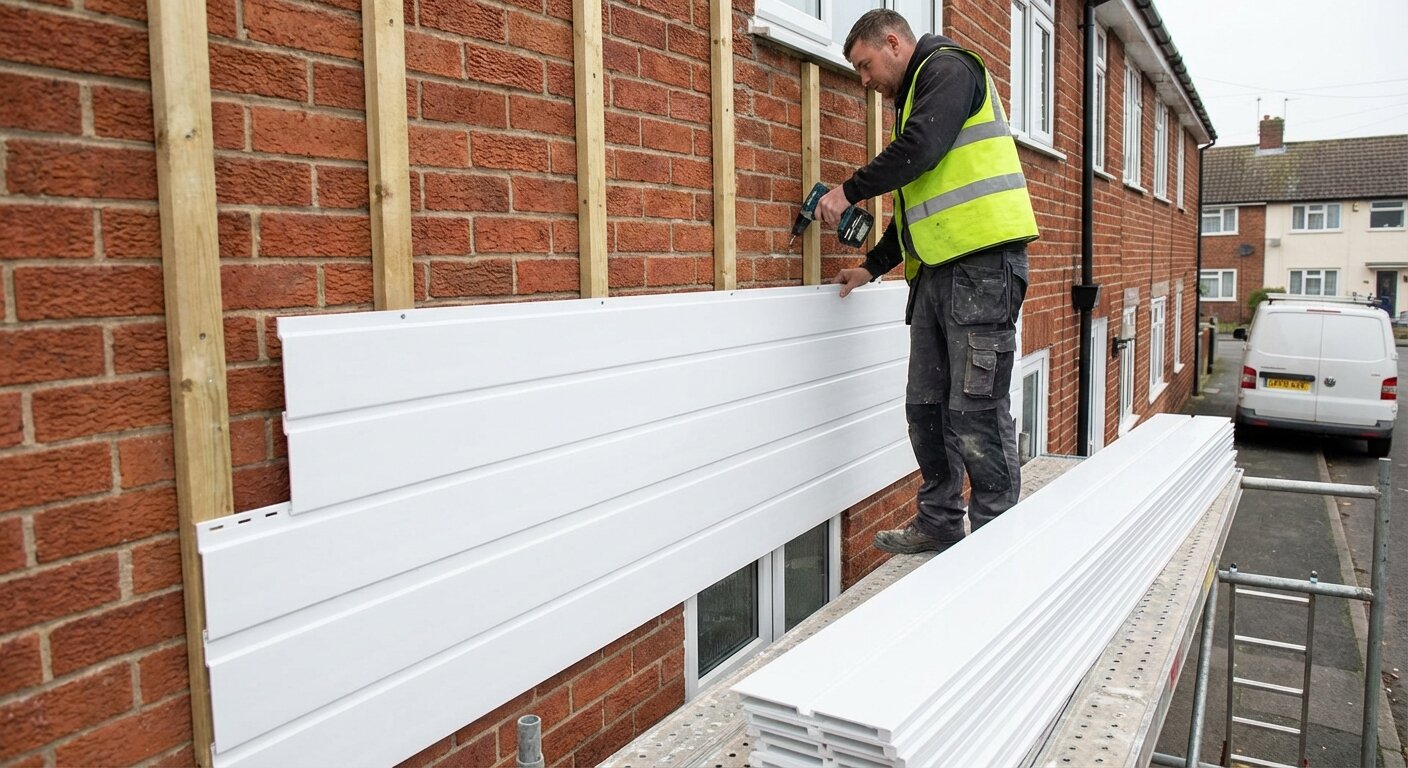
PVC-U boards are approximately 40–60% lighter than equivalent composite boards. This difference is significant in practice:
- Easier to carry up scaffolding and handle at height
- Faster to install — less physical fatigue for the installer
- Lower delivery costs — more material per pallet
- Less structural load on the building — important for lightweight garden room frames
Cost
PVC-U cladding is consistently cheaper than composite — typically 30–60% less per square metre for the boards alone. When you factor in the lighter fixings, easier handling, and faster installation time, the total installed cost difference can be even greater.
For large-area cladding projects (entire houses, multi-unit developments), this cost difference is substantial and often decisive.
Moisture Resistance
PVC-U absorbs zero moisture. Composite cladding, despite its polymer content, can absorb small amounts of water through exposed cut ends, fixings holes, and any surface damage that breaks through the protective cap. While modern co-extruded composite products have significantly reduced this issue, PVC-U’s complete immunity to moisture absorption gives it an inherent advantage in wet, exposed locations.
Recyclability
PVC-U is a single-material product that is straightforward to recycle through established recycling networks (such as Recovinyl in Europe). Composite cladding’s mixed wood-and-polymer composition makes it much harder to recycle — in practice, most end-of-life composite cladding goes to landfill or energy recovery rather than material recycling.
Colour Range
PVC-U cladding is available in a wider range of colours and finishes than most composite ranges. The foil-wrapping process used for PVC-U woodgrain effects can reproduce virtually any colour or pattern, whereas composite manufacturers typically offer 8–15 standard colours.
Common Misconceptions
”Composite is maintenance-free”
This claim appears frequently in composite cladding marketing but is misleading. Composite is low maintenance, not zero maintenance. The wood fibre content makes it susceptible to algae and mould growth that requires periodic cleaning, and some products need annual treatment with a protective oil or coating to maintain their appearance.
”PVC-U always looks plasticky”
This was true of early PVC-U cladding products, but modern co-extruded and foil-wrapped boards with deep woodgrain textures are convincing at normal viewing distances (3+ metres). Close up, yes — PVC-U still feels and looks like plastic. But on a building viewed from the street, the difference from timber or composite is minimal.
”Composite is more eco-friendly”
The environmental comparison is complex. Composite often uses recycled wood and plastic, which is a genuine sustainability benefit at the manufacturing stage. However, its mixed-material composition makes end-of-life recycling difficult. PVC-U, while petroleum-derived, is fully recyclable and has a longer lifespan, which means fewer replacement cycles and less waste over the building’s life.
”PVC-U cannot be used in exposed locations”
PVC-U cladding performs well in exposed coastal and upland locations. Its zero moisture absorption and corrosion resistance make it better suited to salt-spray environments than composite, which can absorb moisture through exposed edges.
Making the Right Choice for Your Project
Choose Composite When:
- The cladding will be viewed and touched at close range (entrance porches, garden room interiors/exteriors)
- A natural timber appearance is the primary design goal
- The budget allows for the premium
- The walls are heavily south-facing and thermal movement is a concern (dark colours)
- You want superior acoustic dampening (e.g., a music studio garden room)
Choose PVC-U When:
- Budget is a primary consideration
- The project covers a large area (full house cladding, multi-unit development)
- Minimum maintenance is the priority
- The installation is DIY or the team is more experienced with PVC-U
- The location is exposed — coastal, windswept, or north-facing and prone to algae
- A wide colour choice is needed
Consider Mixing Both
On some projects, using composite for high-visibility areas (front elevation, entrance features) and PVC-U for less visible elevations (rear, side walls) provides a good balance of aesthetics and economy. Ensure the colour match between the two materials is acceptable — order samples of both and view them together in situ before committing.
Frequently Asked Questions
Can composite and PVC-U cladding be installed using the same methods?
The installation principles are similar — both require battens, a ventilation cavity, and appropriate trims. However, composite’s greater weight may require stronger fixings, and its lower thermal expansion means expansion gaps can be smaller. Always follow the specific manufacturer’s installation guide for each product.
Which material is better for a garden room?
PVC-U is the most popular choice for garden rooms due to its low cost and zero maintenance. Composite is a good alternative if you want a more premium, natural appearance and the budget allows. Both perform well in this application.
Do both materials need a ventilation gap behind them?
Yes. Both composite and PVC-U cladding must be installed over a ventilated cavity (minimum 25 mm) to manage moisture behind the boards. This is a Building Regulations requirement, not a material-specific one.
How long before composite cladding needs replacing?
Quality composite cladding typically lasts 25–30 years. Some manufacturers offer 25-year guarantees on structural performance. However, the surface appearance may deteriorate faster than PVC-U — fading, algae staining, and surface erosion are more common issues on composite than on PVC-U.
Is composite cladding heavier to deliver and handle?
Yes, noticeably so. A pallet of composite cladding can weigh 50–80% more than an equivalent pallet of PVC-U. Factor in delivery access, site storage, and scaffolding load limits when planning the project.