Cladding for Garden Rooms: Best Materials and Profiles
The best cladding for a garden room depends on the look you want, the maintenance you are willing to do, and how long you expect the building to last. PVC-U shiplap or weatherboard cladding is the most popular choice in the UK because it is affordable, rot-proof, virtually maintenance-free, and available in a wide range of colours and woodgrain finishes. Timber cladding suits natural, organic designs but needs repainting or restaining every three to five years. Composite cladding offers a middle ground between the two, while metal cladding delivers a bold contemporary aesthetic at a higher price point.
This guide compares every mainstream cladding material, explains which profiles work best on garden room structures, and covers the practical considerations — from ventilation and insulation to planning rules — that affect your choice.
Why Cladding Matters on a Garden Room
Garden rooms are typically lightweight timber-frame structures, and the external cladding is their first line of defence against the weather. Unlike a traditional brick or block house, a garden room relies entirely on its cladding, breather membrane, and insulation layers to keep the interior dry, warm, and comfortable.
Choosing the wrong cladding — or installing it incorrectly — can lead to:
- Moisture ingress behind the cladding, causing timber frame rot and mould growth
- Poor thermal performance if cladding is not detailed correctly at junctions with windows, doors, and the roof
- Premature deterioration if the material is not suited to the building’s exposure conditions
- Aesthetic disappointment if the finish does not complement the garden setting or the main house
Getting the cladding right is one of the most important decisions in the entire garden room build.
Material Comparison
PVC-U Cladding
PVC-U (unplasticised polyvinyl chloride) is the default choice for the UK garden room market. Its combination of low cost, zero maintenance, and wide colour availability makes it hard to beat for most projects.
Advantages:
- Immune to rot, insect attack, and fungal decay
- No painting, staining, or surface treatment required — ever
- Available in shiplap, weatherboard, and decorative profiles
- Colour options include white, cream, sage green, anthracite grey, black, golden oak, rosewood, and more
- Lightweight — easy to handle and fix, even on lightweight timber frames
- Fully recyclable at end of life
Considerations:
- Not a natural material — some clients prefer the authentic look and feel of real timber
- Thermal expansion requires proper detailing at abutments (5–8 mm gaps per run)
- Can look plasticky if a low-quality product is used — choose co-extruded boards with woodgrain texturing for the most convincing appearance
Typical lifespan: 25–40 years with minimal maintenance
Timber Cladding
Timber remains a popular choice for garden rooms that prioritise a natural, organic appearance. Western red cedar, Siberian larch, and thermowood (thermally modified softwood) are the most commonly specified species.
Advantages:
- Authentic natural appearance with genuine grain and texture variation
- Can be left to silver naturally for a weathered look, or painted/stained in any colour
- Lower embodied carbon than PVC-U (if sourced from certified managed forests)
- Widely available from timber merchants and builders’ merchants
Considerations:
- Requires regular maintenance — repaint or restain every 3–5 years to maintain appearance and protection
- Susceptible to rot, fungal decay, and insect attack if not properly treated and maintained
- More expensive over its lifetime when maintenance costs are factored in
- Heavier than PVC-U — may need additional fixing detail on lightweight frames
Typical lifespan: 15–30 years depending on species, treatment, and maintenance regime
Composite Cladding
Composite cladding blends wood fibres or flour with polymer binders to create a board that looks like timber but behaves more like plastic. It sits between PVC-U and timber in both price and performance.
Advantages:
- Realistic woodgrain appearance — closer to real timber than most PVC-U products
- Low maintenance — no painting required; occasional washing is sufficient
- Resistant to rot, insect attack, and moisture damage
- Available in a range of colours and finishes
Considerations:
- Heavier than PVC-U — boards can be 50–100% heavier per linear metre
- More expensive than PVC-U, and sometimes more expensive than timber (excluding timber’s maintenance costs)
- Some products are prone to fading or surface erosion over time
- Not all composite products are recyclable — check the manufacturer’s end-of-life policy
Typical lifespan: 25–30 years
Metal Cladding
Standing-seam aluminium, corrugated steel, and zinc cladding are increasingly used on contemporary garden rooms, particularly those designed by architects.
Advantages:
- Bold, contemporary aesthetic — makes a strong design statement
- Extremely durable — aluminium and zinc do not rust
- Low maintenance — no painting required
- Very long lifespan — 40–60 years for aluminium; zinc develops a protective patina naturally
Considerations:
- High material cost — typically two to three times the price of PVC-U per square metre
- Requires specialist fixing details — not a DIY-friendly material
- Can be noisy in heavy rain unless backed with insulation
- Conducts heat — additional insulation detailing may be needed to avoid thermal bridging
Typical lifespan: 40–60 years
Material Comparison Table
| Factor | PVC-U | Timber | Composite | Metal |
|---|---|---|---|---|
| Typical lifespan | 25–40 years | 15–30 years | 25–30 years | 40–60 years |
| Maintenance | Wash only | Repaint every 3–5 years | Wash only | Wash only |
| Rot resistance | Immune | Requires treatment | Resistant | Immune |
| Weight (per m²) | 3–5 kg | 5–12 kg | 6–10 kg | 3–8 kg |
| Colour options | Wide range | Unlimited (paint/stain) | Moderate range | Limited |
| DIY-friendly | Yes | Yes | Yes | No (specialist) |
| Embodied carbon | Moderate | Low (if certified) | Moderate | Higher |
| Recyclable | Yes | Yes (biomass/compost) | Varies | Yes |
Choosing the Right Profile
The profile — the cross-sectional shape of the cladding board — determines the building’s visual character as much as the material itself.
Shiplap
The most popular profile for garden rooms. Shiplap boards have a rebated overlap that creates a flat face with subtle shadow lines. This clean, modern look suits contemporary garden offices, studios, and summerhouses.
- Best for: Modern designs, clean lines, minimalist aesthetics
- Installation: Horizontal, bottom to top
- Available in: PVC-U, timber, composite
Weatherboard
Weatherboard (also called featheredge or lap cladding) uses tapered boards that create deeper shadow lines and a more traditional stepped appearance. This profile works well on garden rooms that need to complement period properties or rural settings.
- Best for: Traditional designs, coastal settings, period property gardens
- Installation: Horizontal, bottom to top, with consistent overlap
- Available in: PVC-U, timber
Tongue and Groove
Tongue-and-groove (T&G) boards interlock with a machined tongue fitting into a groove on the adjacent board. This creates a smooth, continuous face suitable for both horizontal and vertical installation.
- Best for: Vertical board effects, seamless finishes
- Installation: Horizontal or vertical
- Available in: Timber, PVC-U (some ranges)
Slatted / Open-Joint
Slatted cladding uses individual battens or slats fixed with gaps between them, creating a contemporary screen effect. The gaps allow partial visibility of the wall or structure behind, adding depth and visual interest.
- Best for: Feature walls, contemporary designs, partially screened areas
- Installation: Horizontal or vertical, with consistent spacing
- Available in: Timber, composite, PVC-U
Planning and Building Regulations
Planning Permission
Most garden rooms fall under permitted development rights and do not require planning permission, provided they meet certain criteria:
- The garden room is single storey with a maximum height of 2.5 m (if within 2 m of a boundary) or 4 m (dual pitch roof) / 3 m (any other roof type) further from the boundary
- It does not cover more than 50% of the garden area
- It is not in front of the principal elevation
- It is not in a conservation area, National Park, or Area of Outstanding Natural Beauty (where additional restrictions apply)
The choice of cladding material does not normally trigger a planning requirement, but in conservation areas, the local authority may have preferences regarding materials and finishes.
Building Regulations
Garden rooms used as habitable spaces (home offices with electrical installations, heating, or plumbing) may need to comply with Building Regulations. Key areas relevant to cladding include:
- Approved Document C (Site preparation and resistance to contaminants and moisture) — the cladding system must resist the passage of moisture into the building
- Approved Document L (Conservation of fuel and power) — the wall build-up must achieve the required U-value; cladding forms the outer skin but insulation within the frame does the thermal work
- Approved Document B (Fire safety) — relevant if the garden room is close to a boundary; cladding may need to achieve specific fire ratings
Installation Best Practices for Garden Rooms
Garden rooms present specific installation challenges that differ from cladding a masonry house:
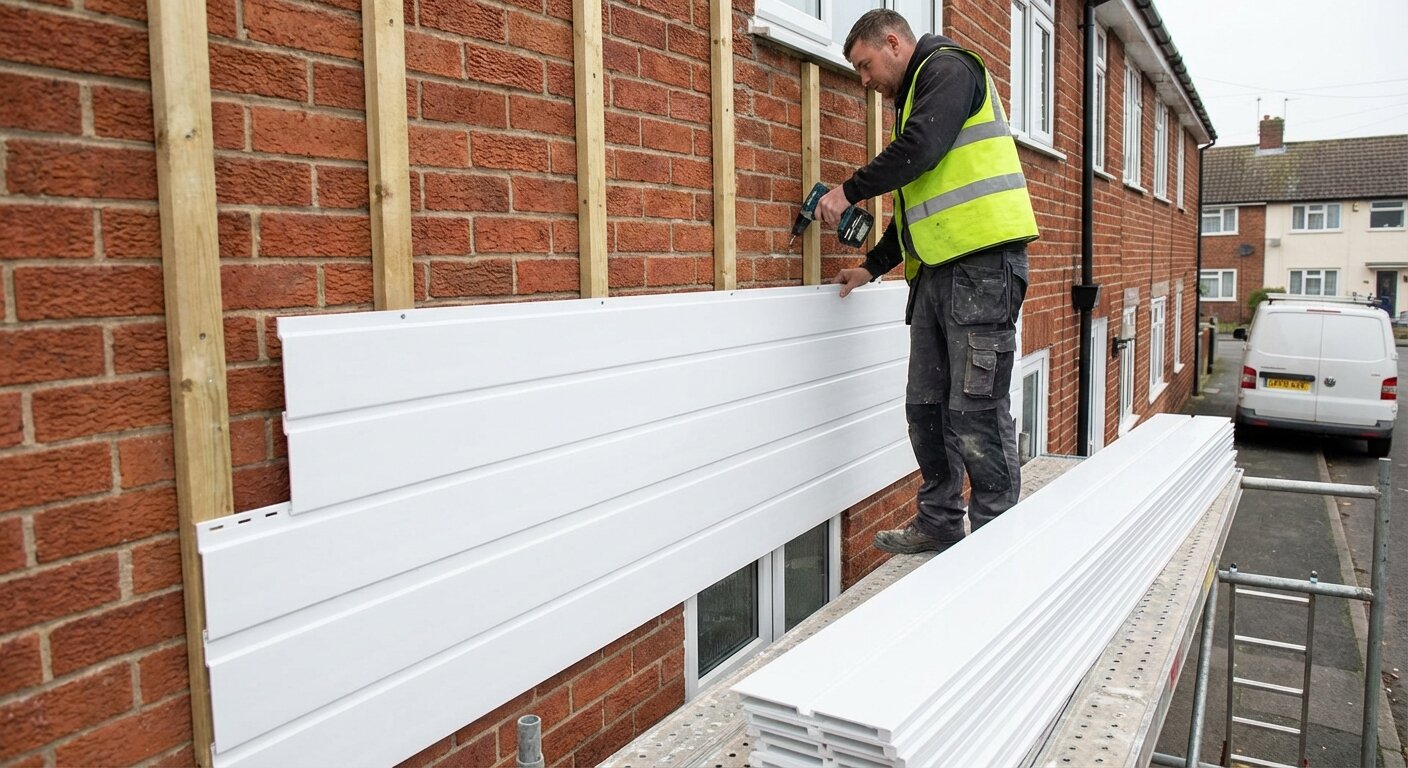
1. Ensure a Proper Ventilated Cavity
Fix battens (minimum 25 mm × 50 mm treated softwood) vertically at 400–600 mm centres over the breather membrane. This creates the essential ventilation gap that prevents moisture accumulation behind the boards. On timber-frame garden rooms, this ventilated cavity is critical — without it, moisture can become trapped against the frame, causing structural decay.
2. Use a Breathable Membrane
A breather membrane (meeting BS 4016 or BS EN 13859-2) must be fitted between the timber frame and the battens. This allows water vapour from inside the building to escape outward while preventing liquid water from reaching the frame.
3. Detail Around Openings Carefully
Windows and doors are the most vulnerable points. Use J-channel trims, flashing tape, and compatible sealant to create weathertight junctions. Ensure that the head flashing above each window directs water onto the face of the cladding below, not behind it.
4. Manage Thermal Expansion
PVC-U expands by approximately 3–4 mm per 5 m board in a 50°C temperature range. On garden rooms — which are typically smaller than houses — this is less of an issue, but expansion gaps must still be left at corners, window reveals, and any other abutments.
5. Consider the Base Detail
The bottom edge of the cladding should sit at least 150 mm above ground level to prevent splash-back and to clear any potential flooding. Use a ventilated starter strip to allow airflow into the cavity while keeping insects out.
Colour and Finish Selection
The colour of your garden room cladding should complement both the garden setting and the main house. Popular choices include:
- Anthracite grey (RAL 7016) — the UK’s most popular cladding colour, giving a modern, architectural look
- Sage green — blends naturally into garden surroundings
- Heritage cream — suits traditional garden buildings and period properties
- Golden oak woodgrain — provides a warm, timber-like appearance without the maintenance
- Black — bold and contemporary, particularly effective on flat-roofed designs
- White — classic and clean, works with any garden style
Where possible, order a sample of your chosen colour and hold it against the main house exterior in different light conditions before committing.
Frequently Asked Questions
Can I use the same cladding as my house on the garden room?
Yes, and this is often the best approach for a cohesive look — particularly if the garden room is visible from the same vantage point as the house. Using matching cladding profiles and colours creates a unified property aesthetic.
How much cladding do I need for a typical garden room?
A standard 4 m × 3 m garden room with a 2.4 m wall height and one door opening and two window openings requires approximately 20–25 m² of cladding, including a 10% waste allowance. Measure each wall individually and deduct openings for accuracy.
Is PVC-U cladding waterproof enough for a garden room?
PVC-U cladding is non-porous and sheds water extremely effectively, but no cladding system is a standalone waterproof barrier. The cladding works as the outer skin of a rainscreen system — the breather membrane behind it provides the definitive moisture barrier. Both layers working together keep the building dry.
Can I insulate behind the cladding?
Insulation should be placed within the timber frame of the garden room, not in the ventilated cavity behind the cladding. The cavity must remain clear to allow airflow. Filling it with insulation would trap moisture and compromise the entire wall system.
Do I need a breather membrane if I use PVC-U cladding?
Yes. On any timber-frame garden room, a breather membrane is essential regardless of the cladding material. The membrane protects the timber frame from any moisture that may reach it — whether from driving rain penetrating the cladding system or from condensation within the wall.