Push-Fit vs Solvent Weld Soil Pipe: When to Use Each
Meta description: Comparing push-fit and solvent weld soil pipe systems - learn when to use each, installation differences, and pros and cons for plumbers.
Suggested URL: /blog/push-fit-vs-solvent-weld-soil-pipe
Introduction
The choice between push-fit and solvent weld soil pipe affects installation time, cost, and long-term performance. Both systems meet Building Regulations and both are widely used by professional installers – but they’re not interchangeable in every situation.
Understanding when each system excels helps you specify correctly, work efficiently, and avoid problems down the line. This guide compares both options with practical guidance for plumbers, builders, and specifiers.
Understanding the Two Systems
Push-Fit (Ring Seal)
Push-fit soil pipe uses rubber ring seals to create watertight joints. Pipes simply push into fittings – no adhesives, heat, or special tools required.
How it works:
- Chamfer the pipe end
- Mark insertion depth
- Lubricate the seal with silicone grease
- Push pipe into fitting until mark reaches the collar
- Joint is immediately complete
The rubber seal compresses against the pipe, preventing leaks while allowing thermal movement.
Solvent Weld
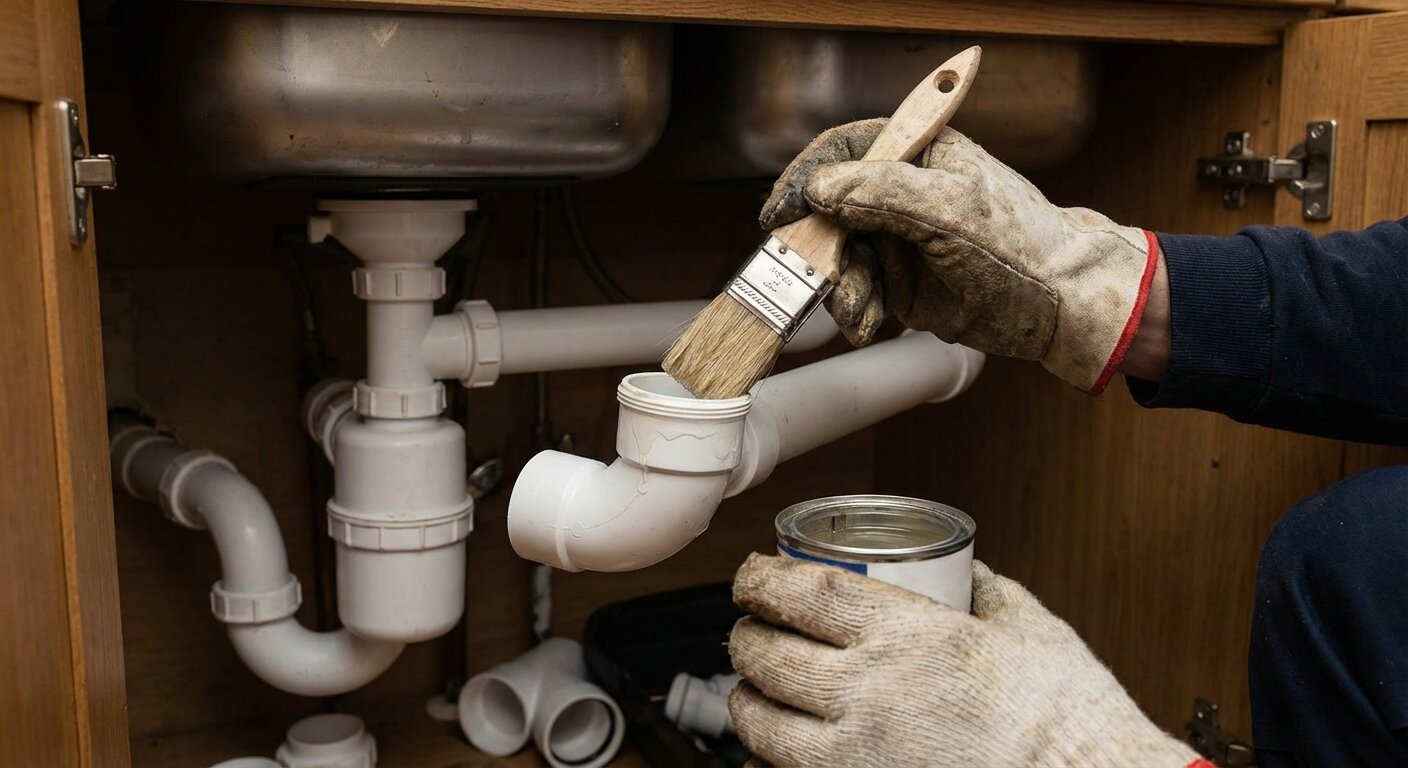
Solvent weld systems use chemical adhesive (solvent cement) to fuse pipe and fitting together. The solvent partially dissolves the PVC surfaces, creating a permanent molecular bond.
How it works:
- Dry-fit and mark pipe
- Clean and deburr pipe end
- Apply solvent cement to pipe and fitting socket
- Insert pipe with quarter twist
- Hold for 30 seconds
- Allow curing time before pressure testing
The joint becomes a single piece – as strong as (or stronger than) the pipe itself.
Key Differences Compared
| Factor | Push-Fit | Solvent Weld |
|---|---|---|
| Installation speed | Very fast | Slower (cutting, cleaning, curing) |
| Skill level | Basic | Moderate |
| Tools required | Hacksaw, lubricant | Hacksaw, solvent, cleaning materials |
| Disassembly | Possible (with effort) | Permanent – cut to remove |
| Temperature limits | -20°C to +60°C | Higher temperature tolerance |
| Movement accommodation | Yes (built-in) | No – needs expansion joints |
| Cost | Higher material cost | Lower material cost |
| Weather sensitivity | Works in any conditions | Solvent won’t cure below 5°C |
When to Use Push-Fit
Push-fit soil pipe excels in specific scenarios:
External Soil Stacks
External stacks experience significant thermal movement – potentially 5-7mm per 3m length between summer and winter. Push-fit joints absorb this movement automatically.
Key point: Solvent weld external stacks require expansion couplers at intervals, adding complexity and cost.
Time-Critical Installations
When speed matters, push-fit wins. A typical external stack installation might take 2 hours with push-fit versus 4 hours with solvent weld (including curing time).
Cold Weather Working
Solvent cement requires temperatures above 5°C for proper curing. Push-fit works regardless of temperature – valuable during winter installations.
Retrofit and Renovation
Connecting to existing systems is often easier with push-fit. Rubber seal adapters accommodate slight misalignments, and joints can be adjusted if needed.
Installations by General Builders
Where plumbing isn’t the installer’s primary trade, push-fit’s simplicity reduces error risk. Correct technique is easy to verify visually.
Access-Limited Situations
Push-fit allows straight-in connection without rotation. Useful where fittings must be positioned before final pipe insertion.
When to Use Solvent Weld
Solvent weld suits other applications better:
Internal Concealed Pipework
Inside buildings, temperature variations are minimal. Solvent weld’s permanent joints eliminate any risk of seal degradation or accidental disconnection behind walls.
Key point: Many installers prefer solvent weld for all internal work, reserving push-fit for external stacks only.
Hot Waste Discharge
Commercial kitchens, laboratories, or industrial settings may discharge waste above 60°C. Solvent weld handles higher temperatures than standard push-fit seals.
Underground Installation
While push-fit underground pipes exist, solvent weld ensures joints cannot separate from ground movement or settlement. Belt-and-braces reliability.
Cost-Sensitive Projects
Solvent weld materials typically cost 15-25% less than equivalent push-fit. On large projects, this adds up significantly.
High-Security Situations
Prisons, psychiatric facilities, and anti-vandal applications use solvent weld because joints cannot be deliberately disconnected.
Maximum Integrity Requirements
For critical applications where any leak risk must be minimised, solvent weld’s permanent fusion provides peace of mind.
Installation Best Practice: Push-Fit
Preparation
- Cut pipe square using a pipe cutter or fine-tooth saw
- Deburr inside and outside edges
- Chamfer the leading edge at 15° (essential for seal protection)
- Clean any debris from pipe and fitting
Assembly
- Apply silicone-based lubricant to the rubber seal and pipe end
- Never use oil-based lubricants (degrades rubber)
- Mark insertion depth on pipe (usually 50mm for 110mm pipe)
- Push pipe home firmly until mark reaches fitting collar
- Verify seal is correctly seated (visual check through some fittings)
Securing
- Use pipe clips appropriate for push-fit (allow axial movement)
- Support pipes at maximum 1.8m centres (vertical) or 1.2m (horizontal)
- Ensure clips don’t clamp push-fit joints – allow movement
Common Mistakes
- Forgetting to chamfer (damages seal on insertion)
- Using wrong lubricant (seal deterioration)
- Over-insertion (reduces expansion space)
- Clamping at joint locations (prevents thermal movement)
Installation Best Practice: Solvent Weld
Preparation
- Cut pipe square with fine-tooth saw or pipe cutter
- Deburr thoroughly inside and outside
- Dry-fit and mark insertion depth
- Clean surfaces with appropriate cleaner (removes grease, oxidation)
Applying Solvent Cement
- Use the correct solvent for pipe material (PVC vs PVC-C vs ABS)
- Apply evenly to pipe end and fitting socket
- Work quickly – solvent begins evaporating immediately
- Ensure adequate coverage without excessive dripping
Making the Joint
- Insert pipe with quarter twist (distributes cement evenly)
- Push fully home to the marked depth
- Hold firmly for 30 seconds minimum
- Wipe away excess cement immediately
Curing Times
Allow joints to cure before pressure testing or moving:
- Light handling: 15-30 minutes
- Full pressure testing: 24 hours (longer in cold conditions)
- Hot discharge: 48 hours minimum
Common Mistakes
- Insufficient surface preparation (weak bond)
- Working in cold conditions (cement won’t cure properly)
- Moving joints before initial set (breaks bond)
- Using incompatible or old solvent cement
Can You Mix Systems?
Yes, with appropriate adapters. Common scenarios include:
- Push-fit stack to solvent weld internal branches – use socket/spigot adapters
- Connecting to cast iron – adapters available for both systems
- Repair sections – push-fit repair couplings work on any rigid pipe
Adapters add cost but provide flexibility. When designing systems, minimise adapter use by choosing one primary system.
Cost Comparison
For a typical two-storey domestic installation (external stack, four branches):
| Item | Push-Fit | Solvent Weld |
|---|---|---|
| Pipe (110mm × 6m) | £18-24 | £12-18 |
| Fittings (branches, bends) | £45-60 | £30-45 |
| Consumables | £5 (lubricant) | £8 (solvent, cleaner) |
| Labour (time difference) | - | +£50-80 |
| Approximate total | £68-89 | £100-151 |
Push-fit materials cost more but faster installation often results in lower overall cost. Factor in your labour rate and project specifics.
Conclusion
Both push-fit and solvent weld soil pipe systems have their place in professional plumbing. As a general guide:
- Choose push-fit for external stacks, cold weather work, speed-critical jobs, and installations requiring future disassembly
- Choose solvent weld for internal concealed work, high-temperature discharge, maximum joint security, and cost-sensitive large projects
Many experienced installers use push-fit externally and solvent weld internally – combining each system’s strengths. Whatever you choose, proper installation technique matters more than the system itself.
Need to stock up on soil and waste supplies? Browse our comprehensive range including both push-fit and solvent weld systems with next-day delivery available.
Internal links:
- Push-fit soil and waste system
- Solvent weld soil and waste system
- Soil pipe clips and brackets
- Soil pipe adaptors
- Solvent cement and lubricants
Word count: 1,212 words